
Modern businesses are under constant pressure to release software faster, maintain system reliability, strengthen security, and deliver exceptional user experiences. While DevOps has significantly improved collaboration between development and operations teams, many organizations still struggle with manual deployments, repetitive testing, infrastructure inconsistencies, and operational bottlenecks.
This is where DevOps automation becomes essential.
By automating repetitive processes across the software development lifecycle, organizations can accelerate releases, reduce human errors, improve compliance, optimize costs, and empower engineering teams to focus on innovation instead of routine operational work. Many businesses achieve these outcomes through Enterprise DevOps Services, which provide standardized automation frameworks, CI/CD pipelines, and infrastructure management capabilities.
In this comprehensive guide, we will explore what DevOps automation is, why it matters, what can be automated, implementation strategies, tools, challenges, metrics, real-world examples, and emerging trends shaping the future of software delivery.
What is DevOps Automation?
DevOps automation is the practice of using tools, scripts, workflows, and platforms to execute software development and IT operations tasks automatically with minimal human intervention. It streamlines processes such as code integration, testing, infrastructure provisioning, deployment, monitoring, security scanning, and compliance enforcement.
Instead of manually performing repetitive tasks, teams build automated workflows that ensure consistency, speed, and reliability throughout the software delivery pipeline.
A typical DevOps automation workflow looks like this:
Code Commit
↓
Automated Build
↓
Automated Testing
↓
Security Validation
↓
Deployment Automation
↓
Monitoring & Logging
↓
Feedback & Optimization
The result is faster software delivery, lower operational risk, and a more efficient development process.
Why DevOps Automation Has Become a Business Necessity?
As applications grow more complex and customer expectations continue to rise, manual operations become a significant obstacle to growth. DevOps automation addresses these challenges by improving both technical and business outcomes.
1. Accelerates Software Releases
Traditional deployment processes often involve multiple manual approvals, testing cycles, and configuration steps. Automation removes these bottlenecks by enabling continuous integration and continuous deployment (CI/CD), allowing organizations to release updates more frequently and with greater confidence.
Faster releases help businesses respond quickly to market changes, customer feedback, and competitive demands.
2. Reduces Human Errors
Manual configurations and deployments can introduce inconsistencies that lead to outages, security vulnerabilities, and performance issues. Automated workflows ensure tasks are executed consistently every time, significantly reducing operational mistakes.
3. Optimizes Infrastructure Costs
Organizations often overspend on cloud resources because workloads are not managed efficiently. Automated provisioning, scaling, and resource optimization help businesses use infrastructure more effectively while reducing unnecessary spending.
4. Strengthens Security and Compliance
Modern DevOps automation integrates security checks directly into development pipelines. Vulnerability scans, compliance validations, policy enforcement, and access controls occur automatically throughout the development lifecycle instead of being handled at the final stage.
5. Improves Developer Productivity
Developers spend less time managing environments, troubleshooting deployments, or handling infrastructure-related issues. Automated systems free engineering teams to focus on coding, innovation, and product development.
6. Promotes Organizational Agility
When repetitive work is automated, teams can experiment faster, launch features more quickly, and adapt to changing business requirements without significant delays.
What Can Be Automated in DevOps?
A common misconception is that DevOps automation only refers to deployments. In reality, almost every stage of the development and operations lifecycle can benefit from automation.
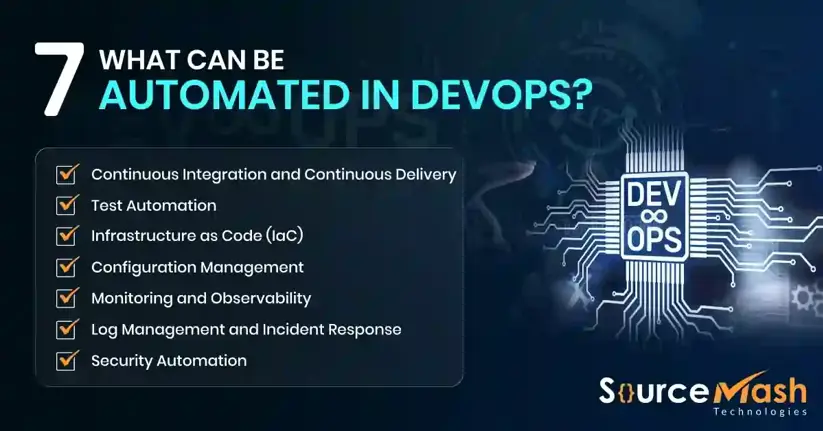
✓ Continuous Integration and Continuous Delivery
CI/CD pipelines automatically build, test, and deploy applications whenever code changes are committed.
Benefits include:
- Faster releases
- Reduced deployment failures
- Immediate feedback on code quality
- Improved collaboration between development teams
Popular tools include Jenkins, GitHub Actions, GitLab CI/CD, and CircleCI.
✓ Test Automation
Testing is one of the most critical areas of DevOps automation. Automated testing validates applications across multiple stages, helping teams detect issues before they reach production.
Tools commonly used include Selenium, JUnit, TestNG, and SonarQube.
✓ Infrastructure as Code (IaC)
Infrastructure as Code allows teams to define and manage infrastructure using machine-readable configuration files rather than manual setup processes.
This ensures:
- Environment consistency
- Faster provisioning
- Better scalability
- Version-controlled infrastructure
Popular IaC solutions include Terraform, AWS CloudFormation, Ansible, and Puppet.
✓ Configuration Management
Configuration automation ensures servers, databases, containers, and applications remain consistent across all environments. Without automation, configuration drift can occur, leading to production issues and unexpected downtime.
✓ Monitoring and Observability
Modern applications require real-time visibility into performance, availability, and infrastructure health. Automated monitoring systems continuously collect and analyze data to identify issues before they affect users.
Popular monitoring solutions include:
✓ Log Management and Incident Response
Applications generate massive volumes of logs every day. Automated log management systems centralize log collection, identify anomalies, and trigger alerts when issues arise.
Combined with automated incident response tools, organizations can dramatically reduce resolution times and improve service reliability.
✓ Security Automation
Security automation has become a core component of modern DevOps practices. Organizations increasingly adopt DevSecOps models that integrate security into every phase of development.
Automated security activities often include:
- Source code scanning
- Dependency analysis
- Container security validation
- Compliance monitoring
- Policy enforcement
- Threat detection
Essential DevOps Automation Tools
Choosing the right tooling is crucial for building an effective automation ecosystem.
Many organizations combine multiple tools to create a comprehensive automation framework suited to their business requirements.
Real-World Examples of DevOps Automation
Understanding DevOps automation is easier when viewed through practical applications.
✓ Streaming Platforms
Large streaming platforms use automated CI/CD pipelines to deploy thousands of updates while maintaining service availability for millions of users. Automated testing and deployment strategies help ensure seamless user experiences during continuous feature releases.
✓ Financial Services
Financial institutions often automate infrastructure provisioning and configuration management using Infrastructure as Code. This minimizes configuration drift and helps maintain strict compliance and security standards.
✓ E-commerce Businesses
Retail and e-commerce organizations rely on automated scaling mechanisms to handle traffic spikes during major sales events, ensuring high availability while controlling cloud costs.
✓ Trading and Regulated Industries
Companies operating in highly regulated environments integrate automated compliance checks and security scans directly into deployment pipelines to accelerate releases while meeting regulatory requirements.
How to Implement DevOps Automation Successfully?
Implementing automation is not simply about purchasing tools. It requires a structured, strategic approach.
Step 1: Assess Your Current Environment
Begin by identifying manual processes, deployment bottlenecks, infrastructure challenges, and operational inefficiencies. Understanding the current landscape helps establish priorities and success metrics.
Step 2: Identify High-Impact Automation Opportunities
Focus first on repetitive activities that consume significant time or introduce risk. Testing, deployments, infrastructure provisioning, and monitoring are often ideal starting points.
Step 3: Standardize Processes
Automation works best when workflows are standardized and documented. Establishing consistent procedures creates a stable foundation for automation initiatives.
Step 4: Build CI/CD Pipelines
Develop automated pipelines that handle building, testing, validating, and deploying applications. These pipelines become the backbone of software delivery.
Step 5: Implement Infrastructure as Code
Move infrastructure management from manual administration to version-controlled code-based processes.
Step 6: Integrate Security Automation
Introduce automated security checks throughout the development lifecycle instead of waiting until deployment.
Step 7: Monitor, Measure, and Improve
Continuously evaluate automation performance and optimize workflows based on measurable business outcomes.
Key Metrics for Measuring DevOps Automation Success
Successful automation initiatives are data-driven. The following metrics provide valuable insight into performance and operational maturity.
Regular monitoring of these KPIs helps organizations identify inefficiencies, improve reliability, and maximize the value of automation investments.
Common Challenges of DevOps Automation
Although automation offers significant benefits, implementation is not without obstacles.
Organizations frequently encounter challenges such as legacy system dependencies, fragmented toolchains, skill shortages, cultural resistance, and governance complexities.
Other common concerns include:
- Managing large-scale automation environments
- Security misconfigurations
- Inadequate monitoring
- Tool integration issues
- Rising operational complexity
The most successful organizations address these challenges incrementally, beginning with high-value use cases and expanding automation maturity over time.
Business Benefits and ROI of DevOps Automation
From a business perspective, DevOps automation delivers benefits far beyond operational efficiency.
When implemented strategically, DevOps automation directly contributes to revenue growth, operational resilience, and competitive advantage.
Emerging Trends in DevOps Automation
DevOps automation continues to evolve rapidly.
Several technologies are reshaping how organizations manage modern software delivery.
✓ AI-Powered DevOps (AIOps)
Artificial intelligence is increasingly being used to analyze operational data, predict failures, optimize performance, and automate incident resolution.
✓ GitOps
GitOps extends Infrastructure as Code principles by using Git repositories as the single source of truth for infrastructure and application deployments.
✓ Platform Engineering
Organizations are building internal developer platforms that provide self-service infrastructure and deployment capabilities to development teams.
✓ Self-Healing Infrastructure
Automated systems can now identify common failures and resolve them without human intervention, reducing downtime and improving reliability.
✓ Policy-as-Code
Security and compliance requirements are increasingly enforced automatically through code-based governance frameworks.
Frequently Asked Questions
What is DevOps automation?
DevOps automation is the use of tools and workflows to automate software development and IT operations tasks such as testing, deployment, monitoring, infrastructure provisioning, and security management.
What are the biggest benefits of DevOps automation?
The primary benefits include faster software delivery, improved reliability, lower operational costs, stronger security, better compliance, and enhanced developer productivity.
What tools are commonly used for DevOps automation?
Popular tools include Jenkins, GitHub Actions, Terraform, Kubernetes, Docker, Ansible, Prometheus, Grafana, Splunk, and SonarQube.
What is the difference between DevOps and DevOps automation?
DevOps is a culture and methodology that promotes collaboration between development and operations teams. DevOps automation is the implementation of tools and processes that automate tasks within the DevOps lifecycle.
Is DevOps automation suitable for small businesses?
Yes. Even small businesses can benefit from automation by reducing manual effort, improving software quality, accelerating releases, and minimizing operational overhead.
Conclusion
DevOps automation has moved from being a technical enhancement to a business-critical capability. Organizations that automate testing, deployments, infrastructure management, monitoring, security, and compliance can deliver software faster, reduce costs, improve reliability, and create better customer experiences.
As technologies such as AI-driven operations, GitOps, and self-healing infrastructure continue to mature, automation will remain at the center of modern software delivery strategies. Businesses that invest in DevOps automation today will be better positioned to innovate, scale, and compete in an increasingly digital world.