Introduction
For decades, IBM AS/400 now evolved into IBM i running on IBM Power Systems has served as the foundation of banking operations worldwide. From managing customer accounts and processing loans to supporting payment systems and regulatory reporting, IBM i has earned a reputation for exceptional reliability, security, and transaction-processing performance.
However, the banking industry has changed dramatically. Customers now expect real-time transactions, seamless mobile banking, personalized financial services, and 24/7 digital access. At the same time, fintech firms and digital-native banks are introducing innovative services powered by cloud computing, artificial intelligence (AI), open APIs, and advanced analytics.
As a result, banks operating on traditional IBM i environments face a critical challenge: how to maintain the stability and trustworthiness of their core systems while enabling digital innovation and faster service delivery.
This is where core banking modernization becomes essential. Modernization allows banks to preserve the proven business value of IBM i while introducing the technologies required to compete in today's digital banking ecosystem.
Understanding Core Banking and Its Role in Banking Operations
Core banking refers to the centralized system that manages the essential functions of a financial institution, including:
- Deposit and withdrawal processing
- Loan origination and servicing
- Customer account management
- Payment processing
- Fund transfers
- Transaction management
- Customer data management
- Interest calculations
- Regulatory reporting
These systems act as the operational heart of a bank, connecting branches, ATMs, mobile apps, websites, payment networks, and third-party financial services.
Modern core banking platforms enable:
- Real-time transaction processing
- Faster product launches
- Enhanced security controls
- Better customer experiences
- Open banking integration
- Regulatory compliance automation
Why IBM i Became the Banking Industry's Backbone
Since its introduction in 1988, IBM AS400 has become one of the most trusted enterprise computing platforms for financial institutions.
Banks adopted IBM i due to:
- Exceptional uptime and stability
- Integrated database architecture
- High transaction-processing capabilities
- Strong security framework
- Scalability for mission-critical workloads
- Lower operational downtime
Today, many banks still rely on IBM i for:
- Retail banking systems
- Commercial banking platforms
- Loan management applications
- Treasury operations
- Mortgage processing
- Credit card systems
- Payment processing platforms
- Customer information management
Despite these strengths, many IBM i banking applications were developed decades ago using RPG, COBOL, CL, and green-screen interfaces, making integration with modern digital ecosystems increasingly difficult.
Why Core Banking Modernization Is No Longer Optional
1.The Digital Banking Revolution
Modern customers expect banking services to be:
- Instant
- Mobile-first
- Personalized
- Available around the clock
- Accessible through multiple channels
Traditional batch-oriented architectures often struggle to meet these expectations, resulting in slower customer experiences and reduced competitiveness.
2.Growing Technical Debt
- Many legacy banking applications contain decades of accumulated business logic. Over time, maintaining these systems becomes increasingly expensive due to:
- Aging technology stacks
- Complex code structures
- Limited documentation
- Shortage of RPG and COBOL developers
3.Regulatory and Compliance Pressures
Banks must continuously comply with evolving regulations related to:
- Data privacy
- Anti-money laundering (AML)
- Know Your Customer (KYC)
- Fraud prevention
- Risk management
- Audit reporting
Modernized platforms simplify compliance through automation and centralized governance.
4.Rising Competitive Pressure
Digital-only banks and fintech companies leverage cloud-native platforms, APIs, and AI-driven services to launch new offerings significantly faster than traditional institutions.
Without modernization, banks risk losing customers to more agile competitors.
Risks of Delaying Core Banking Modernization
Banks that postpone modernization often face considerable business risks:
Increased Operational Costs:- Legacy infrastructure requires ongoing maintenance, specialist resources, and aging hardware support.
Security Vulnerabilities:- Older architectures may struggle to meet modern cybersecurity requirements and evolving threat landscapes.
Talent Shortage:- Banks increasingly face challenges recruiting developers with RPG, COBOL, and legacy platform expertise.
Slower Innovation:- Lengthy development cycles delay product launches and reduce responsiveness to market changes.
Customer Attrition:- Poor digital experiences can lead customers to migrate toward fintech competitors and digital-native banks.
Regulatory Challenges:- Maintaining compliance becomes more difficult when systems lack automation and modern reporting capabilities.
Legacy AS400 Core Banking vs Modern Digital Core Banking
Modernization bridges this gap while preserving proven banking processes and business logic.
IBM i Modernization Technologies Enabling Digital Banking
Successful modernization is not only about changing infrastructure. It also involves adopting technologies that connect IBM i systems to modern banking ecosystems. These technologies allow banks to enhance existing applications without replacing the entire core banking system. Organizations investing in IBM i Modernization Technologies can improve integration capabilities, support digital banking initiatives, and accelerate innovation while maintaining the reliability of their existing IBM i environment.
Common modernization technologies include:
- REST API enablement
- IBM Integrated Web Services (IWS)
- SQL modernization
- Web services integration
- Java and Node.js on IBM i
- IBM Power Virtual Server
- Red Hat OpenShift integration
- DevOps and CI/CD automation
- API management platforms
These technologies allow banks to enhance existing applications without replacing the entire core banking system.
Hybrid Cloud Banking with IBM i
Many banks are embracing hybrid cloud strategies rather than moving everything to the public cloud.
A hybrid approach allows institutions to:
- Keep core banking applications on IBM i
- Use cloud platforms for analytics
- Support mobile banking services
- Improve disaster recovery capabilities
- Scale digital workloads more efficiently
This strategy enables modernization while maintaining regulatory control and operational stability.
Key Benefits of Core Banking Modernization on IBM i
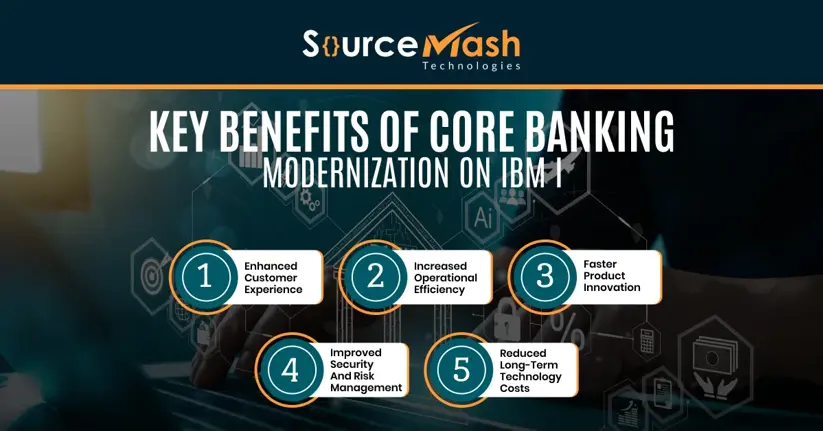
1.Enhanced Customer Experience
Modernized systems support:
- Real-time account updates
- Digital onboarding
- Mobile banking services
- Personalized recommendations
- Self-service capabilities
- Faster customer support
2. Increased Operational Efficiency
Automation minimizes manual work and improves:
- Transaction processing speed
- Data accuracy
- Process consistency
- Employee productivity
3. Faster Product Innovation
Modern architectures enable banks to:
- Launch products faster
- Integrate third-party services
- Support fintech partnerships
- Respond quickly to market demands
4. Improved Security and Risk Management
Modern banking environments support:
- Advanced encryption
- Multi-factor authentication
- Real-time fraud monitoring
- Continuous threat detection
- Automated compliance reporting
5. Reduced Long-Term Technology Costs
Modernization reduces dependence on aging hardware and scarce legacy development resources while increasing operational efficiency.
How Much Does Core Banking Modernization Cost?
One of the most common questions among banking leaders is:
"How much will modernization cost?"
There is no universal answer because costs depend on multiple factors:
Key Cost Drivers
- Number of applications
- Complexity of business logic
- Volume of historical data
- Regulatory requirements
- Existing integrations
- Chosen modernization strategy
- Cloud adoption goals
Typical Investment Levels
Banks should evaluate modernization as a long-term investment focused on efficiency, customer retention, security, and growth rather than simply a technology expenditure.
Common Challenges in AS400 Banking Modernization
✓ Legacy Application Complexity
Critical business rules may be deeply embedded within RPG or COBOL applications developed over several decades.
✓ Data Migration Risks
Core banking data requires complete integrity during migration to prevent operational, regulatory, and customer-impacting issues.
✓ Business Continuity Requirements
Banking systems often operate 24/7, making downtime unacceptable during modernization projects.
✓ Integration Complexity
Legacy applications frequently interact with multiple internal and external systems that must continue functioning during transition.
✓ Change Management
Employees require training and support to successfully adopt new tools and processes.
Core Banking Modernization Strategies for IBM i Banks
1. Rehosting (Lift and Shift)
Moves workloads to newer infrastructure without major application modifications.
Best For
- Fast modernization
- Infrastructure upgrades
- Lower-risk initiatives
Advantages
- Lower cost
- Faster implementation
- Minimal application changes
2. Replatforming
Applications remain largely intact but are optimized for modern environments.
Benefits
- Better performance
- Improved scalability
- Stronger cloud compatibility
3. Refactoring
Transforms RPG or COBOL applications into modern architectures and languages such as Java or .NET while preserving business logic.
Benefits
- Better maintainability
- Easier integration
- Improved agility
4. Re-Architecting
Applications are redesigned using:
- Microservices
- Containers
- Kubernetes
- Cloud-native platforms
- DevOps methodologies
Benefits
- Maximum flexibility
- Continuous innovation
- Long-term scalability
Which Modernization Approach Should Your Bank Choose?
The right strategy depends on business goals, compliance requirements, technical debt, and available budget.
Modernization Without Replacing the Core
A common misconception is that modernization requires replacing the entire core banking platform.
In reality, many successful banks are adopting a progressive modernization approach that keeps IBM i as the system of record while extending functionality through:
- API layers
- Middleware
- AI services
- Mobile applications
- Digital banking channels
- Analytics platforms
This approach reduces risk while accelerating innovation.
API Enablement and Open Banking
Modern banking ecosystems depend on APIs.
API enablement allows banks to:
- Connect IBM i systems with mobile apps
- Share data securely with fintech partners
- Support open banking initiatives
- Accelerate product innovation
- Improve customer experiences
Many institutions now expose RPG and COBOL applications through REST APIs without disrupting core operations.
Leveraging AI in IBM i Banking Environments
✓ AI-Powered Customer Service
Chatbots and virtual assistants provide:
- 24/7 support
- Faster response times
- Personalized recommendations
✓ Intelligent Fraud Detection
AI analyzes transaction patterns to identify suspicious activities in near real time.
✓ Automated Banking Operations
AI helps automate:
- Loan approvals
- Customer onboarding
- Credit scoring
- Risk assessments
- Compliance monitoring
✓ AI Without Core Replacement
Modern integration platforms enable AI services to interact with IBM i systems without requiring full application rewrites.
Real-World Banking Modernization Scenarios
✓ Loan Processing Modernization
Banks can automate loan approvals and credit assessments, reducing processing times from days to hours.
✓ Payment Processing Transformation
Modernized payment systems support:
- Real-time payments
- Instant transfers
- Faster settlements
✓ Digital Account Opening
Customers can open accounts through mobile apps and web platforms without visiting branches.
✓ Fraud Prevention
Advanced analytics and AI improve fraud detection while reducing false positives.
✓ Mobile Banking Expansion
API-enabled IBM i systems seamlessly power modern mobile banking platforms.
A Step-by-Step Roadmap for Core Banking Modernization
Step 1: Assessment and Discovery
Evaluate:
- Applications
- Databases
- Infrastructure
- Integrations
- Security controls
Step 2: Define Business Objectives
Establish measurable goals such as:
- Reduced costs
- Faster product delivery
- Better customer experience
- Improved compliance
Step 3: Select the Modernization Strategy
Choose the approach that aligns with technical and business requirements.
Step 4: Modernize Data and APIs
Build the foundation for cloud, mobile, AI, and open banking initiatives.
Step 5: Implement and Test
Conduct:
- Functional testing
- Integration testing
- Compliance validation
- Performance testing
Step 6: Train Teams and Optimize
Ensure successful adoption through training, monitoring, and continuous improvement.
Key Considerations Before Modernizing an IBM i Banking Environment
Before starting a modernization initiative, banks should evaluate:
- Regulatory requirements
- Data governance policies
- Disaster recovery capabilities
- Application dependencies
- Vendor selection criteria
- Security frameworks
- Rollback strategies
- Long-term roadmap planning
A comprehensive assessment significantly reduces project risk.
Future Trends Shaping Core Banking Modernization
Several technology trends continue to influence the future of banking:
- Cloud-native banking platforms
- Open banking ecosystems
- Embedded finance
- AI-driven operations
- Real-time payments
- Hyperautomation
- Digital identity verification
- Microservices architectures
- Banking-as-a-Service (BaaS)
Banks that embrace these technologies will be better positioned to compete in an increasingly digital financial landscape.
Frequently Asked Questions
Can AS400 still support modern banking?
Yes. IBM i remains one of the most reliable enterprise platforms available. However, modernization is often needed to support APIs, cloud integration, AI, and mobile banking capabilities.
What is the difference between modernization and migration?
Modernization improves existing systems and processes, while migration typically involves moving applications or data to a new platform or environment. Many banks pursue both simultaneously.
Does IBM still support AS400?
IBM continues to actively support and enhance IBM i on Power Systems. While the AS400 brand evolved into IBM i, the platform remains widely used across the banking sector.
Do banks need to replace IBM i completely?
No. Many banks modernize successfully by introducing APIs, middleware, cloud services, and AI capabilities while retaining IBM i as the system of record.
Can RPG applications be converted to Java or .NET?
Yes. Modernization tools and services can transform RPG-based applications into modern languages while preserving existing business logic.
What is the safest modernization approach?
Phased modernization is generally considered the lowest-risk approach because it allows gradual transformation while maintaining operational continuity.
Is IBM i cloud compatible?
Yes. IBM i workloads can run in hybrid cloud and cloud-hosted environments, enabling greater flexibility and scalability.
How long does core banking modernization take?
Project timelines vary based on complexity. Incremental modernization projects may take a few months, while large-scale core transformations can span multiple years.
Conclusion
AS400 and IBM i systems have powered the global banking industry for decades thanks to their unmatched reliability, security, and transaction-processing capabilities. However, today's banking environment demands real-time services, omnichannel experiences, open banking integration, cloud connectivity, and AI-driven innovation.
The good news is that modernization does not necessarily require replacing the core banking platform. Through API enablement, application modernization, cloud adoption, AI integration, and phased transformation strategies, banks can preserve the business value of IBM i while unlocking the agility needed for future growth.
Financial institutions that modernize strategically today will be better positioned to improve customer experiences, accelerate innovation, strengthen security, maintain compliance, and remain competitive in the rapidly evolving digital banking ecosystem.