Introduction
Organizations today generate vast amounts of data across every stage of their operations. From website interactions and purchasing behavior to marketing performance, inventory management, and customer service activities, businesses have access to more information than ever before.
Yet despite this abundance of data, many executives continue to struggle with critical business questions:
- Why are revenue targets being missed despite increasing traffic?
- Which customer segments drive the highest profitability?
- Where are conversion opportunities being lost?
- Which investments generate measurable business value?
- How can leadership make faster, more informed decisions?
The challenge is rarely a lack of data. The problem is a lack of visibility.
Many organizations operate within fragmented technology ecosystems where ecommerce platforms, CRM systems, marketing tools, financial applications, and operational databases function independently. As a result, decision-makers often spend valuable time reconciling reports instead of acting on meaningful insights.
This is where the combination of Data Analytics & Executive Dashboard Platforms and Ecommerce Transformation becomes a powerful business growth strategy.
When organizations connect data across the enterprise, transform it into actionable intelligence, and align digital commerce initiatives with business objectives, they create a foundation for measurable revenue growth, operational efficiency, and sustainable competitive advantage.
The Modern Revenue Challenge: More Data, Less Clarity
Business leaders have never had greater access to information. However, access to information does not automatically translate into better decisions.
A common challenge facing growing organizations is the gap between available data and actionable insight.
- Marketing teams track campaign performance.
- Sales teams monitor revenue pipelines.
- Customer service teams measure satisfaction and response times.
- Operations teams focus on fulfillment and inventory.
- Finance teams evaluate profitability and forecasting.
While each department generates valuable insights, these metrics often exist in isolation, creating a fragmented view of organizational performance.
The result is a business environment where executives may be looking at hundreds of reports but still lack clear answers regarding growth opportunities, operational risks, and revenue drivers.
True business transformation begins when organizations move beyond isolated reporting and establish a unified view of enterprise performance.
Why Executive Dashboards Are Becoming Strategic Growth Engines
For many organizations, dashboards were originally developed as reporting tools.
Today, leading enterprises view dashboards differently.
Modern executive dashboards have evolved into strategic decision-support platforms that connect operational activities directly to business outcomes through business intelligence capabilities.
Rather than presenting data for review, they enable leadership teams to answer critical questions such as:
- Which products generate the highest profit margins?
- Which marketing channels drive the most valuable customers?
- Where are customer journeys experiencing friction?
- How does operational performance impact revenue?
- Which investments produce the strongest return?
The most effective executive dashboards do not simply display metrics. They provide context, identify trends, highlight risks, and support proactive decision-making.
This shift transforms dashboards from reporting assets into revenue-generating business tools.
The Revenue Growth Framework: From Data to Business Outcomes
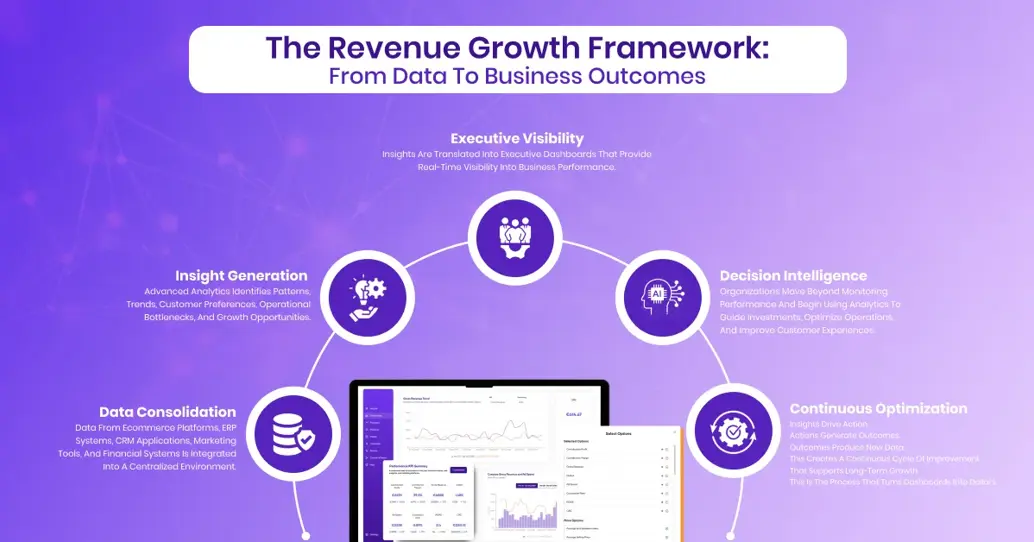
Organizations often invest heavily in analytics technology but struggle to realize meaningful returns because they focus on reporting rather than action.
High-performing organizations follow a structured framework.
Stage 1: Data Consolidation
Data from ecommerce platforms, ERP systems, CRM applications, marketing tools, and financial systems is integrated into a centralized environment.
This eliminates information silos and establishes a single source of truth.
Stage 2: Insight Generation
Advanced analytics identifies patterns, trends, customer preferences, operational bottlenecks, and growth opportunities.
At this stage, businesses begin answering questions that directly impact revenue and profitability.
Stage 3: Executive Visibility
Insights are translated into executive dashboards that provide real-time visibility into business performance.
Leadership teams gain instant access to the metrics most critical to strategic decisions.
Stage 4: Decision Intelligence
Organizations move beyond monitoring performance and begin using analytics to guide investments, optimize operations, and improve customer experiences.
Stage 5: Continuous Optimization
Insights drive action.
Actions generate outcomes.
Outcomes produce new data.
This creates a continuous cycle of improvement that supports long-term growth.
This is the process that turns dashboards into dollars.
How Data Analytics Directly Impacts Ecommerce Revenue
Many organizations associate analytics with reporting.
In reality, advanced analytics influences nearly every factor contributing to ecommerce success.
Customer Acquisition Optimization
Analytics helps organizations identify the channels, campaigns, and audience segments generating the highest-value customers.
Rather than simply increasing traffic, businesses can focus on attracting customers most likely to convert and remain loyal over time.
This leads to lower acquisition costs and higher customer lifetime value.
Conversion Rate Optimization
Every ecommerce business experiences friction within the customer journey.
Potential obstacles include:
- Complex checkout experiences
- Poor mobile usability
- Ineffective product pages
- Slow loading speeds
- Unclear calls to action
Analytics allows organizations to identify these barriers and prioritize improvements based on business impact.
Even small improvements in conversion rates can produce significant revenue gains without increasing marketing spend.
Customer Retention and Loyalty
Acquiring customers is only part of the growth equation.
Long-term profitability depends on retaining customers and encouraging repeat purchases.
Analytics enables businesses to understand purchasing patterns, identify churn risks, and develop personalized engagement strategies that strengthen customer relationships.
Revenue Forecasting
Predictive analytics helps organizations anticipate customer demand, seasonal trends, and market fluctuations.
Instead of reacting to business changes, leaders can proactively allocate resources, manage inventory, and plan growth initiatives.
What High-Performing Ecommerce Leaders Measure Differently
Many organizations track dozens of metrics.
Successful organizations focus on the few metrics that directly influence growth.
Strategic Revenue Metrics
- Revenue Growth Rate
- Gross Profit Margin
- Revenue by Channel
- Revenue by Product Category
- Customer Lifetime Value
Customer Experience Metrics
- Conversion Rate
- Cart Abandonment Rate
- Checkout Completion Rate
- Repeat Purchase Rate
- Customer Satisfaction Score
Marketing Performance Metrics
- Return on Advertising Spend
- Customer Acquisition Cost
- Marketing-Sourced Revenue
- Campaign Attribution
- Organic Growth Performance
Operational Efficiency Metrics
- Inventory Turnover
- Fulfillment Accuracy
- Order Processing Time
- Return Rate
- Supply Chain Performance
Organizations that align these metrics with executive dashboards gain a clearer understanding of how daily decisions influence overall business performance.
A Real-World Revenue Growth Scenario
Consider a rapidly growing retailer experiencing strong traffic growth but stagnant online revenue.
Traditional reports suggested marketing performance was improving.
However, a centralized analytics environment revealed a different story.
Executive dashboards identified three critical issues:
- Mobile cart abandonment rates were significantly higher than desktop rates.
- Product page engagement declined on several top-selling items.
- Customers frequently exited during payment processing.
Using these insights, the organization redesigned the mobile checkout experience, enhanced product content, and streamlined payment workflows.
The result was not simply better reporting.
The result was increased conversions, improved customer satisfaction, and measurable revenue growth.
This example highlights an important principle:
Business growth rarely comes from having more data. It comes from acting on the right insights.
The Future of Revenue Growth Is Analytics-Driven
The next generation of business growth will be powered by intelligent decision-making.
Organizations are increasingly adopting:
- AI-driven analytics
- Predictive forecasting
- Automated insights
- Real-time business intelligence
- Advanced customer personalization
As customer expectations continue to evolve, organizations that leverage analytics strategically will be better positioned to identify opportunities, respond to market changes, and maintain competitive advantage.
The future belongs to businesses that can transform information into action faster than their competitors.
How Sourcemash Technologies Helps Organizations Turn Insights Into Revenue Growth
Collecting data is no longer the challenge. The real challenge is transforming information into decisions that improve business performance.
At Sourcemash Technologies, we help organizations build data-driven ecosystems that connect analytics, executive reporting, and ecommerce operations to support measurable growth.
Our expertise spans:
- Data Analytics & Business Intelligence
- Executive Dashboard Development
- Ecommerce Transformation
- Customer Journey Analytics
- Conversion Rate Optimization
- Performance Monitoring & Reporting
By integrating data from multiple business systems, we help organizations create a unified view of performance, enabling leadership teams to identify opportunities, resolve inefficiencies, and make faster strategic decisions.
Whether the objective is improving customer acquisition, increasing conversion rates, enhancing operational efficiency, or accelerating digital transformation, our solutions are designed to align technology investments with measurable business outcomes.
Through a combination of analytics, executive visibility, and ecommerce innovation, Sourcemash Technologies helps businesses transform data into insights, insights into action, and action into sustainable revenue growth.
Conclusion
The most successful organizations no longer view data analytics, executive dashboards, and ecommerce transformation as separate initiatives.
They recognize that these capabilities work together to create a connected growth ecosystem.
- Analytics provides intelligence.
- Dashboards deliver visibility.
- Ecommerce transformation converts insights into action.
When combined, they enable organizations to make faster decisions, improve customer experiences, optimize operations, and unlock new revenue opportunities.
In an increasingly competitive digital landscape, the difference between average performance and sustained growth often comes down to one thing:
The ability to turn insight into action and dashboards into dollars.