Digital banking, online payments, mobile transactions, card services, and real-time payment ecosystems have transformed the financial services industry. While these innovations improve customer experiences and operational efficiency, they also create new opportunities for fraudsters and cybercriminals.
Today's financial institutions must combat increasingly sophisticated threats, including payment card fraud, account takeover attacks, credential theft, insider threats, identity fraud, phishing campaigns, and data breaches involving sensitive payment information.
The financial impact is significant. According to the Association of Certified Fraud Examiners (ACFE)Reports to the nation, organizations lose an estimated 5% of annual revenue to fraud each year. Meanwhile, financial services organizations continue to face some of the highest breach-related costs due to the sensitivity of the data they manage and the regulatory requirements they must meet.
To effectively manage these risks, banks need more than standalone fraud monitoring tools or isolated cybersecurity initiatives. They need an integrated approach that combines fraud intelligence, cybersecurity operations, compliance management, and advanced analytics.
Risk & Fraud Analytics in Power BI helps financial institutions monitor suspicious activities, analyze customer risk, identify emerging fraud patterns, and gain actionable insights through centralized dashboards and reporting.
PCI-DSS Managed Cybersecurity Services help protect payment environments and cardholder data through continuous monitoring, access controls, encryption, vulnerability management, threat detection, and incident response.
Together, these capabilities provide a comprehensive framework for fraud prevention, payment security, regulatory compliance, and operational resilience.
Quick Answer: How Do Risk & Fraud Analytics and PCI-DSS Cybersecurity Work Together?
Risk & Fraud Analytics in Power BI enables financial institutions to identify suspicious transactions, detect customer behavior anomalies, monitor fraud trends, and measure operational risk through centralized analytics dashboards.
PCI-DSS Managed Cybersecurity Services protect payment systems and cardholder data through security controls that include:
- Continuous security monitoring
- Data encryption
- Access management
- Vulnerability management
- Threat detection
- Incident response
- Compliance reporting
When combined, these solutions help financial institutions:
- Detect fraud faster
- Protect payment systems and cardholder data
- Reduce fraud-related losses
- Improve threat detection and incident response
- Strengthen compliance readiness
- Improve operational resilience
- Enhance collaboration between fraud and security teams
- Gain a unified view of organizational risk
Key Takeaways
- Detect suspicious transactions in near real time.
- Monitor customer and transaction risk through centralized dashboards.
- Protect payment environments using PCI-DSS security controls.
- Improve fraud investigation efficiency.
- Strengthen data protection and payment security.
- Simplify compliance and audit reporting.
- Gain greater visibility across fraud and cybersecurity risks.
- Leverage AI-driven analytics for proactive fraud detection.
Who Should Read This Article?
This article is designed for:
- Banking CIOs
- CISOs
- Fraud Risk Managers
- Compliance Officers
- Security Operations Teams
- Payment Security Teams
- Digital Banking Leaders
- Financial Services Executives
- Risk Management Professionals
The Growing Challenge of Fraud and Cybersecurity in Banking
Banks process millions of transactions each day across:
- Online banking platforms
- Mobile banking applications
- Payment gateways
- Card processing systems
- ATM networks
- Digital wallets
- Third-party payment providers
As digital banking expands, cybercriminals continue to exploit weaknesses across payment ecosystems, customer accounts, and banking infrastructure.
Common threats include:
- Payment card fraud
- Account takeover attacks
- Unauthorized fund transfers
- Synthetic identity fraud
- Insider threats
- Credential theft
- Business email compromise
- Data breaches involving payment information
- Phishing and social engineering attacks
Many organizations still manage fraud prevention and cybersecurity independently. Fraud teams focus on transactions and customer behavior, while cybersecurity teams focus on protecting applications, networks, and infrastructure.
This separation often results in visibility gaps, slower investigations, duplicated effort, and increased risk exposure.
Modern banking environments require integrated security strategies that combine fraud intelligence with cybersecurity controls.
Why Fraud and Cybersecurity Teams Must Work Together?
Historically, fraud prevention and cybersecurity operated as separate disciplines.
Today, however, many cyberattacks directly enable fraud activities.
For example:
- A phishing email can steal customer credentials.
- Stolen credentials can facilitate account takeover attacks.
- Compromised accounts can be used for unauthorized transactions.
- Payment systems may become targets for further exploitation.
Without integrated monitoring and visibility, these interconnected risks can remain undetected until significant financial damage has occurred.
Organizations that combine fraud analytics with cybersecurity operations can identify threats earlier, accelerate investigations, and improve response effectiveness.
What Is Risk & Fraud Analytics in Power BI?
Risk & Fraud Analytics in Power BI helps financial institutions convert transaction, customer, operational, and security data into actionable business intelligence.
By consolidating data from multiple systems into a centralized reporting environment, banks can improve fraud visibility, monitor risk indicators, and support faster decision-making.
Common Data Sources
A modern fraud analytics platform can integrate with:
- Core banking systems
- Payment gateways
- Card processing platforms
- Mobile banking applications
- CRM platforms
- Fraud management systems
- SIEM platforms
- Identity and access management systems
- Customer support systems
- Threat intelligence solutions
This centralized view helps organizations understand risk across multiple operational environments.
Key Capabilities of Risk & Fraud Analytics in Power BI
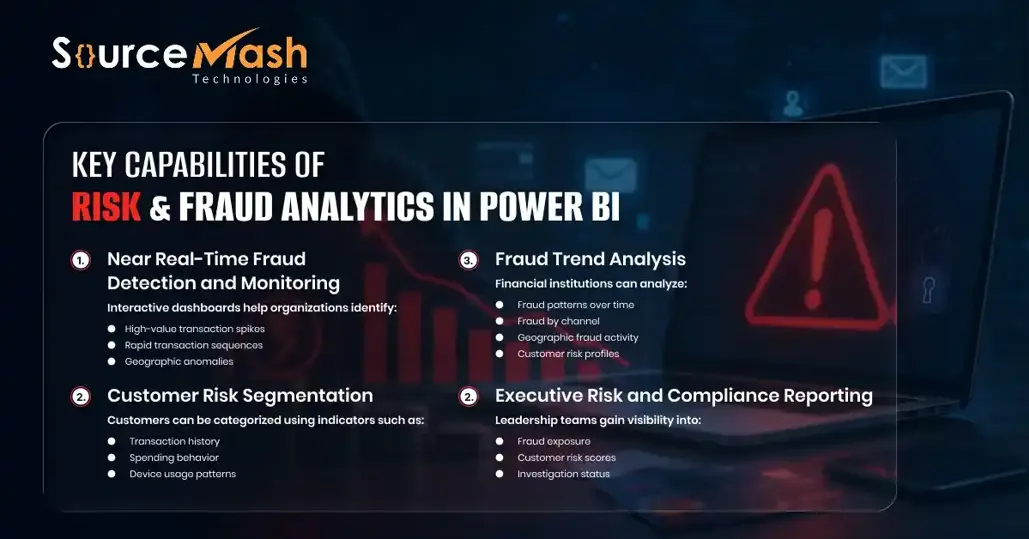
1. Near Real-Time Fraud Detection and Monitoring
Interactive dashboards help organizations identify:
- High-value transaction spikes
- Rapid transaction sequences
- Geographic anomalies
- Failed authentication attempts
- Unusual customer behavior
- Suspicious payment activity
These insights allow fraud teams to investigate incidents before losses escalate.
2. Customer Risk Segmentation
Customers can be categorized using indicators such as:
- Transaction history
- Spending behavior
- Device usage patterns
- Login activity
- Fraud history
- Geographic behavior
- Account activity changes
Risk-based prioritization helps focus resources on the highest-risk accounts.
3. Fraud Trend Analysis
Financial institutions can analyze:
- Fraud patterns over time
- Fraud by channel
- Geographic fraud activity
- Customer risk profiles
- High-risk transaction categories
- Emerging fraud trends
- Financial impact of fraud incidents
These insights support proactive fraud prevention strategies.
4. Executive Risk and Compliance Reporting
Leadership teams gain visibility into:
- Fraud exposure
- Customer risk scores
- Investigation status
- Recovery performance
- Compliance metrics
- Operational risk indicators
- Security performance trends
Centralized reporting improves governance and decision-making.
The Role of AI and Advanced Analytics in Fraud Detection
Traditional fraud detection methods often rely on static rules and predefined thresholds.
Modern financial institutions increasingly use Artificial Intelligence (AI) and Machine Learning (ML) to identify patterns and risks that traditional approaches may miss.
AI-powered fraud analytics can help:
- Detect abnormal customer behavior
- Identify previously unknown fraud patterns
- Improve transaction risk scoring
- Prioritize high-risk alerts
- Reduce false positives
- Enhance investigation workflows
- Support predictive risk management
Advanced capabilities may include:
- Behavioral Analytics
- Anomaly Detection
- Predictive Fraud Modeling
- User Behavior Analytics (UBA)
- Risk-Based Authentication
- Transaction Risk Scoring
When integrated into Power BI dashboards, these insights become accessible to fraud analysts, security teams, and business leaders.
Essential Fraud Analytics KPIs
A comprehensive fraud analytics solution should monitor:
- Fraud Detection Rate
- Fraud Loss Value
- Suspicious Transaction Volume
- High-Risk Customer Count
- Chargeback Rate
- Failed Authentication Attempts
- Account Takeover Incidents
- Alert Response Time
- Investigation Resolution Time
- Customer Risk Score Distribution
- Fraud Recovery Rate
- False Positive Ratio
These KPIs help measure fraud prevention effectiveness while identifying emerging risks.
What Is PCI-DSS Managed Cybersecurity?
PCI-DSS (Payment Card Industry Data Security Standard) is a globally recognized framework designed to protect cardholder data and secure payment environments.
PCI-DSS Managed Cybersecurity Services help organizations strengthen security controls while supporting ongoing compliance efforts.
Typical services include:
- Security monitoring
- Threat detection
- Firewall administration
- Vulnerability management
- Endpoint protection
- SIEM management
- Access control management
- Incident response support
- Compliance reporting
- Security assessments
- Encryption management
- Log monitoring and retention
The objective is to reduce cyber risk, protect payment data, and strengthen payment security operations.
Regulatory and Compliance Considerations
Financial institutions operate under increasing regulatory scrutiny.
Organizations may need to address requirements involving:
- PCI DSS 4.0
- Financial sector cybersecurity regulations
- Internal audit requirements
- Third-party risk management obligations
- Data privacy requirements
- Governance and reporting frameworks
Demonstrating continuous monitoring, secure payment processing, documented controls, and audit readiness has become essential for maintaining both compliance and customer trust.
Risk & Fraud Analytics in Power BI supports visibility and reporting, while PCI-DSS Managed Cybersecurity helps implement and maintain critical security controls.
Risk & Fraud Analytics vs. PCI-DSS Managed Cybersecurity
| Capability | Risk & Fraud Analytics in Power BI | PCI-DSS Managed Cybersecurity |
|---|---|---|
| Fraud Detection | ✅ | Limited |
| Transaction Monitoring | ✅ | Limited |
| Customer Risk Scoring | ✅ | ❌ |
| Behavioral Analytics | ✅ | ❌ |
| Fraud Trend Analysis | ✅ | ❌ |
| Executive Dashboards | ✅ | Limited |
| Security Monitoring | Partial | ✅ |
| Threat Detection | Partial | ✅ |
| Data Encryption | ❌ | ✅ |
| Access Management | ❌ | ✅ |
| Vulnerability Management | ❌ | ✅ |
| Incident Response Support | Investigation Support | ✅ |
| Compliance Reporting | ✅ | ✅ |
Although these solutions address different aspects of risk management, they become significantly more effective when implemented together.
How Risk & Fraud Analytics and PCI-DSS Cybersecurity Work Together?
✓ Step 1: Centralize Data
Collect information from:
- Core banking systems
- Payment gateways
- Card processing platforms
- Fraud monitoring systems
- Security monitoring tools
- SIEM platforms
- Identity management solutions
✓ Step 2: Analyze Fraud and Risk Activity
Power BI dashboards help identify:
- Suspicious transactions
- Customer anomalies
- Fraud trends
- Account takeover indicators
- Unusual user behavior
✓ Step 3: Secure Payment Environments
PCI-DSS controls strengthen security through:
- Encryption
- Access controls
- Network security
- Vulnerability management
- Continuous monitoring
✓ Step 4: Automated Alerting and Investigation
Fraud and security teams receive alerts when suspicious activities or security incidents occur, enabling faster response and resolution.
✓ Step 5: Compliance Monitoring and Audit Readiness
Organizations gain centralized visibility into:
- Fraud metrics
- Security performance
- Compliance status
- Audit requirements
- Control effectiveness
This simplifies reporting and strengthens governance.
Real-World Banking Use Cases
1. Credit Card Fraud Detection
Banks can identify unusual spending behavior, unauthorized card activity, and suspicious payment transactions before substantial losses occur.
2. Online Banking Risk Monitoring
Organizations can detect:
- Suspicious login attempts
- Account takeover activities
- Credential misuse
- Impossible travel events
- Unauthorized fund transfers
3. Fraud Investigation Management
Analysts can review alerts, analyze account activity, identify patterns, and accelerate investigations using centralized dashboards.
4. Compliance and Audit Reporting
Fraud, cybersecurity, and compliance metrics can be consolidated into a unified reporting environment to improve governance and audit readiness.
Real-World Example: Integrating Fraud Analytics and Payment Security
Consider a regional bank processing thousands of payment card transactions daily.
The organization implemented Power BI-based fraud analytics integrated with transaction data, security logs, and fraud monitoring tools.
The bank was able to:
- Detect suspicious spending activity more quickly
- Improve customer risk identification
- Correlate fraud indicators with cybersecurity events
- Accelerate investigations
- Strengthen compliance reporting
At the same time, PCI-DSS managed security controls protected the payment environment through continuous monitoring, vulnerability management, and access controls.
The result was improved fraud visibility, faster response times, and stronger protection of cardholder data.
How SourceMash Enables Data-Driven Fraud Detection, Risk Intelligence, and Compliance Reporting
As financial institutions continue to navigate evolving fraud risks, regulatory requirements, and growing volumes of transaction data, the ability to transform data into actionable intelligence has become a critical business capability.
SourceMash helps banks, payment providers, and financial services organizations leverage Microsoft Power BI, Microsoft Fabric, and modern data analytics solutions to improve risk visibility, strengthen fraud monitoring, and support informed business decision-making. By unifying data from multiple business and technology environments, organizations can gain a comprehensive view of operational, fraud, security, and compliance-related risks.
Banking and Financial Services Analytics Expertise
Financial institutions often manage data across numerous systems, including core banking platforms, payment gateways, CRM solutions, digital banking applications, fraud monitoring tools, and security platforms. This fragmented landscape can make it difficult to identify emerging risks, monitor performance, and generate meaningful insights.
SourceMash helps organizations consolidate and visualize data from diverse sources, enabling stakeholders to monitor key risk indicators, analyze fraud trends, track operational performance, and improve reporting accuracy through centralized dashboards and analytics solutions.
Power BI Solutions for Risk and Fraud Analytics
SourceMash designs and implements Power BI Consulting & Analytics Services that help financial institutions gain greater visibility into:
- Transaction monitoring and anomaly detection
- Customer risk profiling and segmentation
- Fraud trend and pattern analysis
- Chargeback and dispute reporting
- Account activity monitoring
- Compliance and audit reporting
- Executive risk dashboards
- Operational performance measurement
These capabilities support faster decision-making by providing stakeholders with real-time or near real-time access to critical business and risk intelligence.
Microsoft Data Platform and Analytics Expertise
Leveraging Microsoft technologies, SourceMash helps organizations build scalable analytics environments that support enterprise-wide reporting, governance, and data-driven transformation initiatives.
Key capabilities include:
- Power BI dashboard development
- Microsoft Fabric implementation and reporting
- Enterprise reporting automation
- Data integration and transformation
- Analytics modernization initiatives
- KPI and performance monitoring frameworks
- Self-service business intelligence solutions
- Data governance and reporting optimization
By creating a single source of truth for critical business data, financial institutions can improve visibility across fraud, risk, compliance, and operational functions.
Supporting Compliance, Security, and Risk Management Initiatives
Effective risk management requires accurate reporting, continuous visibility, and measurable performance indicators. SourceMash helps organizations develop analytics frameworks that support compliance reporting and strengthen risk governance processes.
In addition to fraud and risk analytics, SourceMash helps organizations gain better visibility into security and compliance metrics by integrating information from security monitoring platforms, audit processes, governance frameworks, and operational systems into centralized reporting environments. This enables stakeholders to monitor key security indicators, track compliance performance, evaluate control effectiveness, and support ongoing payment security initiatives through data-driven reporting and oversight.
Through centralized reporting and performance monitoring, financial institutions can:
- Track compliance-related metrics
- Improve audit readiness
- Monitor control effectiveness
- Analyze risk trends over time
- Enhance executive reporting
- Increase visibility into security performance indicators
- Support data-driven governance initiatives
Why Financial Institutions Choose SourceMash
Organizations operating in highly regulated environments need analytics partners who understand the importance of data accuracy, visibility, governance, and informed decision-making.
SourceMash combines expertise in Microsoft Power BI, Microsoft Fabric, data integration, business intelligence, and advanced analytics to help financial institutions:
- Improve fraud and risk visibility
- Strengthen reporting and operational efficiency
- Enhance compliance and governance reporting
- Increase visibility into security and performance metrics
- Support regulatory and audit initiatives
- Enable data-driven decision-making
- Build scalable analytics frameworks
By transforming complex data into meaningful insights, SourceMash helps financial institutions create a stronger foundation for fraud detection, risk management, compliance reporting, operational oversight, and long-term business resilience.
Common Challenges Financial Institutions Face
Banks frequently encounter:
- Disconnected data sources
- Limited visibility across payment channels
- High alert volumes
- False-positive investigations
- Complex compliance requirements
- Legacy technology environments
- Resource limitations
- Siloed fraud and security teams
An integrated analytics and cybersecurity strategy helps address these challenges through better visibility, automation, and operational efficiency.
The Future of Fraud Prevention in Banking
As digital banking continues to evolve, fraud prevention and cybersecurity programs will become increasingly interconnected.
Key trends shaping the future include:
- AI-powered fraud detection
- Behavioral biometrics
- Continuous authentication
- Real-time payment monitoring
- Zero Trust security models
- Automated threat response
- Intelligent risk scoring
- Integrated fraud and cybersecurity operations centers
Organizations that embrace these technologies will be better positioned to combat evolving threats while maintaining customer confidence and regulatory compliance.
Business Benefits for Financial Institutions
✓ Reduced Fraud Losses
Early detection of suspicious activity minimizes financial losses and operational disruption.
✓ Stronger Data Protection
PCI-DSS security controls help safeguard customer and payment information.
✓ Faster Incident Response
Integrated monitoring enables faster detection, investigation, and remediation.
✓ Improved Compliance Readiness
Ongoing monitoring and reporting support regulatory and audit requirements.
✓ Better Decision-Making
Centralized analytics provide actionable insights across fraud and security operations.
✓ Increased Customer Trust
Strong fraud prevention and cybersecurity programs build confidence among customers, partners, and regulators.
What to Look for in a Solution Provider
When evaluating a fraud analytics and cybersecurity partner, consider:
- Real-time fraud monitoring capabilities
- Power BI implementation expertise
- AI and machine learning integration
- PCI-DSS compliance experience
- 24/7 security monitoring
- Managed SOC capabilities
- Threat intelligence services
- Automated reporting
- Incident response expertise
- Financial services industry knowledge
- Scalable architecture
- Integration with existing banking systems
A provider with expertise in both fraud analytics and cybersecurity can simplify operations while strengthening overall risk management.
Frequently Asked Questions
How does Power BI help detect banking fraud?
Power BI analyzes transaction, customer, operational, and security data to identify suspicious patterns, unusual behavior, and fraud risks through interactive dashboards and reports.
Can Power BI support near real-time fraud monitoring?
Yes. When connected to banking platforms, transaction systems, and security monitoring tools, Power BI can provide near real-time visibility into fraud indicators and risk events.
Can Power BI integrate with banking transaction systems?
Yes. Power BI can connect with core banking systems, payment gateways, CRM platforms, fraud monitoring solutions, databases, and cybersecurity tools.
Does Power BI help with PCI-DSS compliance?
Power BI is not a compliance framework. However, it supports compliance reporting, security KPI monitoring, governance tracking, and audit readiness initiatives.
Why combine fraud analytics with cybersecurity?
Fraud analytics identifies suspicious activities, while cybersecurity protects payment environments, systems, and sensitive data. Together, they provide stronger protection against fraud and cyber threats.
What types of fraud can banks monitor using Power BI?
Organizations can monitor:
- Credit card fraud
- Account takeover attempts
- Suspicious fund transfers
- Authentication failures
- Digital banking fraud
- Chargebacks
- Insider fraud
- Transaction anomalies
Conclusion
As banking continues to evolve in an increasingly digital world, fraud prevention and cybersecurity can no longer operate independently. Risk & Fraud Analytics in Power BI provides the visibility required to detect suspicious activities, monitor customer risk, and improve fraud investigations. PCI-DSS Managed Cybersecurity strengthens payment security through continuous monitoring, data protection, threat detection, and compliance-focused controls.
By combining these capabilities, financial institutions can reduce fraud losses, improve threat detection, strengthen compliance efforts, accelerate incident response, and build long-term customer trust.
The organizations that successfully integrate fraud analytics and cybersecurity will be best positioned to create secure, resilient, and compliant banking environments capable of supporting sustainable growth in the digital era.