Artificial Intelligence (AI) has evolved from an emerging technology into a strategic business capability. Organizations across industries are investing in AI to automate processes, improve decision-making, personalize customer experiences, reduce operational costs, and accelerate innovation.
Despite significant investments, many AI initiatives never make it beyond the proof-of-concept (PoC) phase. While organizations often build promising AI models, they struggle to deploy them successfully in real-world business environments. As a result, projects stall, budgets are wasted, and expected business outcomes fail to materialize.
Successfully moving AI from experimentation to production requires much more than model development. Organizations need a strong data foundation, scalable infrastructure, seamless system integration, governance controls, deployment processes, and continuous optimization strategies.
This is where an AI Digital Product Engineering Consultant in the USA can help organizations transform AI concepts into production-ready solutions that deliver measurable business value.
Quick Answers to Common Questions
Why do AI projects fail to reach production?
AI projects commonly fail because of unclear business objectives, poor data quality, integration challenges, infrastructure limitations, governance concerns, and a lack of operational processes for managing AI systems after deployment.
What is AI Product Engineering?
AI Product Engineering is the process of designing, developing, deploying, and continuously optimizing AI-powered products that deliver measurable business outcomes in production environments.
Why do businesses need AI product engineering services?
These services help organizations overcome technical and operational barriers while transforming AI concepts into scalable, business-ready solutions.
How can organizations successfully operationalize AI?
Successful AI operationalization requires strategic planning, reliable data infrastructure, scalable architecture, lifecycle management processes, enterprise integration, and strong governance frameworks.
What Is an AI Digital Product Engineering Consultant?
An AI Digital Product Engineering Consultant helps businesses move AI initiatives from idea to deployment and long-term success.
Unlike traditional AI specialists who primarily focus on algorithms and model development, product engineering consultants take responsibility for the full lifecycle of AI-powered solutions.
Their expertise often includes:
- AI strategy and roadmap development
- Data engineering and modernization
- Product architecture design
- Software engineering
- Cloud infrastructure implementation
- Deployment automation
- Enterprise system integration
- Security and governance
- Continuous product optimization
Their ultimate objective is to ensure AI investments generate meaningful business outcomes rather than remaining experimental technology projects.
Why Most AI Initiatives Never Reach Production
Many organizations underestimate the challenges involved in transforming an AI prototype into a production-ready solution.
Unclear Business Objectives
One of the most common reasons AI initiatives fail is the absence of clearly defined business goals.
Organizations often become excited about AI capabilities without first identifying the business problem they are trying to solve. Without measurable objectives, it becomes difficult to evaluate success, gain stakeholder alignment, or demonstrate ROI.
Example
A retailer develops an AI recommendation engine because competitors are adopting similar technologies. However, the organization never establishes performance targets related to revenue growth, customer retention, or conversion optimization. Although the model works technically, the project struggles to demonstrate business value.
Poor Data Readiness
Data is the foundation of every successful AI initiative.
Unfortunately, many organizations face challenges such as:
- Inconsistent datasets
- Duplicate records
- Data silos
- Missing information
- Weak governance standards
- Poor data accessibility
These issues significantly impact model accuracy, reliability, and scalability.
Why It Matters
Even advanced AI models cannot deliver consistent business outcomes when they are trained on incomplete or unreliable data.
Infrastructure Limitations
Many AI projects perform effectively in testing environments but face difficulties when exposed to production workloads.
Production AI solutions require:
- Scalable computing resources
- Secure cloud environments
- Reliable storage systems
- High availability architecture
- Performance optimization capabilities
Without proper infrastructure planning, organizations frequently encounter deployment delays and performance bottlenecks.
Integration Challenges
AI solutions generate value only when they are embedded into existing business processes.
However, organizations often struggle to integrate AI systems with:
- CRM platforms
- ERP applications
- Business intelligence systems
- Customer-facing applications
- Internal databases
Example
An AI-powered customer support assistant may provide accurate recommendations. However, if it cannot access customer account information from existing business systems, its effectiveness becomes severely limited.
Lack of MLOps Processes
Deploying AI is only the beginning.
AI systems require continuous monitoring, maintenance, testing, and optimization throughout their lifecycle.
Organizations that lack structured MLOps practices often face:
- Model drift
- Performance degradation
- Delayed updates
- Inconsistent deployments
- Monitoring difficulties
- Maintenance challenges
Without an operational framework, AI solutions become difficult to maintain and scale over time.
Governance, Security, and Compliance Challenges
Responsible AI implementation requires organizations to address critical issues such as:
- Data privacy
- Security controls
- Regulatory compliance
- Bias detection
- Explainability
- Risk management
For highly regulated industries such as healthcare, finance, and insurance, these considerations often become significant barriers to deployment.
The Business Cost of Failed AI Projects
When AI initiatives remain trapped in pilot mode, organizations experience significant business consequences.
Wasted Investment
Businesses invest heavily in:
- AI platforms
- Data preparation
- Infrastructure
- Employee training
- Specialized talent
Projects that never reach production generate limited returns on these investments.
Reduced Competitive Advantage
Organizations successfully deploying AI often improve efficiency, customer experiences, and decision-making speed.
Businesses that fail to operationalize AI risk falling behind more agile competitors.
Decreased Stakeholder Confidence
Repeated project failures can reduce executive confidence in AI initiatives and make future innovation investments more difficult to secure.
How AI Product Engineering Services Help Organizations Succeed
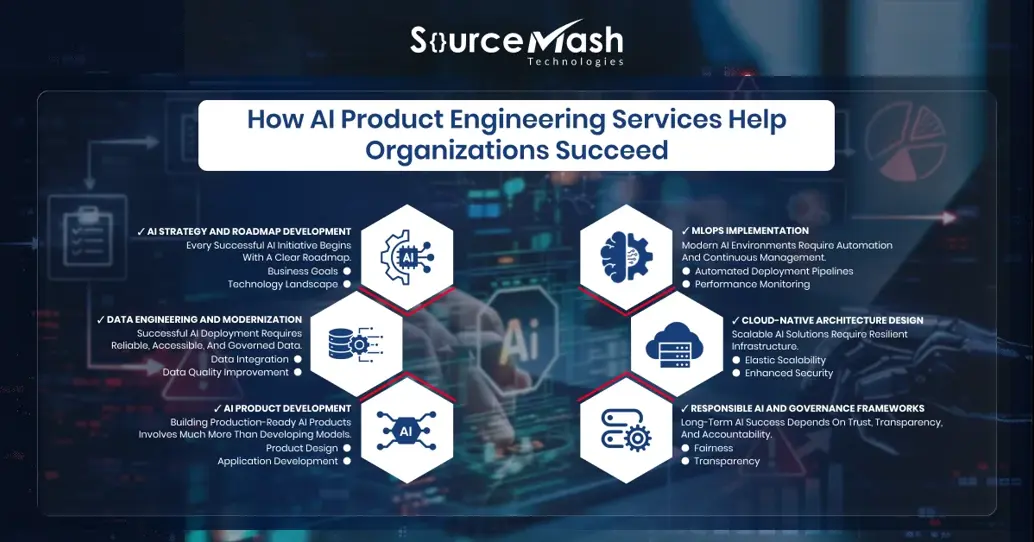
The key to successful AI adoption is treating AI as a product engineering challenge rather than simply a technology experiment.
✓ AI Strategy and Roadmap Development
Every successful AI initiative begins with a clear roadmap.
Experts evaluate:
- Business goals
- Technology landscape
- Organizational readiness
- Data maturity
- Operational requirements
This approach creates a realistic implementation strategy aligned with measurable business outcomes.
Benefits
- Reduced project risk
- Faster implementation
- Better stakeholder alignment
- Improved ROI
✓ Data Engineering and Modernization
Successful AI deployment requires reliable, accessible, and governed data.
Organizations often need assistance with:
- Data integration
- Data quality improvement
- Governance frameworks
- Automated pipelines
- Modern analytics platforms
A strong data foundation significantly improves the likelihood of production success.
✓ AI Product Development
Building production-ready AI products involves much more than developing models.
A comprehensive engineering approach includes:
- Product design
- Application development
- Testing and validation
- User experience optimization
- Deployment planning
The result is a complete business solution rather than a standalone algorithm.
✓ MLOps Implementation
Modern AI environments require automation and continuous management.
MLOps frameworks support:
- Automated deployment pipelines
- Performance monitoring
- Version control
- Continuous testing
- Model retraining
This ensures AI systems remain reliable, scalable, and effective over time.
✓ Cloud-Native Architecture Design
Scalable AI solutions require resilient infrastructure.
Cloud-native architectures provide:
- Elastic scalability
- Enhanced security
- High availability
- Cost optimization
- Disaster recovery capabilities
These environments allow organizations to scale AI operations confidently.
✓ Responsible AI and Governance Frameworks
Long-term AI success depends on trust, transparency, and accountability.
Governance frameworks help organizations establish:
- Fairness
- Transparency
- Security
- Compliance
- Risk management
These practices support sustainable and responsible AI adoption.
Why Businesses Partner with SourceMash Technologies for AI Product Engineering
Many organizations can build AI models. Far fewer possess the expertise required to deploy, integrate, manage, and scale those solutions successfully in production environments.
SourceMash Technologies helps organizations bridge this gap by combining AI expertise with digital product engineering capabilities.
Rather than focusing solely on model development, SourceMash takes a holistic approach that includes:
- AI strategy consulting
- Data engineering
- Product engineering
- Cloud architecture
- MLOps implementation
- Enterprise integration
- Governance and security
This end-to-end methodology helps businesses accelerate implementation timelines, reduce deployment risks, improve operational efficiency, and maximize the return on AI investments.
Whether organizations are exploring predictive analytics, intelligent automation, generative AI applications, or AI-powered digital products, SourceMash supports the entire journey from concept through production and ongoing optimization.
Core Services Offered
✓ AI Strategy Consulting
Align AI investments with measurable business objectives and long-term growth strategies.
✓ Machine Learning Development
Build predictive analytics, forecasting, recommendation systems, and classification models tailored to business requirements.
✓ Generative AI Solutions
Develop intelligent assistants, conversational AI systems, automated workflows, and AI-powered productivity tools.
✓ AI Product Engineering
Design, build, test, deploy, and optimize production-ready AI applications.
✓ MLOps Services
Implement deployment automation, monitoring systems, lifecycle management, and performance optimization processes.
✓ Enterprise AI Integration
Connect AI capabilities with ERP systems, CRM platforms, legacy applications, and business workflows.
✓ Cloud Infrastructure Engineering
Build secure, scalable, and resilient cloud environments that support enterprise AI workloads.
✓ AI Modernization
Upgrade and optimize legacy AI implementations using modern architectures and best practices.
Real-World Example: Turning an AI Pilot Into a Production Solution
Consider a healthcare organization building an AI solution designed to predict patient readmissions.
Although the model demonstrated excellent results during testing, it could not move into production due to fragmented data sources, compliance requirements, and system integration challenges.
By implementing secure data pipelines, establishing governance controls, integrating healthcare systems, and deploying continuous monitoring processes, the organization successfully transformed the pilot into a production-ready solution.
The result was improved patient care, better resource allocation, enhanced operational efficiency, and measurable business value.
Best Practices for Taking AI From Concept to Production
Organizations seeking successful AI adoption should:
- Define clear business objectives.
- Build a strong data foundation.
- Design scalable infrastructure early.
- Integrate AI into existing workflows.
- Establish MLOps practices from the start.
- Prioritize security and compliance.
- Continuously monitor model performance.
- Develop a long-term AI roadmap.
- Measure outcomes against business KPIs.
- Work with experienced AI engineering specialists.
Why Businesses Are Investing More in AI Product Engineering Services
As AI adoption continues to accelerate, organizations increasingly require expertise beyond traditional data science.
Modern AI initiatives demand specialists who understand:
- Business strategy
- Product engineering
- Cloud infrastructure
- Enterprise architecture
- Deployment automation
- Data ecosystems
- Governance frameworks
Companies that view AI as a business capability instead of a standalone technology project are typically better positioned to achieve sustainable success and long-term value.
Conclusion
AI offers immense opportunities for innovation, efficiency, and business growth. However, many initiatives fail to reach production because organizations underestimate the complexity of deployment and operationalization.
Challenges related to business alignment, data readiness, infrastructure, integration, governance, and lifecycle management frequently prevent AI projects from delivering expected results.
Organizations that successfully operationalize AI take a product engineering approach. By combining strategic planning, strong data foundations, scalable architecture, MLOps practices, and responsible governance, businesses can significantly increase their chances of deployment success and long-term ROI.