In today's digital-first economy, businesses are expected to innovate faster, deliver exceptional customer experiences, streamline operations, and generate measurable returns from every technology investment. While traditional software development has long been the foundation of enterprise technology initiatives, the rapid rise of Artificial Intelligence (AI), Generative AI, automation, and predictive analytics is reshaping how organizations build and scale digital products.
As a result, decision-makers are increasingly evaluating whether traditional development approaches can still meet evolving business demands or if AI Product Engineering offers a better path toward long-term growth and higher ROI.
This article explores the key differences between AI Product Engineering and Traditional Software Development, compares their ROI potential, examines real-world business use cases, and helps enterprises determine which approach delivers the most value.
AI Product Engineering vs Traditional Software Development: Quick Answer
Traditional Software Development focuses on building applications that perform predefined tasks based on fixed business requirements.
AI Product Engineering goes further by integrating artificial intelligence, machine learning, analytics, automation, and intelligent decision-making into digital products. These products can continuously learn, adapt, improve, and generate insights over time.
For organizations seeking innovation, automation, operational efficiency, and long-term competitive advantage, AI Product Engineering often delivers significantly greater ROI than traditional software development.
Why This Comparison Matters More Than Ever
Today's enterprises face several common challenges:
- Increasing development costs
- Pressure to accelerate time-to-market
- Growing customer expectations
- Demand for personalized experiences
- Legacy systems slowing innovation
- Rising operational inefficiencies
- Challenges in leveraging enterprise data effectively
A decade ago, simply launching a digital application provided a competitive advantage.
Today, customers expect intelligent experiences, employees expect automation, and executives expect measurable outcomes. Organizations that continue building static applications may find it increasingly difficult to compete against businesses leveraging AI-powered products that continuously optimize customer experiences and operational performance.
Understanding Traditional Software Development
Traditional Software Development follows a structured approach to designing, developing, testing, deploying, and maintaining software solutions.
A standard development lifecycle typically includes:
- 1. Business requirement gathering
- 2. Solution design
- 3. Development
- 4. Testing
- 5. Deployment
- 6. Maintenance
The software performs tasks based on predefined rules and workflows established during development.
For example, a traditional customer service application may create support tickets, assign cases, track resolution status, and generate reports. While effective, the system cannot independently learn from customer interactions or suggest improvements without additional development efforts.
Advantages of Traditional Software Development
Established Frameworks and Processes
Organizations benefit from proven methodologies such as Agile and Scrum.
Predictable Project Planning
Requirements, costs, and timelines are generally easier to estimate.
Compliance-Friendly Architecture
Traditional development is often preferred in highly regulated environments with strict governance requirements.
Suitable for Fixed-Scope Applications
Projects with limited complexity or stable requirements can be implemented effectively without advanced AI capabilities.
Limitations of Traditional Software Development
Slower Innovation Cycles
Enhancements often require additional development phases and extended release schedules.
High Manual Effort
Many business processes remain dependent on human intervention.
Limited Personalization
Applications typically deliver standardized experiences to all users.
Technical Debt Accumulation
Over time, maintenance requirements and legacy architecture can increase operational costs.
Scalability Challenges
Growth frequently requires additional development resources and infrastructure investments.
What Is AI Product Engineering?
AI Product Engineering combines modern software engineering with artificial intelligence, machine learning, automation, cloud technologies, and data analytics to create intelligent digital products.
Unlike traditional applications, AI-powered products can:
- Learn from data
- Predict outcomes
- Automate workflows
- Personalize user experiences
- Generate recommendations
- Continuously improve performance
The focus shifts from building software that simply functions to creating products that actively contribute to business growth and operational efficiency.
Core Components of AI Product Engineering
- Generative AI
- AI Agents
- Machine Learning Models
- Predictive Analytics
- Natural Language Processing (NLP)
- Computer Vision
- Intelligent Search
- Recommendation Engines
- Process Automation
- MLOps
Real-World Business Example
Consider two retail companies launching customer service platforms.
Company A: Traditional Software Development
The platform creates support tickets, routes inquiries, and tracks resolution status. Every customer follows the same predefined process.
Company B: AI Product Engineering
The platform understands customer intent, answers common questions automatically, recommends solutions, predicts customer needs, and learns from previous interactions.
After one year, both organizations own functional software. However, Company B typically experiences faster customer resolutions, lower support costs, higher customer satisfaction, and increased employee productivity.
This demonstrates how AI Product Engineering creates value beyond software functionality.
AI Product Engineering vs Traditional Software Development
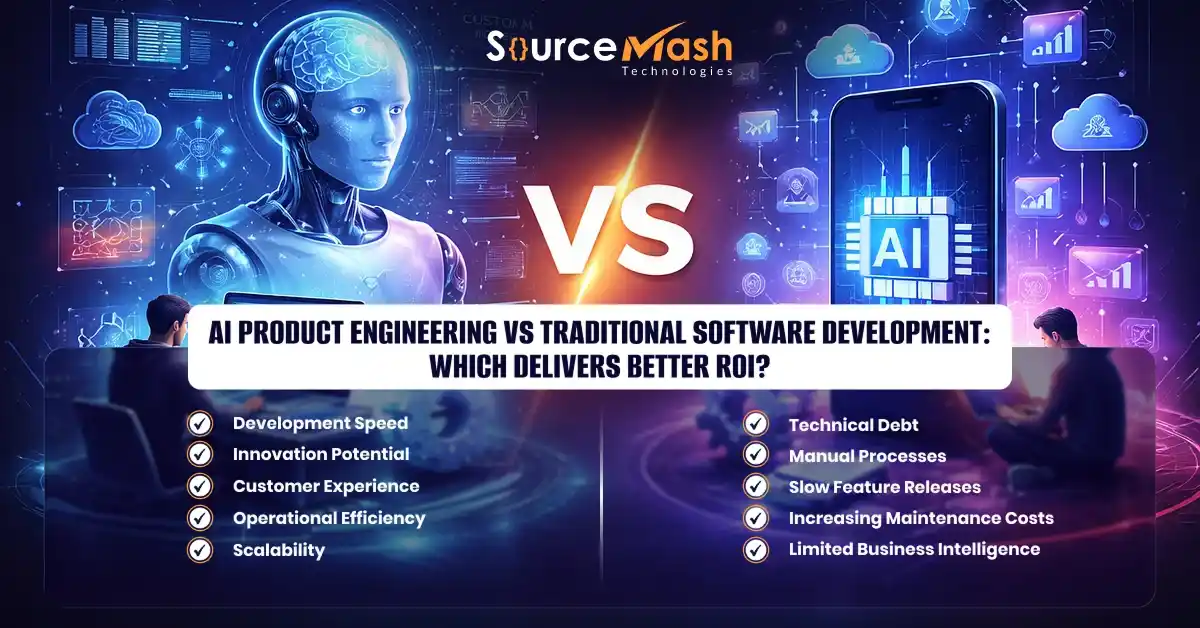
1. Development Speed
Traditional development relies heavily on manual coding, testing, documentation, and deployment activities.
AI Product Engineering accelerates these tasks through AI-assisted coding, automated testing, and intelligent development workflows.
ROI Impact: Faster delivery means businesses can bring products to market sooner and realize value earlier.
2. Innovation Potential
Traditional development often requires separate projects and timelines for every enhancement.
AI Product Engineering supports continuous innovation through predictive capabilities, intelligent recommendations, and ongoing optimization.
ROI Impact: Faster innovation helps organizations respond quickly to changing customer expectations and market conditions.
3. Customer Experience
Traditional applications generally provide the same experience to all users.
AI-powered products offer personalized recommendations, conversational experiences, predictive support, and context-aware interactions.
ROI Impact: Better customer experiences lead to stronger retention and loyalty.
4. Operational Efficiency
Traditional systems often leave many repetitive processes untouched.
AI Product Engineering automates support operations, data processing, approvals, reporting, and internal workflows.
ROI Impact: Reduced operational costs and higher workforce productivity.
5. Scalability
Scaling traditional applications often requires additional infrastructure investments and engineering resources.
AI Product Engineering leverages cloud-native architectures, automation, and AI-driven optimization to support growth more efficiently.
ROI Impact: Higher efficiency and lower operating costs as the organization expands.
ROI Comparison
AI Product Engineering generally outperforms traditional software development across areas such as automation, innovation, personalization, scalability, and long-term business value.
While traditional development remains suitable for fixed-scope business applications, organizations seeking sustainable growth, competitive differentiation, and operational excellence often achieve stronger returns through AI Product Engineering.
The Hidden Costs of Traditional Software Development
Many organizations focus on project costs but overlook long-term expenses.
Technical Debt
Short-term development decisions often create future maintenance challenges.
Manual Processes
Employees continue spending time on repetitive operational tasks.
Slow Feature Releases
Lengthy development cycles can slow innovation.
Increasing Maintenance Costs
Older applications require continuous support and upgrades.
Limited Business Intelligence
Traditional systems collect data but may struggle to generate actionable insights.
Why AI Product Engineering Creates Higher ROI
The true value of AI Product Engineering lies in its ability to create business benefits across multiple areas.
✓ Revenue Growth
AI-powered personalization and recommendation engines can improve conversions and customer engagement.
✓ Cost Reduction
Automation reduces operational expenses.
✓ Improved Productivity
Employees can focus on strategic activities rather than repetitive tasks.
✓ Better Decision-Making
Predictive analytics enables more informed business decisions.
✓ Enhanced Customer Retention
Intelligent and personalized experiences improve customer satisfaction and loyalty.
Industry Use Cases
✓ Healthcare
AI Product Engineering supports intelligent patient engagement, predictive diagnostics, and workflow automation.
✓ Manufacturing
Applications include predictive maintenance, quality inspection, and production forecasting.
✓ Retail and eCommerce
Common use cases include product recommendations, dynamic pricing, inventory forecasting, and AI customer support.
✓ Financial Services
Organizations leverage AI for fraud detection, risk assessment, compliance monitoring, and customer insights.
✓ Enterprise Technology
AI improves ERP, CRM, IT service management, and business intelligence solutions.
Emerging AI Product Engineering Trends
✓ Agentic AI
AI agents capable of independently executing business tasks.
✓ Enterprise AI Copilots
AI assistants designed to improve employee productivity.
✓ Hyperautomation
Combining AI, analytics, and automation to streamline enterprise operations.
✓ AI-Powered ERP and CRM
Smarter enterprise platforms capable of predictive decision support.
✓ Autonomous Testing
AI-driven quality assurance that accelerates software releases.
✓ Intelligent Customer Experience Platforms
Systems delivering real-time personalization across customer touchpoints.
AI Product Engineering Lifecycle
Step 1: Business Discovery
Identify business challenges, objectives, and opportunities.
Step 2: Data Assessment
Evaluate data quality, governance, and readiness.
Step 3: AI Strategy Development
Define use cases, success metrics, and architecture.
Step 4: Product Engineering
Develop AI-powered applications and workflows.
Step 5: Enterprise Integration
Connect solutions with ERP, CRM, and other enterprise systems.
Step 6: Continuous Optimization
Improve performance using production data and feedback.
AI Product Engineering Readiness Checklist
- Business objectives clearly defined
- Executive sponsorship secured
- Data quality assessed
- Security requirements documented
- Infrastructure readiness evaluated
- Integration requirements reviewed
- Governance established
- ROI metrics identified
- Compliance requirements documented
- Change management plan prepared
Why Enterprises Choose Sourcemash Technologies
AI Product Engineering requires expertise that spans consulting, engineering, data, cloud, automation, and enterprise systems.
Sourcemash Technologies helps businesses move beyond traditional software development by creating intelligent digital products designed to deliver measurable business outcomes.
Our Core Capabilities
- AI Product Engineering
- AI Strategy & Consulting
- Generative AI Development
- AI Agent Development
- Data Engineering & Analytics
- Enterprise Application Development
- DevOps Automation
- SAP S/4HANA Services
- Microsoft Dynamics 365 Solutions
- Salesforce Consulting
- Cloud Modernization
What Sets Sourcemash Technologies Apart
- Business-first approach
- Enterprise technology expertise
- End-to-end service delivery
- Focus on measurable ROI
- Future-ready architectures
Whether you're modernizing legacy systems or building AI-powered products, Sourcemash Technologies helps transform technology investments into long-term business value.
Frequently Asked Questions
Is AI Product Engineering more expensive than traditional software development?
While initial investments may be higher, organizations often realize greater long-term ROI through automation and efficiency gains.
What industries benefit most from AI Product Engineering?
Healthcare, manufacturing, retail, finance, logistics, technology, and professional services are among the industries seeing significant benefits.
Can AI Product Engineering work with existing applications?
Yes. Modern AI solutions can be integrated into existing business systems and applications.
How long does implementation take?
Timelines vary depending on project scope, integrations, infrastructure, and business requirements.
What ROI can organizations expect?
Results differ by use case, but common benefits include productivity improvements, faster innovation, lower costs, and enhanced customer experiences.
Is AI Product Engineering suitable for small and medium-sized businesses?
Yes. AI technologies are becoming increasingly accessible for businesses of all sizes.
Conclusion
Traditional Software Development remains valuable for projects with stable requirements and predictable objectives. However, businesses focused on innovation, automation, scalability, and customer experience are increasingly recognizing the advantages of AI Product Engineering.
The future belongs to organizations that build products capable of learning, adapting, predicting, and continuously improving. AI Product Engineering enables businesses to create those intelligent experiences while generating stronger long-term ROI.
For enterprises pursuing sustainable growth and competitive advantage, AI Product Engineering is no longer a future trend. It is becoming a core business strategy.