The Future of Warehousing Is Intelligent
Warehouses are no longer just storage facilities. They have evolved into strategic operational centers that directly impact inventory performance, order fulfillment, customer satisfaction, profitability, and supply chain efficiency.
Today's businesses must manage fluctuating demand, complex inventory requirements, faster delivery expectations, labor shortages, and increasing operational costs. Traditional warehouse management methods often rely on historical reports and manual decision-making, making it difficult to respond quickly to changing business conditions.
Artificial Intelligence (AI) is transforming warehouse operations by enabling predictive decision-making, inventory optimization, real-time visibility, and intelligent automation. By combining AI, machine learning, analytics, ERP integration, warehouse management systems (WMS), and business intelligence tools, organizations can build intelligent warehouses that continuously improve performance and support long-term growth.
What Are AI-Powered Warehouse Solutions?
AI-powered warehouse solutions use artificial intelligence, machine learning, predictive analytics, and connected enterprise systems to improve warehouse operations, inventory management, demand planning, fulfillment processes, and workforce productivity.
Unlike traditional warehouse systems that react after problems occur, AI-powered solutions analyze real-time and historical data to predict future outcomes, identify risks, and recommend actions before disruptions affect operations.
Key Benefits of AI-Powered Warehousing
- Improve demand forecasting accuracy
- Reduce stockouts and excess inventory
- Optimize inventory investments
- Increase warehouse productivity
- Accelerate order fulfillment
- Improve workforce utilization
- Lower operational costs
- Enhance customer satisfaction
- Strengthen supply chain resilience
- Support data-driven decision-making
Warehouse operations have become significantly more complex due to:
- Omnichannel fulfillment requirements
- Expanding product portfolios
- Rising order volumes
- Same-day and next-day delivery expectations
- Global supplier networks
- Labor shortages and rising workforce costs
- Increased inventory complexity
These challenges often result in inefficiencies that negatively impact operational performance and customer experience.
✓ Inventory Challenges
Organizations commonly struggle with:
- Frequent stockouts
- Excess inventory
- High carrying costs
- Slow-moving inventory
- Poor inventory visibility
- Inefficient replenishment planning
✓ Operational Challenges
Common operational obstacles include:
- Inefficient picking routes
- Fulfillment bottlenecks
- Warehouse space utilization issues
- Manual planning processes
- Delayed reporting
✓ Workforce Challenges
Many warehouses face:
- Labor shortages
- Limited productivity visibility
- Inefficient task allocation
- Rising labor expenses
✓ Data Challenges
Disconnected systems often create:
- Data silos
- Inconsistent reporting
- Duplicate information
- Limited real-time visibility
- Slower decision-making
Traditional warehouse systems answer:
"What happened?"
AI-powered warehouse solutions answer:
- What is likely to happen next?
- Why is it happening?
- What actions should be taken?
- Which decision delivers the best outcome?
This shift from reactive to predictive operations creates a significant competitive advantage.
Core Technologies Behind Intelligent Warehousing
Modern warehouse intelligence combines several technologies into a connected ecosystem.
Key Technologies Include
- Artificial Intelligence (AI)
- Machine Learning (ML)
- Predictive Analytics
- ERP Integration
- Warehouse Management Systems (WMS)
- Transportation Management Systems (TMS)
- Power BI Analytics
- Business Intelligence Platforms
- Mobile Warehouse Applications
- Internet of Things (IoT)
- Computer Vision
- Predictive Maintenance
- Generative AI Assistants
Together, these technologies enable continuous operational optimization and real-time decision-making.
AI Demand Forecasting
Demand forecasting is one of the most impactful applications of AI in warehouse management. It enables businesses to predict future product demand more accurately and make better inventory planning decisions.
Traditional forecasting methods often rely heavily on historical sales data and manual assumptions. AI forecasting models continuously analyze multiple data sources and adapt to changing demand patterns, resulting in more accurate predictions.
How AI Demand Forecasting Works
AI models analyze historical and real-time data to identify patterns, trends, and correlations that influence customer demand.
Data Sources Used in Demand Forecasting
- Historical sales data
- Seasonal demand trends
- Marketing activities
- Customer purchasing behavior
- Supplier lead times
- Inventory movement history
- Regional demand variations
- Market conditions
- Economic indicators
- Product lifecycle stages
Benefits of AI Demand Forecasting
- Reduce stockout risks
- Improve product availability
- Support proactive replenishment
- Improve forecast accuracy
- Optimize purchasing decisions
- Enhance customer satisfaction
- Improve inventory planning
AI-Powered Inventory Optimization
While demand forecasting predicts future demand, inventory optimization determines the ideal inventory levels required to meet that demand.
AI continuously evaluates inventory performance, consumption patterns, supplier lead times, and service-level targets to optimize inventory across the warehouse network.
Safety Stock Optimization
AI calculates optimal safety stock levels by analyzing demand variability and supplier lead-time performance.
Dynamic Reorder Points
Instead of fixed replenishment rules, AI dynamically adjusts reorder points based on current conditions.
ABC Inventory Classification
AI helps identify high-value and business-critical products that require additional planning attention.
Multi-Warehouse Inventory Planning
Organizations operating multiple facilities can optimize inventory allocation across locations.
Slow-Moving Inventory Management
AI identifies aging and underperforming inventory before it becomes a financial burden.
Benefits of AI Inventory Optimization
- Lower carrying costs
- Improved inventory turnover
- Better working capital utilization
- Increased inventory availability
- More accurate replenishment planning
- Reduced excess inventory
- Improved warehouse efficiency
Warehouse Analytics and Business Intelligence
Warehouses generate large volumes of operational data every day. Analytics transforms this information into actionable insights that help organizations improve performance and make informed decisions.
Key Warehouse Data Sources
- ERP systems
- WMS platforms
- TMS platforms
- Inventory databases
- Supplier systems
- E-commerce platforms
- Order management systems
- Mobile applications
Essential Warehouse KPIs
Inventory KPIs
- Inventory Accuracy
- Inventory Turnover
- Fill Rate
- Inventory Aging
- Carrying Costs
- Safety Stock Performance
Fulfillment KPIs
- Order Cycle Time
- Order Accuracy
- Perfect Order Rate
- Backorder Rate
- Picking Productivity
- Packing Efficiency
Workforce KPIs
- Labor Productivity
- Labor Utilization
- Receiving Efficiency
- Put-Away Performance
Shipping KPIs
- On-Time Delivery
- Cost per Shipment
- Carrier Performance
- Return Rate
- Customer Satisfaction
Monitoring these KPIs supports continuous operational improvement and better business outcomes.
Power BI for Warehouse Intelligence
Power BI helps organizations transform warehouse data into interactive dashboards and real-time reports. By consolidating information from multiple systems, warehouse leaders gain visibility into operational performance and emerging trends.
Inventory Dashboard
Tracks:
- Inventory levels
- Stock valuation
- Inventory aging
- Product availability
- Replenishment status
Fulfillment Dashboard
Tracks:
- Order status
- Picking productivity
- Packing efficiency
- Throughput rates
- Shipping accuracy
Workforce Dashboard
Tracks:
- Labor utilization
- Productivity trends
- Shift performance
- Task completion rates
Executive Dashboard
Tracks:
- Operating expenses
- Inventory investment
- Capacity utilization
- Service levels
- Overall warehouse performance
Business Benefits of Power BI
- Real-time visibility
- Automated reporting
- Centralized KPI monitoring
- Faster decision-making
- Improved operational transparency
- Self-service analytics
ERP Integration for Connected Warehousing
Disconnected systems can create data inconsistencies and operational inefficiencies. ERP integration connects warehouse operations with procurement, inventory, finance, sales, and logistics systems.
Critical Integration Areas
- Procurement
- Inventory Management
- Finance
- Sales
- Logistics
- Customer Service
- Supply Chain Planning
Business Benefits of ERP Integration
- Improved data accuracy
- Centralized information management
- Automated workflows
- Synchronized business processes
- Better reporting capabilities
- Faster operational decisions
ERP integration serves as the foundation for a connected and intelligent warehouse environment.
Mobile Warehouse Applications
Mobile warehouse applications enable workers to access and update real-time data directly from the warehouse floor.
Common Capabilities
- Barcode scanning
- Receiving operations
- Put-away management
- Cycle counting
- Inventory transfers
- Order picking
- Packing verification
- Shipment validation
Business Benefits
- Increased inventory accuracy
- Faster transactions
- Reduced paperwork
- Improved workforce productivity
- Better operational visibility
AI-Powered Fulfillment Optimization
Fulfillment performance directly impacts customer satisfaction and warehouse efficiency. AI improves fulfillment by optimizing operational workflows and resource allocation.
✓ Smart Pick Path Optimization
AI determines the most efficient picking routes to minimize travel distance and improve productivity.
✓ Dynamic Slotting
Products are positioned based on demand and movement patterns to improve picking efficiency.
✓ Intelligent Labor Allocation
AI assigns warehouse tasks according to workload, priority, and workforce availability.
✓ Wave Planning Optimization
Orders are automatically grouped to maximize fulfillment efficiency.
✓ Real-Time Order Prioritization
AI continuously evaluates order queues and prioritizes time-sensitive shipments.
Benefits of Fulfillment Optimization
- Faster order processing
- Improved picking efficiency
- Better workforce utilization
- Greater warehouse throughput
- Reduced bottlenecks
- Improved order accuracy
Emerging Technologies in Intelligent Warehousing
✓ Predictive Maintenance
AI predicts equipment failures before they occur, reducing downtime and maintenance expenses.
✓ Computer Vision
Computer vision automates inventory verification, barcode recognition, shipment validation, and safety monitoring.
✓ IoT-Enabled Warehousing
Connected sensors provide real-time visibility into inventory, equipment, and warehouse conditions.
✓ Generative AI for Warehouse Management
Generative AI enables users to interact with warehouse data using natural language queries and automated reporting.
Industry Applications of AI-Powered Warehouse Solutions
Retail
- Demand forecasting
- Seasonal inventory planning
- Replenishment optimization
E-Commerce
- Peak-demand forecasting
- Inventory optimization
- Faster fulfillment
Manufacturing
- Raw material forecasting
- Production inventory planning
- Material availability management
Wholesale Distribution
- Multi-location inventory management
- Demand forecasting
- Inventory optimization
Third-Party Logistics (3PL)
- Multi-client inventory visibility
- Service-level monitoring
- Capacity planning
How to Implement an AI-Powered Warehouse Strategy
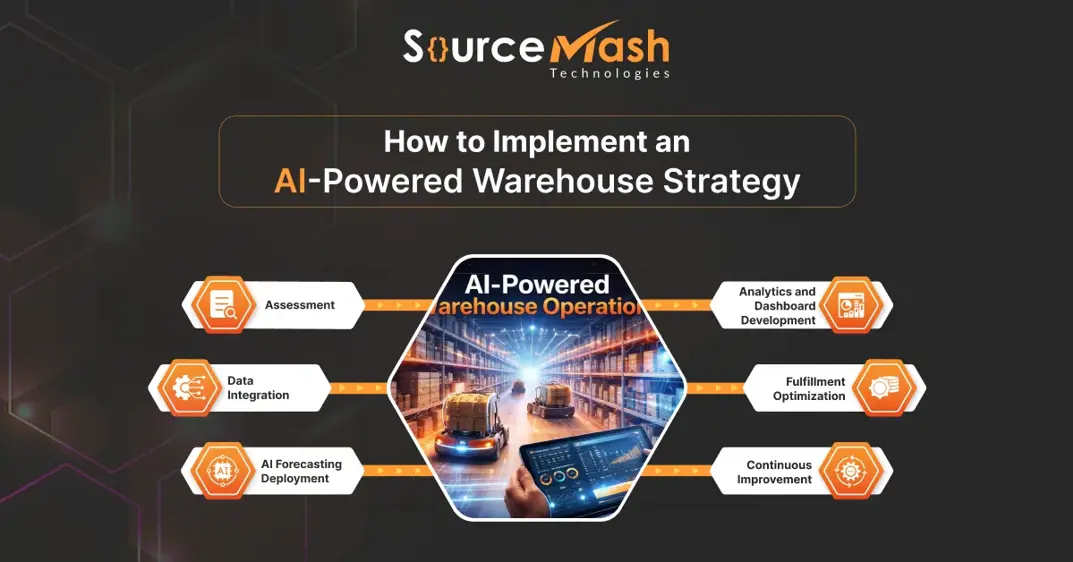
Phase 1: Assessment
- Analyze current processes
- Identify bottlenecks
- Define KPIs and objectives
Phase 2: Data Integration
- Connect ERP and WMS systems
- Eliminate data silos
- Improve data quality
Phase 3: AI Forecasting Deployment
- Deploy forecasting models
- Validate predictions
- Improve forecast accuracy
Phase 4: Analytics and Dashboard Development
- Implement reporting solutions
- Establish KPI monitoring
- Improve operational visibility
Phase 5: Fulfillment Optimization
- Optimize picking routes
- Improve labor allocation
- Reduce bottlenecks
Phase 6: Continuous Improvement
- Monitor KPIs
- Refine AI models
- Continuously improve performance
Measuring ROI of AI-Powered Warehouse Solutions
Successful AI initiatives should be measured using business-focused performance metrics.
Inventory Metrics
- Inventory turnover
- Inventory availability
- Stockout reduction
- Carrying cost reduction
Operational Metrics
- Productivity improvements
- Throughput increases
- Picking efficiency
- Operational cost reductions
Service Metrics
- Order accuracy
- On-time delivery
- Fulfillment speed
- Service-level performance
Financial Metrics
- Revenue growth
- Cash flow improvement
- Profitability enhancement
- Return on inventory investment
How SourceMash Technologies Helps Build Intelligent Warehouses
SourceMash Technologies helps organizations modernize warehouse operations through:
- AI-powered demand forecasting
- Inventory optimization solutions
- ERP, WMS, and TMS integrations
- Power BI warehouse analytics
- Mobile warehouse applications
- Fulfillment optimization solutions
- Predictive analytics platforms
- Generative AI reporting assistants
- Digital transformation strategies
By combining expertise in AI, analytics, integration, and warehouse operations, SourceMash helps businesses improve efficiency, visibility, and supply chain performance.
Frequently Asked Questions
What are AI-powered warehouse solutions?
AI-powered warehouse solutions use artificial intelligence, analytics, and automation to improve inventory management, forecasting, fulfillment, and decision-making.
How does AI improve inventory management?
AI analyzes demand patterns, inventory movements, and supplier performance to optimize inventory levels and reduce stockouts or overstock situations.
Why is ERP integration important?
ERP integration creates a unified data environment that improves reporting, planning, workflow automation, and operational visibility.
What KPIs should warehouses monitor?
Key KPIs include inventory accuracy, inventory turnover, fill rate, labor productivity, order accuracy, order cycle time, and on-time delivery.
Can AI integrate with existing ERP systems?
Yes. Most AI solutions can integrate with leading ERP platforms, including Microsoft Dynamics 365, SAP, Oracle, and NetSuite.
How long does implementation take?
Implementation timelines vary based on complexity, but organizations often begin realizing measurable value within a few months using a phased deployment approach.
The Future of AI-Powered Warehousing
The future of warehousing will be driven by:
- Autonomous Mobile Robots (AMRs)
- Digital Twins
- AI Agents
- Hyperautomation
- Advanced Computer Vision
- Collaborative Robotics
- Generative AI Copilots
- Self-Optimizing Warehouse Ecosystems
Organizations that invest in intelligent warehousing today will be better positioned to meet evolving customer expectations and compete in increasingly data-driven supply chains.
Conclusion
AI-powered warehousing has become a strategic necessity for organizations seeking greater efficiency, agility, scalability, and profitability.
By combining AI demand forecasting, inventory optimization, warehouse analytics, ERP integration, Power BI dashboards, mobile warehouse applications, and fulfillment optimization, businesses can transform traditional warehouses into intelligent operational ecosystems.
The result is improved visibility, faster fulfillment, lower inventory costs, stronger workforce productivity, enhanced customer satisfaction, and greater supply chain resilience.
Organizations that embrace intelligent warehousing today will build smarter, faster, and more competitive warehouse operations for the future.