Introduction
Artificial intelligence is rapidly evolving from an emerging technology into a core business capability. Organizations across industries are investing in AI to improve productivity, streamline operations, enhance decision-making, and deliver superior customer experiences.
While customer-facing AI often attracts the most attention, successful enterprise AI transformation rarely begins there. Organizations that achieve sustainable AI adoption typically start with internal AI copilots, establish governance frameworks, organize enterprise knowledge, integrate business systems, and gradually introduce more autonomous AI capabilities before expanding into customer-facing experiences.
This phased approach reduces implementation risk, improves AI accuracy, strengthens governance, and creates the foundation necessary for scalable AI adoption.
This article explores a practical Enterprise AI Roadmap that guides organizations from AI Copilot Implementation to Internal AI Agents, Agentic AI capabilities, and ultimately Generative AI Customer Service Agents.
Executive Summary
Artificial intelligence is becoming one of the most significant drivers of enterprise transformation. Organizations are increasingly investing in AI to improve operational efficiency, support employees, automate workflows, and enhance customer experiences.
A successful enterprise AI journey typically follows this progression:
AI Readiness Assessment → Governance Foundation → AI Copilot Implementation → Data & System Integration → Enterprise Knowledge Foundation → Internal AI Agents → Agentic AI → Generative AI Customer Service Agents → Continuous Optimization
A comprehensive AI Readiness Assessment can help organizations evaluate their current capabilities, identify implementation gaps, and prioritize AI initiatives that align with business objectives.
This phased approach helps organizations:
- Improve employee productivity
- Accelerate decision-making
- Reduce operational costs
- Strengthen security and compliance
- Build trusted enterprise knowledge systems
- Improve customer experiences
- Enable AI-driven automation
- Scale AI responsibly across the organization
The most successful AI programs balance innovation with governance, creating long-term business value while minimizing risk.
Understanding the Three Core Enterprise AI Capabilities
To build a successful enterprise AI strategy, organizations must understand the distinct roles played by AI Copilots, Internal AI Agents, and Generative AI Customer Service Agents.
1. AI Copilots
AI copilots are intelligent assistants designed to help employees perform tasks more efficiently. They assist users by generating content, retrieving information, analyzing documents, and supporting decision-making.
Common AI Copilot Use Cases
- Content creation
- Meeting summaries
- Knowledge retrieval
- Document analysis
- Research assistance
- Reporting and analytics
- Email drafting
- Workflow support
- Data interpretation
Rather than replacing employees, AI copilots act as productivity accelerators that reduce repetitive work and allow teams to focus on higher-value activities.
Benefits of AI Copilots
Organizations implementing AI copilots commonly experience:
- Faster task completion
- Improved employee productivity
- Reduced administrative burden
- Better access to enterprise knowledge
- More consistent decision-making
- Enhanced collaboration
- Improved employee experience
Because they provide immediate productivity benefits with relatively low implementation risk, AI copilots are often the ideal starting point for enterprise AI adoption.
2. Internal AI Agents
Internal AI agents represent the next stage of AI maturity.
Unlike copilots, which help employees perform tasks, internal AI agents can take action and execute workflows across enterprise systems on behalf of users.
Common Examples of Internal AI Agents
IT Support Agents
- Reset passwords
- Create support tickets
- Provision software access
- Troubleshoot common issues
HR Agents
- Answer policy questions
- Manage leave requests
- Support onboarding activities
- Provide benefits information
Procurement Agents
- Create purchase requests
- Validate approvals
- Check vendor information
- Track order status
Finance Agents
- Process invoices
- Generate financial reports
- Monitor expenses
- Support audit preparation
Benefits of Internal AI Agents
- Workflow automation
- Operational efficiency
- Reduced manual effort
- Faster process execution
- Improved employee support
- Increased consistency across operations
Internal AI agents help organizations gain confidence in AI-driven automation before deploying autonomous capabilities directly to customers.
3. Generative AI Customer Service Agents
Generative AI Customer Service Agents interact directly with customers using natural language, contextual understanding, enterprise knowledge, and connected business systems.
Unlike traditional rule-based chatbots, generative AI agents can understand intent, generate contextual responses, retrieve information from multiple systems, and execute service-related actions.
Core Capabilities
- Natural language conversations
- Personalized responses
- Context awareness
- Knowledge retrieval
- Task execution
- Intelligent escalation
- Multi-step interactions
Business Benefits
- Faster customer support
- Improved customer satisfaction
- Consistent customer experiences
- Reduced service costs
- Increased self-service adoption
- Enhanced service availability
These capabilities are transforming customer service from transactional support into intelligent, personalized engagement.
AI Copilot vs Internal AI Agent vs Customer Service Agent
| Capability | AI Copilot | Internal AI Agent | Customer Service Agent |
|---|---|---|---|
| Assists Users | Yes | Limited | Limited |
| Executes Actions | No | Yes | Yes |
| Workflow Automation | Basic | Advanced | Advanced |
| Uses Enterprise Systems | Limited | Extensive | Extensive |
| Primary Users | Employees | Employees | Customers |
| Autonomy Level | Low | Medium | High |
| Business Focus | Productivity | Operational Efficiency | Customer Experience |
Understanding these differences helps organizations build a structured AI adoption strategy instead of treating all AI solutions as the same capability.
Understanding Agentic AI
As enterprise AI evolves, organizations are increasingly moving toward Agentic AI.
While Generative AI focuses primarily on creating responses, Agentic AI goes significantly further by planning tasks, making decisions within defined boundaries, using enterprise tools, and executing workflows.
Agentic AI can:
- Reason through problems
- Plan tasks
- Use enterprise tools
- Access business systems
- Make decisions within approved boundaries
- Execute multi-step workflows
Generative AI Example
A customer asks:
"Where is my order?"
The AI generates an answer based on available information.
Agentic AI Example
The AI:
- Checks the order management system
- Retrieves shipping information
- Reviews delivery status
- Updates CRM records
- Creates a replacement request if needed
- Sends customer notifications
All within a single workflow.
This capability transforms AI from a conversational assistant into an operational business partner.
The Enterprise AI Adoption Roadmap
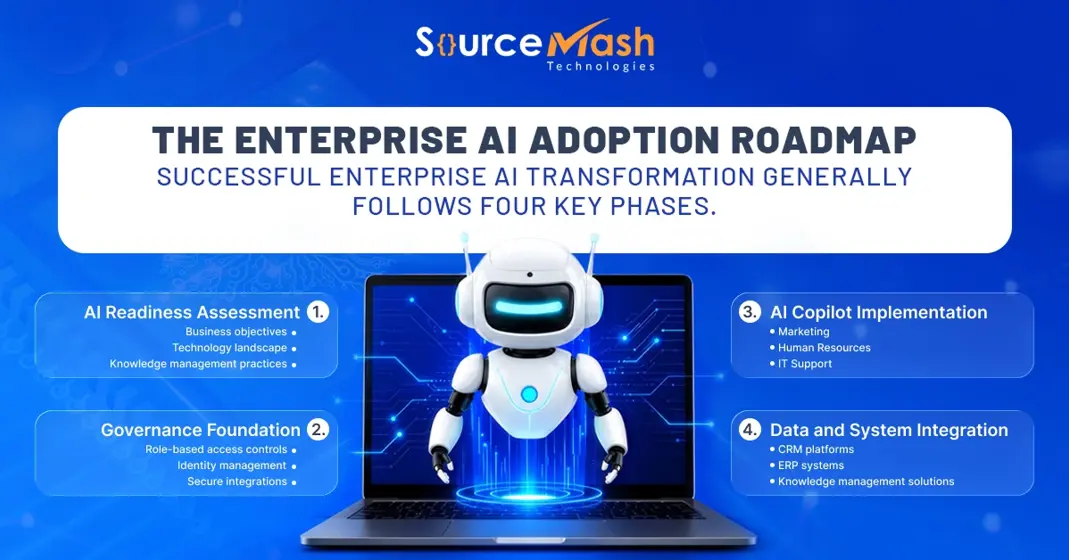
Successful enterprise AI transformation generally follows eight key phases.
Phase 1: AI Readiness Assessment
Before implementing AI solutions, organizations should assess:
- Business objectives
- Technology landscape
- Data maturity
- Compliance requirements
- Workforce readiness
- Security capabilities
- Knowledge management practices
This assessment helps identify opportunities, risks, and implementation barriers.
Phase 2: Governance Foundation
Governance should be established before large-scale AI deployment.
Organizations should implement:
Security Controls
- Role-based access controls
- Identity management
- Data encryption
- Audit logging
- Secure integrations
Responsible AI Standards
- Transparency
- Fairness
- Human oversight
- Accountability
- Explainability
Compliance Frameworks
- Data privacy regulations
- Industry-specific requirements
- Internal governance standards
- Records retention policies
Strong governance enables organizations to scale AI confidently while protecting customers, employees, and business data.
Phase 3: AI Copilot Implementation
The next step is deploying employee-facing AI assistants across business functions.
Common starting areas include:
- Marketing
- Human Resources
- Finance
- Operations
- IT Support
- Customer Service
Early pilot projects often deliver measurable productivity improvements while helping organizations understand how AI interacts with existing workflows.
Phase 4: Data and System Integration
For AI to deliver meaningful business value, it must connect to enterprise systems.
Examples include:
- CRM platforms
- ERP systems
- Knowledge management solutions
- Collaboration platforms
- Document repositories
- Data warehouses
Integration transforms AI from a standalone assistant into a connected business capability.
Phase 5: Enterprise Knowledge Foundation
A strong enterprise knowledge layer becomes the central intelligence source for AI systems.
Organizations should create a centralized repository containing:
- Product documentation
- Support articles
- Policies and procedures
- Customer FAQs
- Training materials
- Internal knowledge bases
This foundation enables AI systems to provide accurate and reliable responses based on approved information.
Phase 6: Internal AI Agents
Once governance, integrations, and knowledge foundations are established, organizations can begin deploying AI agents capable of executing operational tasks.
These agents can:
- Create service tickets
- Process approvals
- Trigger workflows
- Retrieve enterprise records
- Coordinate actions across systems
- Automate routine business processes
This stage allows organizations to validate AI autonomy before extending it beyond the enterprise.
Phase 7: Agentic AI Capabilities
The next stage introduces more autonomous AI capabilities.
Agentic AI solutions can:
- Coordinate systems
- Manage complex workflows
- Plan actions
- Execute multi-step processes
- Use enterprise tools
- Support business decisions
Organizations can gradually increase autonomy while maintaining human oversight for critical decisions.
Phase 8: Generative AI Customer Service Agents
After governance and knowledge foundations are fully established, organizations can confidently deploy customer-facing AI solutions.
These systems provide:
- Personalized customer support
- Consistent service experiences
- Omnichannel engagement
- Automated issue resolution
- Intelligent escalation to human agents
This phased approach minimizes implementation risk while maximizing long-term business value.
Building the Enterprise AI Foundation
1. Enterprise Knowledge Layer
A centralized enterprise knowledge repository should contain:
- Product information
- Technical documentation
- Support procedures
- Regulatory policies
- Training materials
- Customer service resources
Providing AI with access to trusted information significantly improves response quality and reliability.
2. Retrieval-Augmented Generation (RAG)
Retrieval-Augmented Generation (RAG) has emerged as a preferred architecture for enterprise AI deployments.
Instead of relying solely on model training data, RAG retrieves information from approved enterprise systems before generating a response.
Benefits of RAG
- Improved accuracy
- Reduced hallucinations
- Access to real-time information
- Better compliance support
- Increased transparency
- Stronger trust in AI outputs
For enterprises seeking reliable and scalable AI solutions, RAG has become a foundational capability.
High-Level Enterprise AI Architecture
A typical enterprise AI architecture follows a layered approach:
Employees or Customers
↓
AI Copilot or AI Agent
↓
Retrieval-Augmented Generation (RAG) Layer
↓
Enterprise Knowledge Base
↓
Connected Business Systems (CRM, ERP, Documents, Data Sources)
↓
Security, Governance, and Compliance Controls
This architecture combines large language models with enterprise knowledge and connected business systems, enabling AI to provide accurate, secure, and policy-aligned responses.
Deploying Generative AI Customer Service Agents
Once governance, integrations, and knowledge systems are mature, organizations can extend AI directly to customer interactions.
1. Natural Language Understanding
Customers can communicate naturally without learning commands, menus, or predefined workflows.
2. Personalized Customer Experiences
AI agents can leverage:
- Customer history
- Account information
- Preferences
- Previous interactions
to provide more relevant and personalized support.
3. Omnichannel Engagement
AI agents can operate across:
- Websites
- Mobile applications
- Customer portals
- Messaging platforms
- Live chat environments
- Social support channels
4. Automated Service Resolution
Common use cases include:
- Order tracking
- Billing inquiries
- Appointment scheduling
- Account updates
- Subscription management
- Product recommendations
5. Intelligent Escalation
When issues exceed AI capabilities, conversations can be transferred to human agents along with:
- Conversation history
- Customer context
- Recommended actions
- Relevant documentation
This reduces handling time and improves service quality.
Measuring Enterprise AI Success
Organizations should establish measurable KPIs before implementation begins.
1. Employee Productivity Metrics
- Time saved per employee
- Document creation speed
- Research efficiency
- Administrative workload reduction
- Knowledge retrieval speed
2. Customer Service Metrics
- First Contact Resolution (FCR)
- Average Handling Time (AHT)
- Customer Satisfaction (CSAT)
- Net Promoter Score (NPS)
- Customer Effort Score (CES)
3. Operational Metrics
- Cost per interaction
- Automation rate
- Resolution speed
- Ticket volume reduction
- Agent productivity improvements
Tracking these metrics helps organizations demonstrate ROI and optimize AI investments over time.
Best Practices for Enterprise AI Adoption
To maximize success:
- Start with clearly defined business goals.
- Establish governance before scaling AI.
- Prioritize high-quality enterprise data.
- Begin with AI copilots before customer-facing AI.
- Build a centralized enterprise knowledge foundation.
- Integrate business systems early.
- Use RAG to improve accuracy and trust.
- Deploy internal AI agents before customer-facing AI agents.
- Maintain human oversight for critical decisions.
- Continuously measure business outcomes.
- Invest in employee adoption and training.
- Focus on business value rather than technology hype.
Organizations that follow a structured roadmap are far more likely to achieve sustainable AI transformation and measurable business results.
Frequently Asked Questions
What is an AI Copilot?
An AI copilot is an AI-powered assistant that helps employees perform tasks more efficiently through content generation, knowledge retrieval, workflow support, and decision assistance.
What Is the Difference Between an AI Copilot and an AI Agent?
An AI copilot assists users in completing tasks, while an AI agent can autonomously perform actions and execute workflows across enterprise systems.
What Is Agentic AI?
Agentic AI refers to AI systems capable of planning, reasoning, using tools, and executing multi-step actions with limited human intervention.
Why Should Enterprises Implement AI Copilots Before Customer Service Agents?
AI copilots help organizations establish governance, validate security controls, improve knowledge management, and gain operational experience before deploying customer-facing AI solutions.
What Is Retrieval-Augmented Generation (RAG)?
RAG is an AI architecture that retrieves information from enterprise knowledge sources before generating responses, improving accuracy, reducing hallucinations, and providing access to current enterprise data.
How Can Organizations Measure AI ROI?
Organizations can measure AI ROI through productivity gains, customer satisfaction improvements, operational efficiencies, automation rates, cost reductions, and service performance improvements.
Conclusion
AI Copilot Implementation, Internal AI Agents, Agentic AI, and Generative AI Customer Service Agents are not separate initiatives. They represent successive stages of a unified enterprise AI transformation strategy.
Organizations that begin with AI copilots establish the governance frameworks, knowledge management practices, and operational foundations necessary for long-term AI success. As enterprise knowledge systems mature and integrations expand, businesses can confidently introduce internal AI agents, adopt agentic AI capabilities, and ultimately deliver intelligent customer-facing experiences.
The most effective enterprise AI strategy follows a clear progression:
AI Readiness Assessment → Governance Foundation → AI Copilot Implementation → Data & System Integration → Enterprise Knowledge Foundation → Internal AI Agents → Agentic AI → Generative AI Customer Service Agents → Continuous Optimization
By following this roadmap, organizations can reduce risk, accelerate adoption, improve workforce productivity, enhance customer experiences, and unlock meaningful value from their AI investments while building a scalable foundation for the future of enterprise AI.