Quick Answer
Salesforce's Agentic AI vision combines Data Cloud, Headless Data 360, Model Context Protocol (MCP), Einstein Trust Layer, and Agentforce to create AI agents that can understand business context, make decisions, and securely execute actions across enterprise systems.
Unlike traditional AI assistants that only provide answers, Salesforce agents can access trusted customer data, interact with business applications, trigger workflows, and complete multi-step business processes while operating under governance controls.
What Is Salesforce Agentic AI?
Salesforce Agentic AI is an enterprise AI approach that enables autonomous agents to:
- Understand customer intent
- Access real-time business context
- Reason through business scenarios
- Execute workflows
- Interact with multiple systems
- Collaborate with employees
- Complete end-to-end business processes
The goal is to move beyond AI chatbots and create digital workers capable of taking meaningful actions across the organization.
The Five Components of Salesforce's Agentic AI Architecture
Salesforce's Agentic AI architecture is built on five core components that work together to help AI agents access trusted data, understand business context, connect with enterprise systems, and execute actions securely.
1. Data Cloud
Data Cloud serves as the foundation of the architecture by unifying customer and enterprise data from multiple business systems into a single, trusted source of truth.
2. Headless Data 360
Headless Data 360 makes that unified data available to AI agents through reusable services and APIs, enabling them to access real-time business context without relying on Salesforce interfaces.
3. Model Context Protocol (MCP)
MCP acts as the connectivity layer, allowing AI agents to discover tools, access enterprise data, and interact with business applications through a standardized protocol.
4. Einstein Trust Layer
The Einstein Trust Layer provides governance, security, and compliance controls that help ensure AI agents operate according to organizational policies and permissions.
5. Agentforce
Agentforce is Salesforce's AI agent platform that enables agents to reason, make decisions, execute workflows, and take action using the data, context, and tools available to them.
How These Components Work Together
Each component plays a distinct role:
- Data Cloud provides trusted data.
- Headless Data 360 provides business context.
- MCP provides connectivity.
- Einstein Trust Layer provides governance.
- Agentforce provides intelligence and action.
Together, these components enable Salesforce AI agents to move beyond answering questions and perform real business tasks across enterprise systems.
What is a Data Cloud?
Data Cloud is Salesforce's customer data platform that unifies data from multiple business systems into a single, trusted customer profile. It helps organizations bring together customer information from across the enterprise to create a complete view of each customer.
It can collect data from:
- CRM systems
- Marketing platforms
- Commerce applications
- ERP systems
- Customer service platforms
- Data warehouses
- External data sources
Why It Matters
AI agents need accurate and connected data to make informed decisions. Data Cloud eliminates data silos, unifies customer information, and provides the trusted data foundation that powers Salesforce's AI capabilities.
Benefits of Data Cloud
- Unified customer profiles
- Identity resolution
- Real-time data access
- Cross-channel insights
- Customer journey visibility
- Personalized experiences
Data Cloud serves as the foundation for AI-driven insights and decision-making.
What Is Headless Data 360?
Headless Data 360 is Salesforce's approach to making customer intelligence and business context available to AI agents through APIs and reusable services rather than traditional Salesforce interfaces.
Instead of accessing information through Salesforce screens, AI agents can retrieve relevant business context wherever they operate.
Why It Matters
AI agents require more than customer records to perform effectively. They need access to:
- Purchase history
- Service interactions
- Product usage information
- Marketing engagement data
- Business relationships
- Organizational context
Headless Data 360 delivers this information in real time, helping agents make smarter decisions and take more relevant actions.
Data Cloud vs Headless Data 360
Data Cloud
- Unifies enterprise data
- Creates customer profiles
- Resolves identities
- Serves as the data foundation
Headless Data 360
- Delivers business context
- Enables AI consumption
- Supports agent access
- Exposes intelligence through services
Simply put:
✓ Data Cloud creates the data foundation.
✓ Headless Data 360 makes that data and context available to AI agents.
What is a Model Context Protocol (MCP)?
Model Context Protocol (MCP) is an open standard that enables AI models and agents to securely connect with enterprise tools, applications, and data sources through a common framework.
It provides a standardized way for AI agents to access business capabilities across different systems.
Why MCP Matters
Without MCP, organizations often need separate integrations for each AI model and business application. MCP simplifies this process by allowing agents to:
- Discover tools
- Access business resources
- Retrieve context
- Execute workflows
- Trigger actions
- Use enterprise services
This helps reduce integration complexity and improves interoperability across systems.
Systems MCP Can Connect
- Salesforce
- Slack
- Microsoft 365
- ServiceNow
- SAP
- Snowflake
- Jira
- Confluence
- Google Workspace
- Custom APIs
MCP enables AI agents to work across multiple business platforms rather than remaining limited to a single application.
What Is Agentforce?
Agentforce is Salesforce's platform for building, deploying, and managing intelligent AI agents.
These agents can understand requests, evaluate business context, make decisions, and execute actions across enterprise workflows.
Understand Context
Agents can analyze:
- Customer information
- Historical interactions
- Business policies
- Enterprise knowledge
Make Decisions
Agents can:
- Analyze intent
- Evaluate business rules
- Determine next actions
Execute Actions
Agents can:
- Create records
- Update systems
- Trigger workflows
- Send notifications
- Route approvals
Unlike traditional AI assistants that primarily provide information, Agentforce enables AI agents to perform business tasks and complete workflows.
What Is the Einstein Trust Layer?
The Einstein Trust Layer is Salesforce's governance and security framework for AI interactions.
It helps organizations deploy AI agents responsibly while maintaining security, compliance, and control over enterprise data.
Why It Matters
As AI agents gain access to business data and workflows, organizations need safeguards to ensure those agents operate securely and within approved policies.
Key Capabilities
- Data masking
- Access controls
- Audit logging
- Compliance enforcement
- Prompt protection
- Secure grounding
- Data governance controls
The Einstein Trust Layer helps ensure AI agents operate safely, securely, and in alignment with organizational requirements.
How These Components Work Together
Each component plays a specific role in Salesforce's Agentic AI architecture:
- Data Cloud provides trusted enterprise data.
- Headless Data 360 provides business context.
- MCP provides connectivity across systems and tools.
- Agentforce provides intelligence, reasoning, and action.
- Einstein Trust Layer provides governance and security.
Together, these components enable AI agents to access trusted information, understand business context, securely connect with enterprise systems, and execute meaningful business actions.
Real-World Example: Automated Refund Processing
To understand how Salesforce's agentic architecture works in practice, consider a common customer service scenario where a customer requests a refund through Slack, a support portal, or a customer service chatbot.
Instead of simply answering questions, the AI agent can understand the request, gather context, verify business policies, interact with enterprise systems, make decisions, and complete the refund process with minimal human intervention.
Step 1: Agentforce Understands the Request
Agentforce analyzes the customer's message and identifies the intent as a refund request. It then determines the appropriate workflow to initiate.
Step 2: Headless Data 360 Retrieves Customer Context
The agent gathers relevant information, including:
- Customer profile
- Purchase history
- Subscription details
- Previous support interactions
- Order and payment information
This gives the agent the context needed to make an informed decision.
Step 3: Data Cloud Delivers Unified Customer Data
Data Cloud provides a complete customer view by bringing together data from CRM, commerce, service, and other enterprise systems.
Rather than relying on disconnected records, the agent works from a single source of truth.
Step 4: MCP Connects Business Systems
Using Model Context Protocol (MCP), the agent accesses necessary business applications such as:
- Billing systems
- ERP platforms
- Order management tools
- Payment gateways
This allows the agent to gather information and trigger actions across systems.
Step 5: Einstein Trust Layer Applies Business Policies
Before taking action, Salesforce validates:
- Refund eligibility
- Approval requirements
- Security permissions
- Compliance policies
This ensures decisions align with company rules and governance standards.
Step 6: Agentforce Makes a Decision
Using customer context, business data, and policy checks, the agent determines the appropriate next step.
Possible outcomes may include:
- Automatic refund approval
- Escalation for human review
- Alternative resolution options
Step 7: Human Approval When Necessary
For exceptions such as high-value refunds or policy-sensitive cases, the request is routed to a manager for approval before execution.
Step 8: Refund Is Processed
Once approved, the agent completes the process by:
- Updating customer records
- Triggering refund workflows
- Notifying relevant teams
- Sending confirmation to the customer
The entire process is completed faster and with significantly less manual effort.
Benefits of Salesforce's Agentic AI Architecture
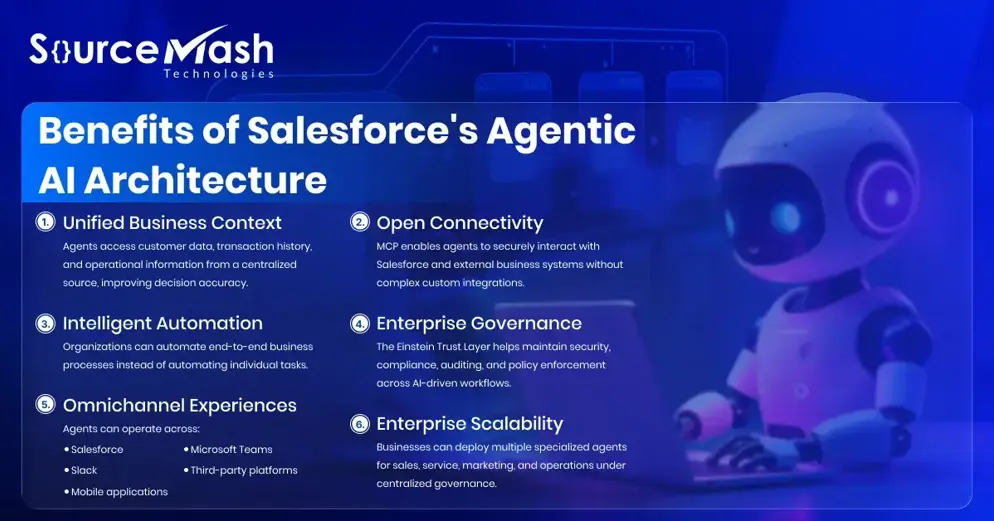
1.Unified Business Context
Agents access customer data, transaction history, and operational information from a centralized source, improving decision accuracy.
2. Open Connectivity
MCP enables agents to securely interact with Salesforce and external business systems without complex custom integrations.
3. Intelligent Automation
Organizations can automate end-to-end business processes instead of automating individual tasks.
4. Enterprise Governance
The Einstein Trust Layer helps maintain security, compliance, auditing, and policy enforcement across AI-driven workflows.
5. Omnichannel Experiences
Agents can operate across:
- Salesforce
- Slack
- Web portals
- Mobile applications
- Microsoft Teams
- Third-party platforms
while maintaining consistent context and business logic.
6. Enterprise Scalability
Businesses can deploy multiple specialized agents for sales, service, marketing, and operations under centralized governance.
Common Use Cases
1. Customer Service
- Case resolution
- Self-service support
- Automated ticket management
- Escalation handling
- Refund processing
- Service request automation
2. Sales
- Opportunity analysis
- Lead qualification
- Next-best-action recommendations
- CRM updates
- Forecast support
- Pipeline management
3. Marketing
- Audience segmentation
- Campaign activation
- Customer journey orchestration
- Personalization
- Churn prediction
- Customer engagement optimization
4. Operations
- Workflow automation
- Resource provisioning
- Approval routing
- Employee onboarding
- Procurement processes
- Internal service management
Key Takeaways
Salesforce's agentic AI strategy brings together several foundational technologies to enable autonomous business execution.
- Data Cloud unifies enterprise and customer data into a trusted source of truth.
- Headless Data 360 provides reusable business context for applications and AI agents.
- MCP connects agents with business systems, tools, and workflows.
- Einstein Trust Layer delivers governance, security, compliance, and policy enforcement.
- Agentforce provides reasoning, decision-making, and action capabilities.
Together, these technologies allow organizations to move beyond simple AI conversations and toward intelligent automation that delivers measurable business outcomes. Organizations looking to implement these capabilities can benefit from expert Salesforce Consulting Services to accelerate adoption and maximize ROI.
FAQs
What is Salesforce Headless Data 360?
Headless Data 360 provides customer and enterprise data as reusable services that AI agents, applications, and digital experiences can access directly without depending on a specific user interface.
Is Data Cloud the same as Headless Data 360?
No. Data Cloud is responsible for unifying and organizing enterprise data. Headless Data 360 makes that unified intelligence available to AI agents and external applications.
What is MCP in Salesforce?
Model Context Protocol (MCP) is an open standard that enables AI agents to securely access business tools, workflows, and enterprise data sources.
What is Agentforce?
Agentforce is Salesforce's platform for building, deploying, orchestrating, and governing autonomous AI agents that can reason, make decisions, and execute business actions.
Why is the Einstein Trust Layer important?
The Einstein Trust Layer provides governance mechanisms such as security controls, compliance safeguards, auditing capabilities, access management, and policy enforcement for AI interactions.
Can Salesforce agents work outside Salesforce?
Yes. Salesforce agents can operate across Slack, websites, mobile applications, Microsoft tools, customer portals, and third-party enterprise systems through APIs and MCP integrations.
What is the biggest advantage of Salesforce's agentic AI architecture?
The greatest advantage is its ability to combine trusted enterprise data, intelligent reasoning, workflow automation, interoperability, and governance, enabling AI agents to perform real business actions rather than simply generating responses.