Introduction
Artificial Intelligence (AI) is transforming healthcare. From AI-powered medical scribes and clinical decision support systems to patient engagement platforms, predictive analytics, virtual assistants, and claims automation solutions, healthcare organizations are increasingly using AI to improve patient outcomes, increase efficiency, and reduce administrative burdens.
As adoption accelerates, healthcare leaders face an important question:
Can Healthcare Organizations Use AI While Remaining HIPAA Compliant?
The answer is yes.
Healthcare organizations can leverage AI while maintaining HIPAA compliance. However, AI is not inherently HIPAA compliant. Compliance depends on how AI technologies are implemented, secured, monitored, and governed throughout their lifecycle.
Organizations remain responsible for protecting electronic protected health information (ePHI), managing third-party vendors, conducting risk assessments, and implementing appropriate administrative, physical, and technical safeguards.
This guide explains how healthcare organizations can adopt AI responsibly while maintaining compliance and protecting patient data.
What Does HIPAA Compliance Mean for AI?
HIPAA does not currently contain regulations specifically written for artificial intelligence. Instead, organizations must apply existing HIPAA requirements whenever AI systems create, receive, maintain, process, store, or transmit ePHI.
Whether an AI solution supports HIPAA compliance depends on:
- The type of healthcare data it accesses
- How ePHI is stored and transmitted
- Security controls protecting sensitive information
- User access management practices
- Vendor responsibilities and contractual agreements
- Ongoing monitoring and governance processes
Healthcare organizations remain accountable for protecting patient information regardless of the technology used.
Why Healthcare Organizations Are Adopting AI
Healthcare organizations use AI to improve operational efficiency, reduce administrative workload, and enhance patient care.
AI can help organizations:
- Improve patient experiences
- Increase clinician productivity
- Automate repetitive tasks
- Support clinical and operational decision-making
- Enhance data analysis capabilities
- Optimize resource utilization
- Improve organizational efficiency
Common AI Use Cases in Healthcare
Hospitals and Health Systems
- Clinical documentation automation
- AI-powered medical scribes
- Medical imaging analysis
- Clinical decision support
- Predictive patient care models
Health Insurance Organizations
- Claims processing automation
- Fraud detection
- Risk scoring
- Customer service automation
- Prior authorization optimization
Telehealth Providers
- Virtual health assistants
- Symptom assessment tools
- Appointment scheduling automation
- Patient communication support
Healthcare Technology Companies
- Population health analytics
- Revenue cycle management
- Workflow automation
- Predictive analytics
- Research and development support
Real-World Example: AI Medical Scribes and HIPAA Compliance
AI-powered medical scribes are increasingly used to document patient-provider interactions and generate clinical notes automatically.
Potential benefits include:
- Reduced documentation burden
- Faster note creation
- Improved workflow efficiency
- Increased clinician productivity
- More time available for patient care
An AI medical scribe can operate within a HIPAA-compliant environment when safeguards are implemented, including:
- Business Associate Agreements (BAAs) where applicable
- Multi-factor authentication (MFA)
- Role-Based Access Controls (RBAC)
- Encryption of data in transit and at rest
- Audit logging
- Ongoing security monitoring
Organizations should evaluate these tools just as they would any technology handling ePHI.
Key AI Security Risks in Healthcare
Because AI systems often process large amounts of sensitive data, they introduce unique cybersecurity and privacy challenges.
Exposure of Electronic Protected Health Information (ePHI)
AI systems may access:
- Electronic Health Records (EHRs)
- Clinical documentation
- Medical images
- Laboratory results
- Insurance information
- Billing records
- Patient communications
This expanded data access can increase the impact of a security incident.
AI-Specific Risks
-
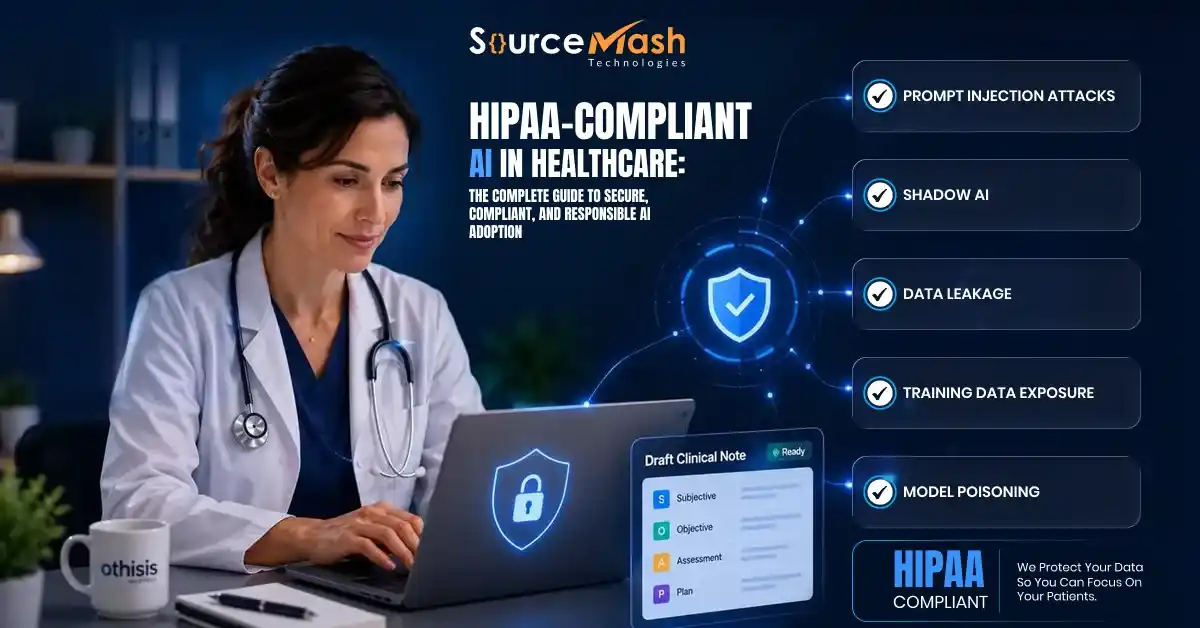
Prompt Injection Attacks
Malicious prompts may manipulate AI behavior and potentially affect information handling.
-
Shadow AI
Employees may use unapproved AI applications outside organizational governance and security controls.
-
Data Leakage
Sensitive information can be exposed through unauthorized AI platforms or insecure data-sharing practices.
-
Training Data Exposure
Improper data management practices may increase the risk of sensitive information being incorporated into AI training environments.
-
Model Poisoning
AI performance may be affected when manipulated or inaccurate data enters the training process.
-
Insecure APIs
Weak API security controls can create pathways for unauthorized access.
-
AI Hallucinations
AI systems may generate inaccurate or misleading information that appears credible and requires human review.
Generative AI and Healthcare Compliance
Generative AI is being used across healthcare for:
- Clinical documentation
- Patient communications
- Knowledge management
- Research support
- Administrative automation
- Operational assistance
Best Practices for Using Generative AI
Organizations should:
- Determine whether the solution interacts with ePHI
- Review vendor security and privacy practices
- Implement appropriate safeguards
- Execute BAAs when required
- Restrict access permissions
- Develop AI governance policies
- Require human review of AI-generated content
Practices to Avoid
Organizations should avoid:
- Uploading patient records to unauthorized platforms
- Using public AI tools with identifiable patient data
- Implementing AI without security review
- Allowing unapproved AI applications
- Assuming vendor compliance without verification
HIPAA Security Requirements for AI Systems
Healthcare organizations must apply HIPAA safeguards to AI environments.
-
Administrative Safeguards
Organizations should maintain:
- Risk assessments
- Security policies and procedures
- Workforce training programs
- Incident response plans
- Vendor management processes
-
Physical Safeguards
Organizations should implement:
- Facility access controls
- Device protection procedures
- Workstation security measures
- Asset management controls
-
Technical Safeguards
Organizations should deploy:
- Multi-factor authentication (MFA)
- Role-Based Access Control (RBAC)
- Encryption
- Audit logging
- Secure transmission methods
- Continuous monitoring
How to Evaluate AI Vendors
Vendor due diligence should be part of every AI implementation project.
Before selecting an AI vendor, ask:
- Will you sign a Business Associate Agreement (BAA)?
- How do you protect ePHI?
- Where is customer data stored?
- Is customer data used for model training?
- What encryption standards are used?
- What audit logging capabilities are available?
- What security certifications do you maintain?
- What is your incident response process?
- Do you use subcontractors?
- How is data retained and deleted?
- How frequently do you conduct security assessments?
Essential Security Controls for Healthcare AI
-
Identity and Access Management
Recommended controls include:
- MFA
- RBAC
- Single Sign-On (SSO)
- Least-privilege access
- Privileged account monitoring
-
Encryption
Organizations should encrypt:
- EHR data
- AI datasets
- Backups
- Cloud storage
- Email communications
- Data transmissions
-
Continuous Monitoring
Effective monitoring should include:
- Security Information and Event Management (SIEM)
- Endpoint Detection and Response (EDR)
- Security Operations Center (SOC) monitoring
- Audit logging
- Threat detection processes
Why Human Oversight Remains Critical
AI can improve operational efficiency, but it should not replace professional judgment.
Human review helps:
- Detect errors
- Identify hallucinations
- Validate recommendations
- Ensure compliance requirements are met
- Reduce patient safety risks
Healthcare professionals should review AI-generated outputs before relying on them for clinical, financial, or compliance-related activities.
Building an Effective AI Governance Program
Security alone is not enough. Organizations also need governance to ensure AI is used responsibly and consistently.
A strong AI governance framework should include:
- Approved AI use cases
- Data minimization requirements
- Human oversight procedures
- Prompt security guidelines
- Output validation processes
- Bias identification practices
- Accuracy testing requirements
- Compliance documentation procedures
- Shadow AI management policies
- Clearly defined responsibilities and accountability
Effective governance reduces compliance risks and promotes responsible AI adoption.
A 7-Step Framework for HIPAA-Compliant AI Adoption
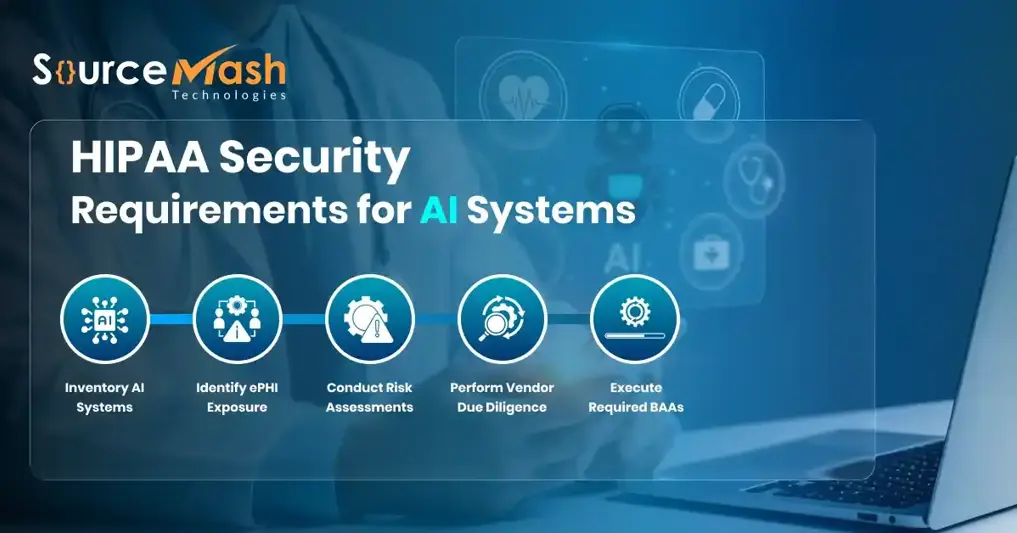
Step 1: Inventory AI Systems
Document all internally developed and third-party AI tools.
Step 2: Identify ePHI Exposure
Determine whether AI systems access, process, store, or transmit ePHI.
Step 3: Conduct Risk Assessments
Evaluate privacy, security, operational, and compliance risks.
Step 4: Perform Vendor Due Diligence
Review vendor security, privacy, compliance, and data management practices.
Step 5: Execute Required BAAs
Ensure contractual protections are established when vendors handle ePHI.
Step 6: Implement Security Controls
Deploy:
- MFA
- RBAC
- Encryption
- Audit logging
- Endpoint protection
- Monitoring solutions
Step 7: Establish Governance and Oversight
Develop policies, roles, accountability mechanisms, and ongoing compliance programs.
Why AI Risk Management Is an Ongoing Process
AI adoption is not a one-time project. Risks evolve as technologies, regulations, vendors, and organizational needs change.
Organizations should:
- Conduct periodic risk assessments
- Review user access regularly
- Monitor AI systems continuously
- Reassess vendors after significant changes
- Update policies and controls as needed
Continuous oversight helps maintain security, compliance, and patient trust.
Common AI and HIPAA Compliance Mistakes
Organizations should avoid:
- Using public AI tools with patient information
- Skipping vendor due diligence
- Granting excessive user permissions
- Failing to monitor AI environments
- Providing insufficient employee training
- Operating without an AI governance framework
Avoiding these mistakes significantly reduces compliance and cybersecurity risks.
HIPAA Compliance Checklist for AI Environments
✅ AI inventory completed
✅ ePHI exposure identified
✅ Risk assessments performed
✅ MFA implemented
✅ RBAC enforced
✅ Encryption enabled
✅ Vendors reviewed
✅ BAAs executed where required
✅ Audit logging enabled
✅ Continuous monitoring established
✅ Endpoint protection deployed
✅ Incident response plans maintained
✅ Employee training conducted
✅ AI governance policies implemented
✅ Least-privilege access enforced
✅ Data retention rules established
✅ Shadow AI risks addressed
✅ Compliance documentation maintained
✅ Periodic reviews scheduled
Frequently Asked Questions
Is AI HIPAA Compliant?
AI itself is not HIPAA compliant. Compliance depends on implementation, security controls, governance, and ongoing oversight.
Can Generative AI Be Used in Healthcare?
Yes. Generative AI can be used in healthcare when appropriate safeguards protect ePHI and support compliance requirements.
What Is Shadow AI?
Shadow AI is the unauthorized use of AI applications without organizational approval, security review, or governance.
Do AI Vendors Need a BAA?
In most cases, yes, when they create, receive, maintain, process, store, or transmit ePHI on behalf of a covered entity or business associate.
What Are the Biggest AI Security Risks in Healthcare?
Common risks include data leakage, prompt injection, unauthorized access, shadow AI, insecure APIs, vendor weaknesses, and AI hallucinations.
How Often Should AI Risk Assessments Be Conducted?
At least annually and whenever significant operational, technological, or regulatory changes occur.
Conclusion
AI has the potential to improve patient care, streamline operations, enhance clinician productivity, and drive innovation across healthcare. However, successful implementation requires more than deploying advanced technology.
Healthcare organizations must combine cybersecurity, privacy protection, vendor oversight, governance, risk management, and human accountability throughout the AI lifecycle.
The key takeaway is simple: AI is not automatically HIPAA compliant. Compliance depends on how organizations secure, manage, monitor, and govern AI systems. Organizations that establish strong security controls, effective governance, and ongoing risk management practices will be best positioned to scale AI responsibly while maintaining patient trust and regulatory compliance.