Introduction
Product engineering is evolving rapidly as businesses face increasing pressure to accelerate innovation, reduce development costs, improve product quality, and meet growing customer expectations. Traditional engineering approaches often struggle to keep pace with modern requirements due to complex development processes, lengthy testing cycles, and continuously changing market demands.
Artificial Intelligence (AI) is transforming this landscape by helping organizations make better decisions, automate repetitive tasks, optimize product performance, and streamline development workflows. Rather than replacing engineers, AI serves as a powerful enabler that allows teams to focus on innovation, creativity, and strategic problem-solving.
From product ideation and design to testing, deployment, and maintenance, AI is becoming an integral part of modern product engineering. Organizations that embrace AI-driven engineering can deliver smarter products, accelerate development timelines, and gain a stronger competitive advantage.
How Does AI Revolutionize Product Engineering?
AI revolutionizes product engineering by introducing intelligence, automation, and predictive capabilities into every stage of product development.
Instead of relying solely on manual processes and historical assumptions, engineering teams can use AI to analyze data, uncover patterns, predict outcomes, and optimize decisions in real time.
AI helps organizations:
- Improve engineering efficiency
- Enhance design accuracy
- Strengthen testing effectiveness
- Predict failures before they occur
- Optimize operational performance
- Deliver better customer experiences
- Adapt products based on real-world usage data
As a result, organizations can develop high-quality products more efficiently while minimizing risks and maximizing innovation.
What Is AI in Product Engineering?
AI in product engineering refers to the application of artificial intelligence technologies throughout the product lifecycle to improve efficiency, innovation, accuracy, and product performance.
These technologies include:
- Machine Learning (ML)
- Generative AI
- Natural Language Processing (NLP)
- Computer Vision
- Predictive Analytics
- Deep Learning
- Digital Twins
By leveraging these technologies, engineering teams can automate routine tasks, gain actionable insights, improve decision-making, and continuously enhance products throughout their lifecycle.
Why AI Is Becoming Essential in Product Engineering
The expectations placed on modern engineering teams continue to increase.
Organizations must:
- Launch products faster
- Deliver seamless user experiences
- Respond quickly to market changes
- Maintain product quality
- Control development costs
Meeting these goals through traditional methods alone can be challenging.
AI addresses these challenges by helping teams:
- Make data-driven decisions
- Improve engineering efficiency
- Reduce manual workloads
- Identify risks earlier
- Support continuous innovation
As products become more intelligent and connected, AI is becoming a critical capability for successful product engineering.
Common Product Engineering Challenges AI Helps Solve
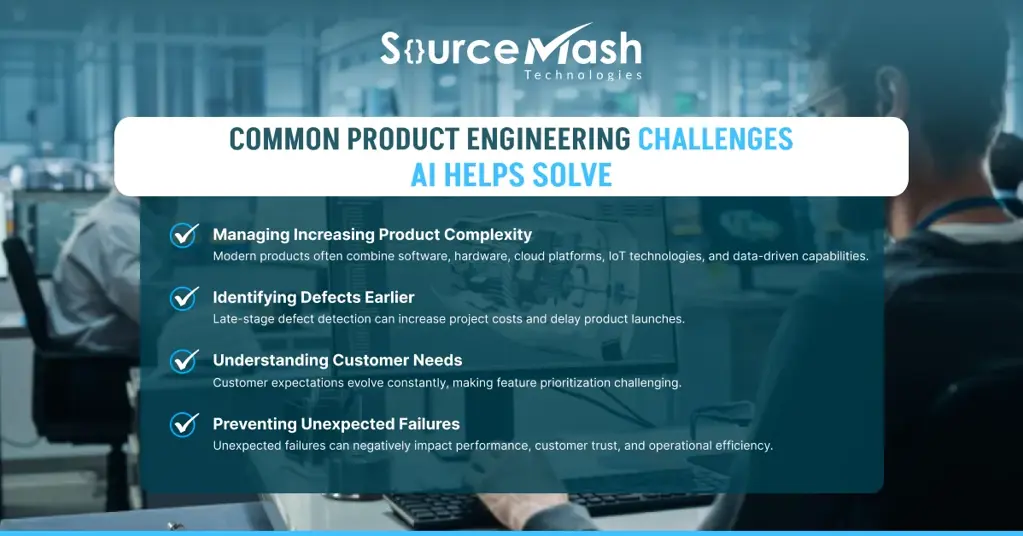
Managing Increasing Product Complexity
Modern products often combine software, hardware, cloud platforms, IoT technologies, and data-driven capabilities.
How AI Helps
AI analyzes large volumes of engineering and operational data to uncover patterns, dependencies, and opportunities for optimization.
Result
Improved engineering visibility and more informed decision-making.
Identifying Defects Earlier
Late-stage defect detection can increase project costs and delay product launches.
How AI Helps
AI-powered testing and analytics identify issues earlier in the development process.
Result
Reduced rework and improved product quality.
Understanding Customer Needs
Customer expectations evolve constantly, making feature prioritization challenging.
How AI Helps
AI analyzes customer feedback, behavior patterns, and usage data to uncover actionable insights.
Result
Products that align more closely with market demands and user preferences.
Preventing Unexpected Failures
Unexpected failures can negatively impact performance, customer trust, and operational efficiency.
How AI Helps
Predictive analytics identifies warning signs and potential issues before they become critical problems.
Result
Improved reliability and operational stability.
AI Across the Product Engineering Lifecycle
Product Ideation and Research
AI helps organizations evaluate opportunities and identify emerging market needs.
Applications
- Market analysis
- Customer sentiment analysis
- Demand forecasting
- Competitive research
- Feature prioritization
Business Value
Organizations can make informed product decisions based on real-world data.
Product Design and Engineering
AI-powered design tools help engineers evaluate and optimize concepts more effectively.
Applications
- Generative design
- Design validation
- Simulation modeling
- Material recommendations
- Performance optimization
Business Value
Faster exploration of design alternatives and improved product performance.
Product Development
AI supports engineering teams throughout the development process.
Applications
- Intelligent code suggestions
- Documentation assistance
- Bug identification
- Code quality analysis
- Workflow optimization
Business Value
Improved productivity and greater focus on innovation-driven activities.
Testing and Quality Assurance
AI enhances software and product validation processes.
Applications
- Automated test generation
- Defect analysis
- Test optimization
- Regression testing
- Performance evaluation
Business Value
More comprehensive testing with improved accuracy and consistency.
Deployment and Operations
AI provides visibility into product and infrastructure performance after release.
Applications
- Performance monitoring
- Resource optimization
- Anomaly detection
- Incident management
- Operational analytics
Business Value
Improved stability and faster issue resolution.
Continuous Improvement and Maintenance
AI enables organizations to continuously enhance products after launch.
Applications
- User behavior analysis
- Predictive maintenance
- Product enhancement recommendations
- Customer usage analysis
- Performance optimization
Business Value
Long-term product relevance and sustainable customer satisfaction.
AI-Powered Product Engineering vs Traditional Product Engineering
| Traditional Product Engineering | AI-Powered Product Engineering |
|---|---|
| Manual data analysis | Intelligent data analysis |
| Rule-based decisions | Predictive decision support |
| Reactive issue resolution | Proactive issue detection |
| Static workflows | Adaptive workflows |
| Limited operational insights | Continuous visibility |
| Manual optimization | Data-driven optimization |
Organizations adopting AI can create more agile, efficient, and scalable engineering ecosystems.
The Impact of Generative AI on Product Engineering
Generative AI represents one of the most transformative developments in modern engineering. Unlike traditional AI systems that primarily analyze information, Generative AI can create new outputs based on requirements, data, and contextual inputs.
Accelerating Product Design
Generative AI enables engineers to explore multiple design alternatives automatically.
Advantages
- Faster concept generation
- Increased innovation opportunities
- Improved design exploration
Enhancing Engineering Documentation
Documentation is critical for knowledge sharing and project execution.
Advantages
Generative AI can assist with:
- Technical documentation
- Requirement summaries
- Product specifications
- Internal knowledge resources
This improves collaboration and documentation consistency.
Supporting Software Engineering
Generative AI acts as an intelligent development assistant.
Advantages
- Coding assistance
- Technical explanations
- Testing support
- Development recommendations
This allows engineers to focus on solving complex business and technical challenges.
Core Technologies Driving AI-Powered Product Engineering
Machine Learning (ML)
Machine Learning enables systems to learn patterns and improve outcomes over time.
Common Uses
- Product optimization
- Forecasting
- Maintenance planning
- Risk assessment
Natural Language Processing (NLP)
NLP helps systems understand and process human language.
Common Uses
- Customer feedback analysis
- Virtual assistants
- Documentation search
- Knowledge management
Computer Vision
Computer Vision enables visual analysis and interpretation.
Common Uses
- Quality inspections
- Defect detection
- Manufacturing automation
- Image analysis
Predictive Analytics
Predictive analytics helps forecast future outcomes.
Common Uses
- Failure prediction
- Capacity planning
- Performance forecasting
- Risk identification
Digital Twins
Digital twins create virtual models of physical products and systems.
Common Uses
- Product simulation
- Design validation
- Lifecycle management
- Performance monitoring
Industry Applications of AI in Product Engineering
Software and SaaS Products
Applications
- Development assistance
- Test automation
- Security monitoring
- Performance optimization
Manufacturing Products
Applications
- Automated inspections
- Production analytics
- Process optimization
- Equipment monitoring
Healthcare Products
Applications
- Smart medical devices
- Healthcare applications
- Monitoring systems
- Diagnostic solutions
Automotive Products
Applications
- Driver assistance systems
- Intelligent diagnostics
- Connected vehicle platforms
- Autonomous technologies
Consumer Electronics
Applications
- Smart assistants
- Connected devices
- Wearable technology
- Personalized user experiences
Benefits of AI for Different Stakeholders
For Product Managers
- Better roadmap planning
- Improved prioritization
- Enhanced customer visibility
For Engineering Teams
- Reduced manual effort
- Improved productivity
- Better collaboration
For Business Leaders
- Improved operational efficiency
- Stronger innovation capabilities
- Better resource utilization
For Customers
- More reliable products
- Improved experiences
- Personalized functionality
Real-World Example of AI in Product Engineering
Business Challenge
A growing software company wanted to improve engineering efficiency while maintaining product reliability and user satisfaction.
AI-Based Approach
The organization implemented:
- AI-assisted development tools
- Intelligent testing solutions
- Product analytics platforms
- Proactive monitoring systems
Outcomes
The company improved development workflows, strengthened product quality, increased operational visibility, and enhanced customer experiences.
How to Successfully Implement AI in Product Engineering
Step 1: Assess Existing Engineering Processes
Identify areas where AI can provide measurable improvements.
Step 2: Define Business Objectives
Align AI initiatives with strategic goals and performance outcomes.
Step 3: Establish a Strong Data Foundation
Ensure data quality, accessibility, and governance practices are in place.
Step 4: Select Appropriate AI Solutions
Choose technologies that support both engineering requirements and business priorities.
Step 5: Start with Focused Use Cases
Begin with specific initiatives that can demonstrate value quickly.
Step 6: Measure and Refine
Continuously evaluate outcomes and optimize implementation strategies.
Business Value and ROI of AI in Product Engineering
Improved Engineering Efficiency
AI helps streamline workflows and reduce routine manual activities.
Better Product Outcomes
Organizations can enhance product performance, reliability, and usability.
Stronger Innovation Capabilities
Engineering teams gain more capacity to focus on strategic initiatives.
Enhanced Decision-Making
Leaders can leverage data-driven insights to support planning and execution.
Long-Term Competitive Advantage
Organizations can adapt faster to changing market conditions and customer expectations.
Why Partner with Sourcemash Technologies for AI-Powered Product Engineering?
Implementing AI in product engineering requires the right expertise and strategy. Sourcemash Technologies helps businesses leverage AI-powered product engineering solutions to develop smarter, scalable, and future-ready products.
Organizations looking to accelerate innovation and build smarter digital products can partner with Sourcemash Technologies to streamline development, improve product quality, and bring new solutions to market faster.
How Sourcemash Technologies Can Help
- AI-powered product engineering consulting
- Product design and development support
- Generative AI integration
- Intelligent testing and quality assurance
- Product modernization
- Data-driven engineering insights
- Continuous product optimization and support
Why Choose Sourcemash Technologies?
- Expertise in modern product engineering
- Innovation-focused approach
- Scalable and future-ready solutions
- Faster implementation and delivery
- Focus on quality and business outcomes
Future Trends Shaping AI-Driven Product Engineering
AI Engineering Copilots
Intelligent assistants that support development and engineering activities.
Autonomous Development Workflows
Systems that automate complex engineering processes.
Agentic AI Systems
AI capable of executing tasks and achieving predefined objectives.
Advanced Digital Twins
More sophisticated virtual product simulations and monitoring capabilities.
Hyperautomation Initiatives
Expanded automation across engineering and operational functions.
Self-Optimizing Products
Products capable of improving their own performance through data analysis.
Predictive Lifecycle Management
Proactive optimization throughout a product's lifecycle.
Embedded AI Capabilities
AI integrated directly into products to enhance functionality and user experiences.
Conclusion
AI is revolutionizing product engineering by introducing intelligence, automation, and predictive capabilities across the entire product lifecycle. From market research and design optimization to testing, deployment, and continuous improvement, AI enables organizations to build better products while improving efficiency and decision-making.
As product complexity grows and customer expectations continue to evolve, AI is becoming an essential component of modern product engineering strategies. Organizations that embrace AI-powered engineering today will be better positioned to innovate faster, deliver superior products, and maintain a sustainable competitive advantage.
Frequently Asked Questions (FAQs)
What is AI in product engineering?
AI in product engineering refers to the use of artificial intelligence technologies to improve product design, development, testing, deployment, and maintenance.
How does AI help product engineering teams?
AI helps teams automate tasks, analyze data, optimize workflows, improve decision-making, and enhance product performance.
What role does Generative AI play in product engineering?
Generative AI supports design exploration, documentation creation, development assistance, and engineering knowledge management.
How does AI improve product quality?
AI helps identify issues earlier, supports testing processes, monitors performance, and enables continuous product optimization.
Which industries benefit most from AI-powered product engineering?
Software, manufacturing, healthcare, automotive, and consumer electronics are among the industries benefiting significantly from AI-driven engineering.
What is a digital twin in product engineering?
A digital twin is a virtual representation of a physical product or system used for simulation, monitoring, validation, and optimization.
Can small and mid-sized businesses use AI in product engineering?
Yes. Businesses of all sizes can adopt AI through focused use cases and scalable implementation strategies.
What are the biggest challenges when implementing AI?
Common challenges include data quality, integration complexity, governance requirements, skills gaps, and organizational change management.
What is the difference between AI and automation?
Automation follows predefined rules, whereas AI can analyze data, learn patterns, and support intelligent decision-making.
What is the future of AI in product engineering?
The future includes AI copilots, autonomous workflows, advanced digital twins, predictive lifecycle management, and increasingly intelligent products.