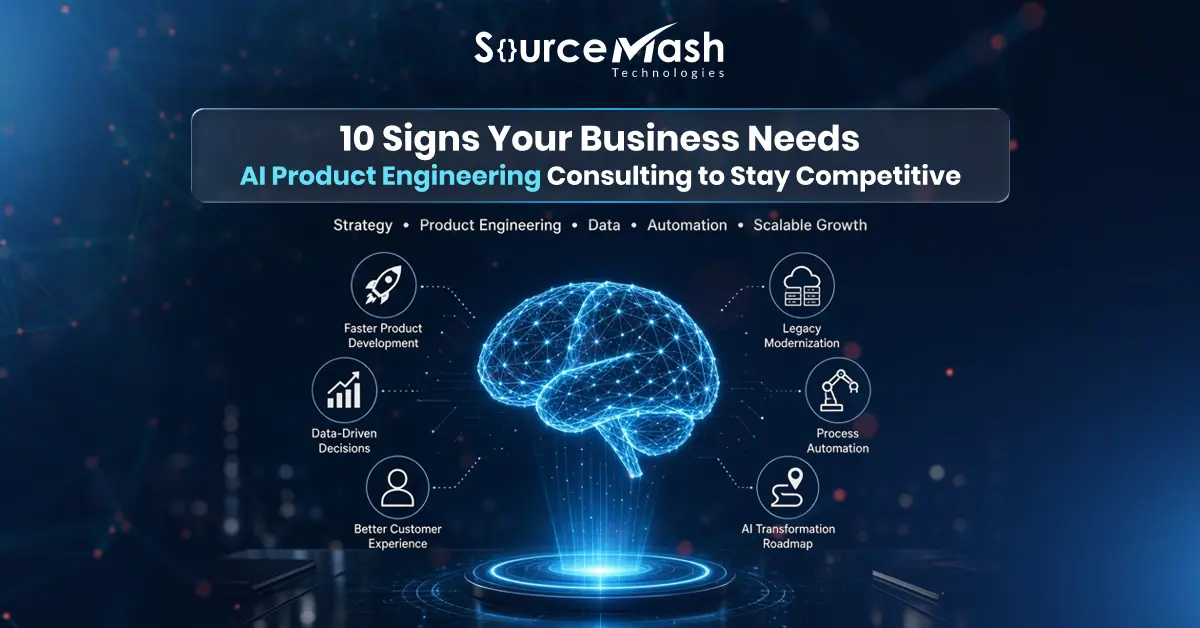
Artificial Intelligence (AI) is transforming how organizations build products, optimize operations, improve customer experiences, and drive innovation. However, implementing AI successfully requires more than adopting new technologies. Businesses need the right strategy, product engineering expertise, data infrastructure, and implementation roadmap to achieve meaningful results.
Many organizations invest in AI initiatives but struggle to identify where AI can create the most value or how to move from experimentation to real business outcomes. This is where AI product engineering consulting becomes valuable.
If your organization is experiencing growth challenges, operational inefficiencies, technology limitations, or increasing competitive pressure, the following signs can help you determine whether an AI Digital Product Engineering Consultant is the right next step.
How Do You Know If Your Business Needs AI Product Engineering Consulting?
Your business may benefit from AI product engineering consulting if you are facing slow product development, underutilized business data, outdated technology systems, inefficient manual processes, limited AI expertise, scalability challenges, or a lack of a clear AI strategy.
AI product engineering consultants help organizations identify AI opportunities, modernize digital products, optimize operations, and implement scalable solutions that align with business objectives.
What Is AI Product Engineering Consulting?
AI product engineering consulting is the process of designing, developing, implementing, and optimizing AI-powered products, applications, and business solutions.
It combines multiple disciplines, including Artificial Intelligence (AI), Machine Learning (ML), Product Engineering, Data Engineering, Cloud Technologies, Software Development, and Business Process Optimization.
The goal is not simply to adopt AI technologies but to solve business problems, improve efficiency, enhance user experiences, and create measurable business value.
Unlike traditional technology consulting, AI product engineering consulting focuses on turning ideas into scalable products that deliver long-term business outcomes.
Why AI Has Become a Business Priority
Business leaders today face increasing pressure to innovate faster, improve customer experiences, reduce operational costs, and make better decisions.
At the same time, organizations are managing growing volumes of data, evolving customer expectations, competitive market pressures, digital transformation initiatives, and resource constraints.
AI helps organizations address these challenges through intelligent automation, predictive analytics, personalization, and data-driven decision-making. However, without the right expertise and implementation strategy, AI projects often fail to deliver their expected value.
1. Product Development Is Slower Than Market Expectations
Speed to market has become a critical success factor in today's digital economy.
If your organization consistently struggles to launch products, features, or updates on schedule, it may indicate inefficiencies within your development processes.
Common Indicators
- Delayed product releases
- Long development cycles
- Growing feature backlogs
- Bottlenecks across teams
- Slow deployment processes
Why This Happens
Many organizations rely on outdated development practices, fragmented workflows, or legacy systems that reduce productivity.
How AI Product Engineering Consulting Helps
Consultants can evaluate existing product development processes and identify opportunities to improve efficiency through automation, AI-assisted development tools, intelligent testing frameworks, and modern engineering practices.
Business Impact
Faster product delivery improves responsiveness to customer needs and helps maintain a competitive advantage.
2. Your Business Data Isn't Driving Better Decisions
Organizations generate significant amounts of data every day, yet many struggle to convert that information into actionable insights.
Common Indicators
- Reporting delays
- Inconsistent data sources
- Limited forecasting capabilities
- Difficulty identifying trends
- Reactive decision-making
Why This Happens
Business data often exists across disconnected systems, making it difficult to access, analyze, and utilize effectively.
How AI Product Engineering Consulting Helps
Consultants can develop data strategies, analytics frameworks, and AI models that transform raw data into valuable business intelligence.
Business Impact
Better insights support informed decision-making, improved forecasting, and stronger business performance.
3. Customer Experiences Are Falling Behind Expectations
Customer expectations continue to evolve as digital experiences become more personalized and responsive.
Organizations that fail to meet these expectations often experience declining engagement and customer retention.
Common Indicators
- Reduced customer satisfaction
- Low engagement rates
- Increased support requests
- Poor user experience feedback
- Falling retention rates
Why This Happens
Customer expectations often evolve faster than existing products and service models.
How AI Product Engineering Consulting Helps
AI-powered capabilities such as recommendation engines, virtual assistants, intelligent search, and customer behavior analysis can significantly improve user experiences.
Business Impact
Better customer experiences often lead to stronger loyalty, increased engagement, and higher customer lifetime value.
4. Legacy Technology Is Limiting Business Growth
Technology should support business growth, not slow it down.
Outdated systems often create operational inefficiencies and prevent organizations from adopting modern capabilities.
Common Indicators
- High maintenance costs
- System performance issues
- Integration challenges
- Limited scalability
- Frequent operational disruptions
Why This Happens
Legacy applications are often not designed to support modern digital products, cloud platforms, or AI-driven solutions.
How AI Product Engineering Consulting Helps
Consultants assess existing systems and create modernization strategies that improve agility, scalability, and future readiness.
Business Impact
Modernized infrastructure enables faster innovation and supports long-term business growth.
5. Manual Processes Are Reducing Efficiency
Repetitive and labor-intensive processes can consume valuable resources and limit productivity.
Common Indicators
- Excessive administrative work
- Repeated manual data entry
- Slow process execution
- Resource-intensive workflows
- Frequent operational bottlenecks
Why This Happens
Many operational workflows evolve over time without continuous process optimization.
How AI Product Engineering Consulting Helps
AI-powered automation can streamline routine tasks, improve accuracy, and reduce dependency on manual processes.
Business Impact
Increased efficiency helps organizations lower costs and focus resources on strategic initiatives.
6. Your Team Lacks AI and Product Engineering Expertise
Successful AI implementation requires specialized expertise that many organizations may not possess internally.
Common Indicators
- Difficulty recruiting AI talent
- Limited machine learning knowledge
- Lack of data engineering expertise
- Insufficient AI leadership
- Skills gaps within teams
Why This Happens
AI development involves multiple specialized disciplines that can be difficult and expensive to build internally.
How AI Product Engineering Consulting Helps
Consultants provide access to experienced professionals across AI strategy, machine learning, data engineering, cloud architecture, and product development.
Business Impact
Organizations can accelerate implementation while minimizing technical risks.
7. AI Projects Struggle to Deliver Measurable Results
Many organizations successfully launch AI pilots but fail to achieve meaningful business outcomes.
Common Indicators
- Limited return from AI projects
- Low user adoption
- Unclear success metrics
- Difficulty scaling pilot projects
- Challenges demonstrating business value
Why This Happens
AI initiatives often begin without well-defined objectives, governance frameworks, or performance measurements.
How AI Product Engineering Consulting Helps
Consultants align AI initiatives with measurable business goals and establish frameworks to evaluate performance.
Business Impact
Organizations improve project success rates and maximize return on AI investments.
8. Scaling Products and Operations Has Become Difficult
Growth introduces complexity that many existing systems and processes are unable to support effectively.
Common Indicators
- Performance bottlenecks
- Infrastructure limitations
- Increased operational complexity
- Service reliability issues
- Challenges supporting higher demand
Why This Happens
Many systems are designed to meet current needs rather than future growth requirements.
How AI Product Engineering Consulting Helps
Consultants build scalable architectures and optimize operational processes to support business expansion.
Business Impact
Organizations can grow confidently without sacrificing reliability or performance.
9. Competitors Are Delivering More Intelligent Digital Experiences
When competitors consistently introduce smarter products and services, organizations risk losing market relevance.
Common Indicators
- Reduced market differentiation
- Competitors launching AI-powered features
- Slower innovation cycles
- Lower customer engagement
- Declining competitive position
Why This Happens
Businesses that delay AI adoption often struggle to keep pace with industry innovation.
How AI Product Engineering Consulting Helps
Consultants identify opportunities where AI can improve products, services, and customer experiences.
Business Impact
Organizations strengthen their market position and remain competitive in rapidly changing industries.
10. You Don't Have a Long-Term AI Transformation Roadmap
Many businesses invest in AI projects without a clear vision for how AI will support future business growth.
Common Indicators
- Undefined AI objectives
- Disconnected technology initiatives
- Lack of governance frameworks
- Unclear investment priorities
- Inconsistent implementation efforts
Why This Happens
AI initiatives are often approached as isolated projects rather than part of a broader transformation strategy.
How AI Product Engineering Consulting Helps
Consultants develop comprehensive AI roadmaps that align technology investments with long-term business goals.
Business Impact
A well-defined strategy helps ensure sustainable and measurable business outcomes.
Common AI Product Engineering Use Cases
Customer Experience
- AI chatbots
- Virtual assistants
- Recommendation engines
- Customer sentiment analysis
Operations
- Workflow automation
- Intelligent document processing
- Resource optimization
- Operational efficiency improvements
Data and Analytics
- Predictive analytics
- Demand forecasting
- Business intelligence
- Real-time reporting
Security and Risk Management
- Fraud detection
- Threat monitoring
- Compliance automation
- Risk assessment
Product Innovation
- AI-powered applications
- Intelligent SaaS platforms
- Smart enterprise software
- Predictive maintenance solutions
Why Businesses Partner With AI Product Engineering Consultants
Faster Implementation
Experienced consultants help businesses move from planning to execution efficiently.
Reduced Risk
Expert guidance minimizes implementation challenges and costly mistakes.
Access to Specialized Expertise
Organizations gain immediate access to experienced AI and engineering professionals.
Scalable Solution Design
Solutions are built to support future business growth and changing requirements.
Better Resource Utilization
Teams can focus on core business priorities while consultants handle specialized implementation tasks.
Stronger Governance
Consultants help establish responsible AI practices, security controls, and governance frameworks.
How to Get Started With AI Product Engineering Consulting
Step 1: Identify Business Challenges
Evaluate operational inefficiencies, customer experience gaps, and product limitations.
Step 2: Assess Data Readiness
Understand whether your data infrastructure can support AI initiatives.
Step 3: Prioritize High-Value Opportunities
Focus on use cases that can generate measurable business value.
Step 4: Develop an AI Roadmap
Create a phased implementation strategy aligned with organizational goals using Google's AI roadmap guidance to assess organizational readiness and build AI capabilities.
Step 5: Build, Test, and Scale
Deploy solutions, measure results, and optimize continuously.
Frequently Asked Questions
What is AI product engineering consulting?
AI product engineering consulting helps organizations design, develop, implement, and optimize AI-powered products and solutions that align with business objectives.
When should a business hire an AI product engineering consultant?
Businesses should consider consulting support when dealing with slow product development, operational inefficiencies, outdated systems, limited AI expertise, scalability challenges, or unclear AI strategies.
How does AI product engineering improve business performance?
AI helps automate processes, improve decision-making, enhance customer experiences, reduce costs, and accelerate innovation.
Which industries benefit from AI product engineering consulting?
Healthcare, finance, retail, manufacturing, logistics, technology, and many other industries can benefit from AI-powered solutions.
Can small and mid-sized businesses benefit from AI consulting?
Yes. Businesses of all sizes can leverage AI to improve efficiency, streamline operations, and support sustainable growth.
Conclusion
AI is no longer just a technology trend. It has become a key business enabler that supports innovation, efficiency, customer satisfaction, and long-term growth.
If your business is experiencing slow product development, inefficient operations, underutilized data, technology limitations, skills gaps, scalability challenges, or a lack of strategic direction, these may be strong indicators that AI product engineering consulting is needed.
By addressing these challenges with the right expertise and implementation strategy, organizations can unlock the full value of AI, improve business performance, and build a sustainable competitive advantage.