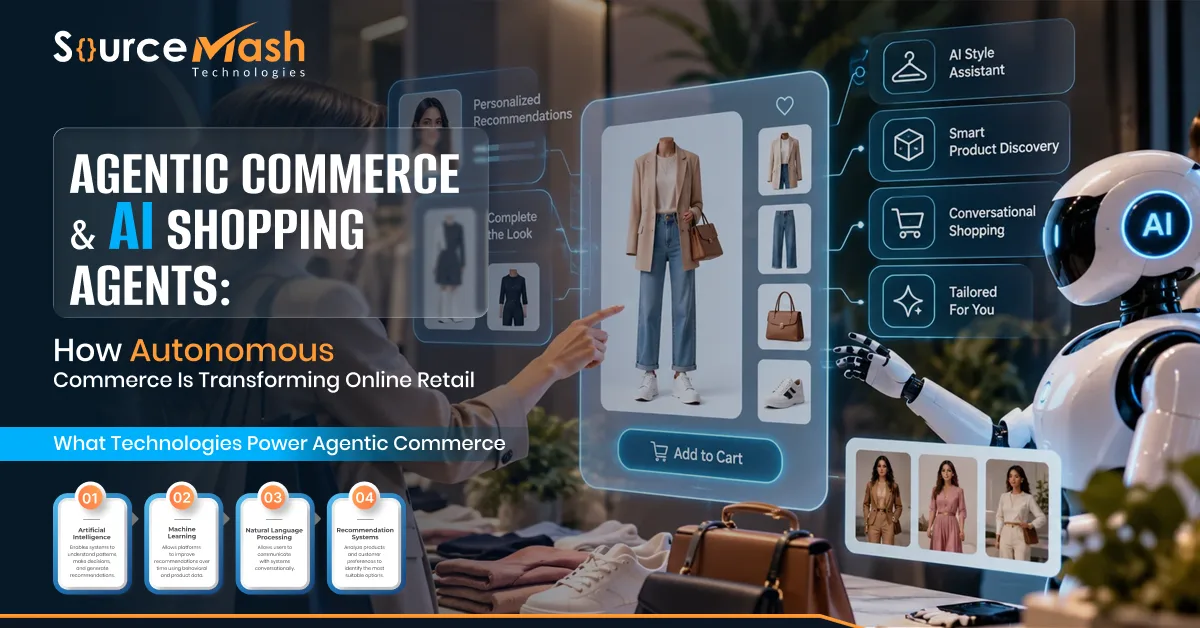
Agentic Commerce uses AI shopping agents to help consumers find, evaluate, compare, and choose products based on their specific needs. Instead of manually researching hundreds of options, buyers receive intelligent recommendations that simplify decision-making and improve purchasing confidence.
What Is Agentic Commerce?
Agentic Commerce is an AI-driven commerce model where intelligent shopping agents help consumers identify, evaluate, compare, and select products based on their goals, preferences, budget, and specific requirements.
Rather than manually searching through hundreds of products, comparing specifications, and reading countless reviews, shoppers can simply describe what they need in natural language. The AI then performs much of the research, analysis, and evaluation on their behalf.
In simple terms:
- Traditional eCommerce helps customers find products.
- Agentic Commerce helps customers make better purchasing decisions.
This shift represents a major evolution in online retail. Instead of focusing primarily on search and discovery, commerce platforms are increasingly focused on helping users achieve desired outcomes with greater confidence and less effort.
Why Are Businesses and Consumers Shifting Toward Agentic Commerce?
Consumers today have access to more products, services, and information than ever before.
While greater choice is beneficial, it also introduces complexity. Modern shoppers often face:
- Thousands of available product options
- Information overload
- Conflicting reviews and recommendations
- Increasingly complex buying decisions
- Research fatigue
At the same time, advances in artificial intelligence have improved the ability of software systems to understand human intent and provide meaningful guidance.
As consumer expectations evolve, buyers increasingly demand:
- Faster answers
- Personalized recommendations
- Simpler shopping journeys
- Better decision support
- Greater purchasing confidence
Agentic Commerce emerges at the intersection of these rising expectations and advancing AI capabilities.
What Problems Does Agentic Commerce Solve?
The biggest challenge in modern commerce is no longer discovering products. The challenge is determining which product best fits a specific need.
Consider someone purchasing:
- A business laptop
- CRM software
- Running shoes
- Manufacturing equipment
Even after identifying potential options, buyers often spend considerable time validating whether those products truly align with their requirements.
Questions such as:
- Is this the right fit?
- Is there a better alternative?
- Am I getting good value for money?
- Will this meet my long-term needs?
often require extensive research.
Agentic Commerce helps close this gap by guiding customers from intent to recommendation.
Instead of asking:
"What products are available?"
Consumers increasingly ask:
How Do AI Shopping Agents Work?
AI Shopping Agents function as intelligent buying assistants that evaluate options and recommend products based on a shopper's individual goals.
1. Understanding Customer Intent
The process begins by understanding what the customer is trying to achieve.
For example:
"Find a lightweight business laptop under $1,200 with 16GB RAM and all-day battery life."
The AI identifies:
- Budget requirements
- Key features
- Use case
- Performance expectations
- Purchase priorities
2. Gathering Product Information
The AI collects relevant information from sources such as:
- Product catalogs
- Manufacturer websites
- Customer reviews
- Inventory systems
- Pricing databases
- Commerce platforms
This creates a comprehensive view of available options.
3. Evaluating Alternatives
The system analyzes products based on factors including:
- Features
- Specifications
- Pricing
- Availability
- Brand reputation
- Customer feedback
- Overall value
Products that fail to meet the user's requirements are filtered out automatically.
4. Generating Recommendations
The AI presents a shortlist of suitable options and explains:
- Why each recommendation was selected
- Key advantages
- Potential trade-offs
- Alternative considerations
5. Supporting the Purchase Decision
Advanced shopping agents may also assist with:
- Coupon discovery
- Product bundles
- Delivery options
- Subscription recommendations
- Cart optimization
The experience extends beyond product discovery to support the entire purchasing journey.
What Technologies Power Agentic Commerce?
Agentic Commerce combines several advanced technologies to deliver intelligent decision-making capabilities.
Key technologies include:
Artificial Intelligence (AI)
Enables systems to understand patterns, make decisions, and generate recommendations.
Machine Learning (ML)
Allows platforms to improve recommendations over time using behavioral and product data.
Large Language Models (LLMs)
Help AI understand natural language queries and complex customer requirements.
Natural Language Processing (NLP)
Allows users to communicate with systems conversationally.
Recommendation Systems
Analyze products and customer preferences to identify the most suitable options.
Product Knowledge Graphs
Connect products, attributes, categories, and relationships to improve contextual understanding.
Commerce APIs
Provide access to inventory, pricing, logistics, and marketplace information.
Analytics Platforms
Measure user behavior and optimize recommendation outcomes.
Together, these technologies create shopping experiences that are far more intelligent than traditional search-based commerce systems.
What Makes Agentic Commerce Different From Traditional eCommerce?
Traditional eCommerce platforms are designed primarily around product discovery.
The typical customer journey involves:
- Searching for products
- Applying filters
- Comparing specifications
- Reading reviews
- Making independent decisions
The platform's primary goal is to help users find products.
Agentic Commerce follows a different approach.
Customers describe their objectives, and the AI:
- Analyzes relevant options
- Evaluates alternatives
- Assesses trade-offs
- Recommends best-fit solutions
- Assists with decision-making
The Core Difference
Traditional eCommerce optimizes product discovery.
Agentic Commerce optimizes decision quality.
While traditional platforms provide access to information, agentic systems actively help consumers reach better purchasing outcomes.
Real-World Applications of Agentic Commerce
Consumer Electronics
AI shopping agents help buyers evaluate:
- Smartphones
- Laptops
- Tablets
- Accessories
Recommendations are based on actual usage requirements rather than general popularity.
Fashion & Apparel
AI can consider:
- Personal style preferences
- Sizing requirements
- Seasonal needs
- Purchase history
This helps provide more relevant suggestions.
Grocery & Retail
Shopping agents can:
- Track regular purchases
- Recommend replenishment schedules
- Suggest alternatives
- Improve spending efficiency
Travel Planning
AI can evaluate:
- Flights
- Hotels
- Transportation
- Budgets
This enables personalized travel recommendations.
Healthcare & Wellness
Consumers can identify products that best align with their health and wellness objectives.
B2B Procurement
Organizations can use AI to:
- Compare suppliers
- Evaluate proposals
- Analyze pricing
- Review inventory needs
- Improve purchasing efficiency
Why Agentic Commerce Matters for SEO, GEO & AI Discoverability
As AI assistants become increasingly involved in shopping decisions, visibility will depend on more than traditional search rankings.
Businesses must ensure that products can be effectively understood, evaluated, and recommended by AI systems.
Key requirements include:
- Structured product data
- Accurate specifications
- Transparent pricing
- Real-time availability
- Comprehensive descriptions
- Authentic customer reviews
In the future, discoverability through AI assistants may become just as important as visibility in search engines.
Brands that optimize for both human users and AI systems will be better positioned to compete in the evolving commerce landscape.
How to Make Products AI-Agent Friendly
Businesses seeking greater AI visibility should focus on improving product intelligence and accessibility.
Maintain Structured Product Data
Use consistent schemas, attributes, and metadata.
Create Detailed Product Content
Clearly communicate:
- Features
- Benefits
- Technical specifications
- Use cases
Improve Review Quality
Authentic customer feedback provides valuable context for AI-driven evaluation.
Keep Information Updated
Maintain accurate:
- Pricing
- Inventory
- Availability
- Shipping information
Strengthen Trust Signals
Demonstrate credibility through:
- Transparent policies
- Customer testimonials
- Security measures
- Reliable brand information
The easier it is for AI systems to understand a product, the more likely it is to be recommended.
Benefits of Agentic Commerce for Consumers and Businesses
Benefits for Consumers
Agentic Commerce simplifies purchasing by helping consumers:
- Reduce decision fatigue
- Evaluate options faster
- Optimize spending
- Save research time
- Make informed decisions
- Gain confidence before purchasing
Instead of navigating overwhelming choices, shoppers receive guidance tailored to their actual goals.
Benefits for Businesses
Organizations can benefit from:
- Higher conversion rates
- Improved customer experiences
- Increased customer retention
- Better cross-selling opportunities
- Stronger personalization
- Improved understanding of customer intent
Businesses that align with AI-driven buying behavior may gain a significant competitive advantage as commerce continues to evolve.
What Challenges Could Slow Agentic Commerce Adoption?
Despite its potential, successful implementation requires overcoming several challenges.
Data Quality
Poor product data can lead to inaccurate recommendations.
System Integration
AI agents often require access to multiple platforms and databases.
Recommendation Accuracy
Businesses must continuously validate recommendation quality.
Privacy Concerns
Consumer trust depends on responsible handling of personal data.
Bias Management
Recommendations should remain fair, objective, and transparent.
Governance and Compliance
Organizations must ensure AI systems align with legal and ethical standards.
Addressing these challenges is essential for delivering reliable and trustworthy experiences.
How Can Businesses Build Trust in AI Shopping Experiences?
Trust will play a critical role in the adoption of Agentic Commerce.
Organizations should prioritize:
Recommendation Transparency
Clearly explain why products are recommended.
Data Privacy
Protect customer information through secure and responsible practices.
User Control
Allow shoppers to adjust preferences and influence recommendations.
Ethical AI Practices
Ensure fairness and avoid manipulation.
Human Oversight
Maintain appropriate review mechanisms where human judgment remains important.
When users understand how decisions are made, they are more likely to trust and adopt AI-assisted commerce experiences.
What Does the Future of Agentic Commerce Look Like?
Commerce is steadily moving toward greater autonomy.
Emerging developments may include:
- Predictive purchasing
- Automated replenishment
- Continuous preference learning
- Voice-driven buying experiences
- Cross-platform shopping coordination
- Autonomous procurement workflows
- Seamless omnichannel experiences
Future shopping environments may require significantly less searching and considerably more goal-oriented assistance.
Rather than acting as tools, AI shopping agents may increasingly function as trusted purchasing partners.
Frequently Asked Questions
1. What Is Agentic Commerce?
Agentic Commerce is an AI-driven commerce model where intelligent shopping agents help consumers identify, evaluate, compare, and select products based on their goals, preferences, budget, and requirements.
2. How Do AI Shopping Agents Work?
AI shopping agents analyze customer intent, gather product information, evaluate alternatives, and provide personalized recommendations to help users make informed purchasing decisions.
3. What Are the Benefits of Agentic Commerce for Businesses?
Agentic Commerce helps businesses improve customer experiences, increase conversion rates, strengthen personalization, reduce buyer friction, and gain deeper insights into customer preferences and purchasing behavior.
4. How Can Agentic Commerce Improve Customer Decision-Making?
By analyzing products, reviews, pricing, features, and customer preferences, AI shopping agents reduce research time and help consumers make faster and more confident purchasing decisions.
5. Is Agentic Commerce Suitable for B2B Businesses?
Yes. B2B organizations can use Agentic Commerce for supplier evaluation, procurement optimization, product comparisons, vendor selection, and intelligent purchasing workflows.
6. What Technologies Power Agentic Commerce?
Agentic Commerce combines Artificial Intelligence (AI), Machine Learning (ML), Large Language Models (LLMs), Natural Language Processing (NLP), recommendation systems, product knowledge graphs, analytics platforms, and commerce APIs.
7. How Can Businesses Prepare for Agentic Commerce?
Businesses should maintain structured product data, publish detailed product information, collect authentic customer reviews, keep inventory and pricing updated, and optimize product content for AI discoverability.
8. How Can SourceMash Technologies Help Businesses Implement Agentic Commerce?
SourceMash Technologies helps organizations design and implement AI-powered commerce solutions, recommendation systems, conversational AI experiences, data integration strategies, and intelligent decision-support capabilities that enable more personalized and effective shopping experiences.
Conclusion
Agentic Commerce represents the next stage in the evolution of digital commerce, shifting the focus from product discovery to intelligent decision-making.
Instead of spending hours researching products, comparing alternatives, and validating choices, consumers can rely on AI Shopping Agents to identify solutions that best match their goals, preferences, budgets, and requirements.
For businesses, success in this new era will depend not only on search visibility but also on AI discoverability, structured product intelligence, and trustworthiness. As shopping experiences become increasingly autonomous, organizations that make their products AI-ready today will be better prepared for the commerce ecosystem of tomorrow.