Executive Summary
Warehouse operations have evolved from simple storage facilities into strategic fulfillment hubs that directly impact customer satisfaction, profitability, and business growth.
As organizations expand across eCommerce, manufacturing, retail, wholesale distribution, and omnichannel environments, warehouses face increasing pressure to:
- Fulfill orders faster
- Improve inventory accuracy
- Reduce operational costs
- Enhance customer experiences
- Maintain real-time visibility
- Support scalable growth
Many growing businesses still rely on spreadsheets, manual inventory tracking, disconnected systems, and paper-based workflows. While these processes may work at smaller volumes, they often become significant barriers to efficiency and scalability.
Warehouse modernization helps organizations improve operational performance by combining technology, optimized processes, automation, and data-driven decision-making.
In this guide, you'll learn:
- What warehouse modernization means
- Why modernization is critical for growth
- How to create a warehouse modernization strategy
- Why a WMS is the foundation of modernization
- How to choose the right warehouse management software
- Best practices for WMS configuration
- Common modernization mistakes to avoid
- Warehouse modernization ROI considerations
- Key performance metrics to track
- Future trends shaping modern warehouses
Key Takeaways
- Warehouse modernization improves efficiency, visibility, and scalability.
- A Warehouse Management System (WMS) serves as the foundation for modern warehouse operations.
- Inventory accuracy below 95% is often a sign of process limitations.
- Cloud-based WMS platforms typically provide faster deployment and easier scalability.
- Successful modernization requires both technology and process optimization.
- Long-term success depends on employee adoption, data accuracy, and continuous performance measurement.
What Is Warehouse Modernization?
Warehouse modernization is the process of improving warehouse operations through technology, automation, workflow optimization, and data-driven decision-making.
The goal is not simply upgrading software.
The goal is creating a warehouse operation that is:
- Efficient
- Scalable
- Agile
- Customer-focused
- Data-driven
- Future-ready
Modern warehouses commonly leverage:
- Warehouse Management Systems (WMS)
- Barcode scanning
- Mobile warehouse applications
- RFID tracking
- Workflow automation
- Real-time dashboards
- Predictive analytics
- Artificial Intelligence (AI)
These capabilities help improve inventory control, labor productivity, fulfillment accuracy, and operational visibility.
Why Warehouse Modernization Matters
Customer expectations continue to rise.
Today's organizations are expected to support:
- Same-day and next-day fulfillment
- Omnichannel operations
- Real-time inventory availability
- Faster order processing
- Increasing SKU complexity
- Multi-location inventory visibility
As a result, warehouse performance directly influences:
- Revenue growth
- Customer retention
- Brand reputation
- Operational costs
- Competitive advantage
Organizations that delay modernization frequently struggle with:
- Inventory inaccuracies
- Stock-outs
- Excess inventory
- Fulfillment delays
- Rising labor costs
- Poor warehouse visibility
- Decreased customer satisfaction
Modernization provides the operational foundation required to remain competitive in a rapidly changing market.
How to Build a Warehouse Modernization Strategy
Before selecting technology, organizations should create a clear modernization roadmap.
Step 1: Assess Current Warehouse Performance
Establish baseline metrics such as:
- Inventory accuracy
- Order accuracy
- Fulfillment cycle time
- Inventory turnover
- Labor productivity
- Cost per order
Understanding current performance makes future improvements measurable.
Step 2: Identify Operational Bottlenecks
Review warehouse workflows and identify inefficiencies.
Evaluate:
- Receiving
- Putaway
- Picking
- Packing
- Shipping
- Replenishment
- Returns processing
Focus on processes creating delays, errors, or excessive labor costs.
Step 3: Prioritize Improvement Opportunities
Not every process must be modernized immediately.
Prioritize initiatives based on:
- Business impact
- Cost reduction potential
- Customer experience improvements
- Scalability requirements
- Return on investment
Step 4: Select Supporting Technologies
Choose technologies that address identified challenges.
Examples include:
- Warehouse Management Systems
- Mobile barcode solutions
- RFID systems
- Automation technologies
- Analytics platforms
Technology should support business objectives, not define them.
Step 5: Define Success Metrics
Establish KPIs before implementation.
Examples include:
- Inventory accuracy
- Order accuracy
- Labor productivity
- Fill rate
- Fulfillment cycle time
These metrics will help measure modernization success.
7 Signs Your Warehouse Has Outgrown Existing Processes
1. Inventory Accuracy Is Declining
When inventory records frequently differ from physical inventory, warehouse performance suffers.
Warning Signs
- Frequent stock discrepancies
- Unexpected stock-outs
- Excess safety stock
- Large counting variances
2. Employees Spend Too Much Time Searching for Products
Warehouse staff should quickly locate inventory.
Warning Signs
- Increased picking times
- Delayed fulfilment
- Excessive travel times
- Reduced productivity
3. Order Errors Continue to Increase
Fulfillment accuracy is one of the most important warehouse performance indicators.
Warning Signs
- Incorrect shipments
- Customer complaints
- Increased returns
- Re-shipping costs
4. Real-Time Inventory Visibility Doesn't Exist
Managers should instantly know:
- Inventory availability
- Product locations
- Replenishment needs
- Open orders
If this information requires spreadsheets or manual investigation, visibility is insufficient.
5. Labor Costs Keep Rising
Rising labor costs without productivity improvements usually indicate process inefficiencies.
Warning Signs
- Excessive overtime
- Additional staffing requirements
- Repetitive manual activities
- Low operational throughput
6. Warehouse Space Is Becoming Limited
Storage shortages often result from poor inventory placement and slotting rather than actual capacity limitations.
Warning Signs
- Congested storage locations
- Overflow inventory
- Poor space utilization
- Disorganized inventory placement
7. Growth Creates Operational Stress
Many warehouses function well at lower volumes but struggle as demand increases.
Warning Signs
- Order backlogs
- Longer fulfillment times
- Increased operational mistakes
- Difficulty handling peak seasons
Why a WMS Is the Foundation of Warehouse Modernization
Effective WMS implementation and configuration helps organizations improve inventory visibility, optimize warehouse workflows, increase fulfillment efficiency, and build a scalable foundation for automation.
A modern WMS helps organizations:
- Track inventory in real time
- Manage inventory locations
- Improve inventory accuracy
- Optimize warehouse workflows
- Increase fulfillment efficiency
- Improve labor productivity
- Support automation initiatives
- Monitor warehouse performance
Without a WMS, most warehouse modernization efforts eventually reach operational limitations.
Benefits of a Modern Warehouse Management System
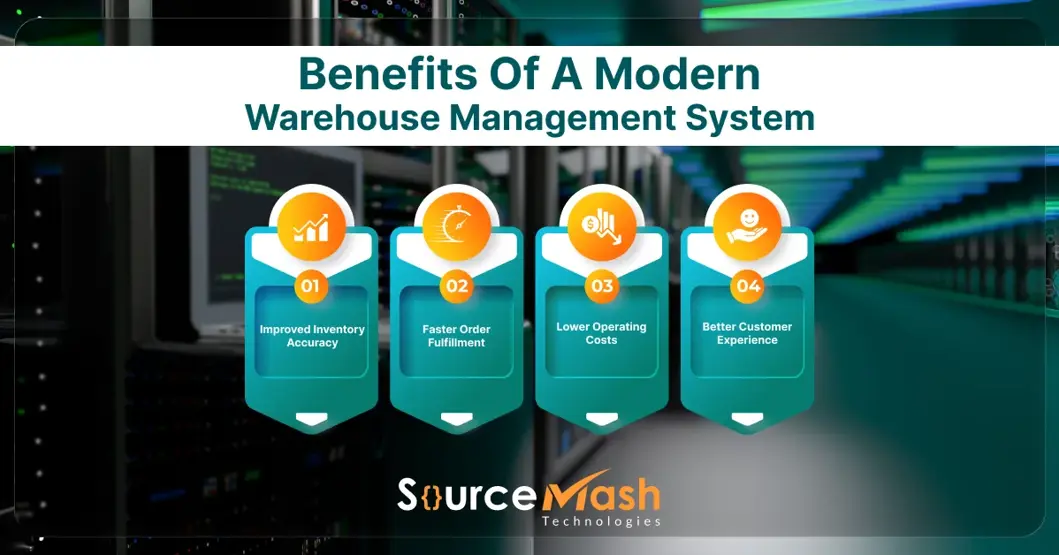
Improved Inventory Accuracy
A WMS provides real-time visibility into inventory movement and inventory locations.
Benefits
- Fewer inventory discrepancies
- Better stock availability
- Reduced inventory carrying costs
- Improved inventory control
Faster Order Fulfillment
A WMS helps manage core warehouse management processes such as receiving, putaway, picking, packing, and shipping.
Supported Activities
- Receiving
- Putaway
- Picking
- Packing
- Shipping
Benefits
- Faster processing times
- Reduced bottlenecks
- Improved throughput
- More consistent execution
Lower Operating Costs
Warehouse efficiency improvements often reduce operating expenses.
Benefits
- Lower labor requirements
- Fewer fulfillment errors
- Reduced overtime
- Better warehouse utilization
Better Customer Experience
Warehouse performance directly influences customer satisfaction.
Benefits
- Faster deliveries
- Higher order accuracy
- Fewer backorders
- Better shipment visibility
Greater Scalability
As order volume grows, a WMS helps maintain operational control.
Benefits
- Multi-warehouse management
- Increased transaction capacity
- Consistent warehouse processes
- Improved visibility across locations
WMS vs ERP vs Inventory Management Software
Understanding the differences between these systems is important during technology evaluation.
| Capability | Inventory Software | ERP | WMS |
|---|---|---|---|
| Inventory Tracking | ✅ | ✅ | ✅ |
| Financial Management | ❌ | ✅ | ❌ |
| Purchasing | Limited | ✅ | Limited |
| Warehouse Location Control | ❌ | Limited | ✅ |
| Advanced Picking | ❌ | Limited | ✅ |
| Labor Management | ❌ | Limited | ✅ |
| Warehouse Analytics | Limited | Limited | ✅ |
Essential WMS Features Every Business Should Evaluate
Inventory Management
Look for:
- Real-time inventory visibility
- Multi-location inventory control
- Cycle counting
- Lot tracking
- Serial tracking
Receiving and Putaway
Key capabilities include:
- ASN management
- Directed putaway
- Quality inspections
- Location validation
Advanced Picking
Support for:
- Wave picking
- Batch picking
- Zone picking
- Cluster picking
Shipping Management
Important functions include:
- Carrier integrations
- Label generation
- Shipment tracking
- Packing optimization
Labor Management
Look for:
- Workforce planning
- Productivity tracking
- Task assignments
- Performance reporting
Analytics and Reporting
A modern WMS should provide:
- KPI dashboards
- Inventory analytics
- Labor analytics
- Operational reporting
Cloud WMS vs On-Premise WMS
Cloud WMS
Advantages
- Lower upfront investment
- Faster implementation
- Automatic updates
- Reduced IT overhead
- Better scalability
Best For
Organizations seeking agile deployment and long-term flexibility.
On-Premise WMS
Advantages
- Greater system control
- Extensive customization options
- Internally managed infrastructure
Best For
Organizations with specific infrastructure or compliance requirements.
For most growing businesses, cloud deployment offers the best balance of cost, scalability, and ease of management.
How to Choose the Right Warehouse Management System
Step 1: Define Business Requirements
Document:
- Order volume
- Number of SKUs
- Warehouse locations
- Compliance requirements
- Future growth goals
Step 2: Map Current Processes
Review:
- Receiving
- Putaway
- Picking
- Packing
- Shipping
- Returns
Avoid automating inefficient workflows.
Step 3: Assess Integration Requirements
A WMS should integrate with:
- ERP systems
- OMS platforms
- Transportation systems
- eCommerce platforms
- Reporting tools
Step 4: Evaluate Scalability
Ensure the solution supports:
- Additional facilities
- Increased order volumes
- Additional users
- Automation initiatives
Step 5: Use a Vendor Evaluation Scorecard
| Evaluation Criteria | Weight |
|---|---|
| Warehouse Functionality | 25% |
| Integration Capabilities | 20% |
| Scalability | 20% |
| Reporting & Analytics | 15% |
| Vendor Support | 10% |
| Total Cost of Ownership | 10% |
WMS Vendor Evaluation Checklist
Use the checklist below while comparing solutions.
| Requirement | Priority |
|---|---|
| Multi-Warehouse Support | High |
| ERP Integration | High |
| Barcode Scanning | High |
| Mobile Warehouse Access | High |
| Advanced Reporting | High |
| Labor Management | Medium |
| Automation Support | Medium |
| Cloud Deployment | Medium |
| AI Capabilities | Low-Medium |
Best Practices for WMS Configuration
Configure Warehouse Locations Properly
Use a consistent location hierarchy:
Warehouse → Zone → Aisle → Bay → Shelf → Bin
This improves inventory visibility and picking efficiency.
Define Inventory Allocation Rules
Examples include:
- FIFO
- FEFO
- Batch Control
- Lot Control
- Serial Tracking
Establish Replenishment Rules
Popular replenishment strategies:
- Min-Max Replenishment
- Demand-Based Replenishment
- Dynamic Replenishment
Configure User Permissions
Use role-based access controls for:
- Managers
- Supervisors
- Receivers
- Pickers
- Packers
- Auditors
Build Operational Dashboards
Track:
- Inventory Accuracy
- Order Accuracy
- Fill Rate
- Labor Productivity
- Fulfillment Cycle Time
Common Warehouse Modernization Mistakes to Avoid
✓ Poor Data Quality — Inaccurate inventory and location data create implementation challenges.
✓ Automating Inefficient Processes — Technology should enhance processes, not replicate inefficiencies.
✓ Inadequate Employee Training — Employee adoption directly impacts implementation success.
✓ Weak Executive Sponsorship — Leadership support is critical for organizational alignment.
✓ Excessive Customization — Too much customization increases cost and complexity.
✓ Ignoring Future Growth — Choose solutions that can support future operational requirements.
✓ Weak Change Management — Employees must understand and embrace new processes.
Warehouse Modernization Costs and ROI
Common Cost Categories
Software Costs
- WMS subscriptions
- Integrations
- Reporting tools
Hardware Costs
- Barcode scanners
- Mobile devices
- RFID equipment
- Label printers
Services Costs
- Consulting
- Implementation
- Integration services
- Data migration
Training Costs
- User onboarding
- Education programs
- Change management
Ongoing Costs
- Technical support
- Software maintenance
- Upgrades
How to Measure Warehouse Modernization ROI
ROI Formula
ROI (%) = ((Annual Benefits − Annual Costs) ÷ Annual Costs) × 100
Example Calculation
- Labor Savings = $120,000
- Inventory Cost Reduction = $50,000
- Annual WMS Cost = $80,000
ROI = (($170,000 − $80,000) ÷ $80,000) × 100
ROI = 112.5%
Additional metrics to evaluate include:
- Payback period
- Labor productivity improvement
- Cost-per-order reduction
- Inventory carrying cost reduction
- Fulfillment accuracy improvement
Warehouse KPIs That Matter
Inventory Accuracy
Measures how closely system inventory matches physical inventory.
Order Accuracy
Measures fulfillment accuracy.
Perfect Order Rate
Measures complete, accurate deliveries.
Cost Per Order
Measures fulfillment efficiency.
Labor Productivity
Measures workforce output.
Inventory Turnover
Measures inventory movement frequency.
Fill Rate
Measures ability to satisfy customer demand.
Fulfillment Cycle Time
Measures order processing speed.
Dock-to-Stock Time
Measures receiving efficiency.
Future Trends in Warehouse Management
AI-Powered Forecasting
AI helps improve:
- Demand prediction
- Inventory planning
- Replenishment forecasting
Autonomous Mobile Robots (AMRs)
AMRs support:
- Inventory movement
- Picking assistance
- Replenishment operations
Predictive Analytics
Advanced analytics helps organizations:
- Anticipate demand
- Improve labor planning
- Optimize inventory positioning
- Reduce operational risk
These technologies are expected to play an increasingly important role in future warehouse modernization initiatives.
Warehouse Modernization Checklist
Before selecting a WMS, confirm the following:
✅ Current inventory accuracy is known
✅ Warehouse bottlenecks have been identified
✅ Automation opportunities have been documented
✅ Integration requirements are defined
✅ Success KPIs are established
✅ Future growth requirements are understood
✅ ROI expectations are calculated
✅ Executive sponsorship is secured
✅ Employee training is planned
✅ Warehouse data is clean and accurate
How SourceMash Technologies Supports Warehouse Modernization
SourceMash Technologies helps organizations improve warehouse performance through:
- WMS selection and implementation
- Warehouse workflow optimization
- ERP and eCommerce integrations
- Barcode and mobility solutions
- Inventory visibility improvements
- Reporting and analytics deployment
- Warehouse transformation consulting
By aligning technology, processes, and operational goals, organizations can improve efficiency, inventory control, and long-term scalability.
Frequently Asked Questions
What is warehouse modernization?
Warehouse modernization is the process of improving warehouse operations through technology, automation, optimized workflows, and data-driven decision-making.
How do I know if my warehouse needs a WMS?
Common signs include inventory inaccuracies, fulfillment delays, increasing labor costs, stock-outs, and poor inventory visibility.
What is the difference between ERP and WMS?
ERP systems manage enterprise-wide business functions, while a WMS focuses specifically on warehouse operations and inventory movement.
How much does a WMS cost?
Costs vary depending on deployment model, business size, integrations, and operational complexity.
Is Cloud WMS better than On-Premise WMS?
For most growth-focused organizations, cloud-based WMS solutions offer better scalability, lower upfront costs, and faster deployment.
Can a WMS manage multiple warehouses?
Yes. Most modern WMS platforms support multi-site inventory and fulfillment management.
What hardware is commonly required?
Typical warehouse hardware includes barcode scanners, mobile computers, RFID readers, and label printers.
Final Thoughts
Warehouse modernization is no longer an optional improvement initiative. It is a strategic investment that directly affects customer satisfaction, operational efficiency, inventory visibility, and business growth.
Organizations that successfully modernize their warehouses begin by understanding their existing challenges, establishing clear goals, selecting the right WMS, and continuously measuring performance.
By combining modern warehouse technology with optimized processes, accurate inventory data, strong leadership support, and employee adoption, businesses can build warehouse operations that are faster, smarter, more efficient, and ready for sustainable growth.