The Executive Guide to Healthcare Application Modernization for Interoperability, Compliance, Cloud, Analytics, and AI
For decades, IBM i (AS400) Hospital Information Systems (HIS) have powered some of healthcare's most critical operations. From patient registration and appointment scheduling to billing, claims processing, laboratory services, pharmacy operations, and revenue cycle management, these systems have served as the foundation of healthcare delivery and administration.
Their longevity is no accident.
IBM i platforms have earned a reputation for exceptional reliability, security, scalability, and business continuity. Many hospitals, healthcare networks, laboratories, and healthcare service providers continue to rely on IBM i applications because they contain decades of healthcare-specific business logic that supports vital operational and financial processes.
However, healthcare is evolving rapidly.
Patients expect seamless digital experiences. Providers require instant access to accurate information. Regulatory agencies continue to drive interoperability initiatives. At the same time, healthcare leaders are investing in cloud technologies, analytics, automation, and Artificial Intelligence (AI) to improve patient outcomes, operational efficiency, and financial performance.
As a result, organizations running IBM i applications face a critical question:
Should Healthcare Organizations Replace Their IBM i Applications or Modernize Them?
For many healthcare providers, modernization offers the ideal balance between innovation and risk management.
Replacing a core healthcare system often requires years of planning, extensive testing, complex data migration, significant capital investment, and substantial staff retraining. These projects frequently introduce operational disruptions and implementation risks.
Modernization takes a different approach.
Instead of replacing systems that continue to deliver value, organizations can preserve proven business processes while introducing modern capabilities such as:
- API-driven integration
- HL7 and FHIR interoperability
- Modern web and mobile interfaces
- Hybrid cloud architecture
- Advanced analytics and reporting
- AI-ready data environments
- Enhanced cybersecurity controls
The goal is not simply to update technology. The objective is to create a connected, secure, compliant, and future-ready healthcare ecosystem that continues to support outstanding patient care while enabling innovation.
Why IBM i Remains a Strategic Healthcare Platform
Despite the emergence of newer technologies, IBM i continues to play a crucial role within healthcare organizations.
In an industry where downtime can directly affect patient care, system stability is paramount. Admissions, billing systems, laboratories, pharmacies, financial operations, and administrative workflows must remain available around the clock.
This is one of the primary reasons healthcare leaders continue to trust IBM i.
1. Reliability and Operational Stability
Healthcare organizations operate in a 24/7 environment where service interruptions are unacceptable.
Whether supporting patient admissions, scheduling workflows, billing activities, claims processing, or financial transactions, IBM i environments consistently deliver the reliability required to maintain uninterrupted operations.
This operational stability helps organizations reduce business risk while ensuring continuity of care.
2. Strong Security for Sensitive Healthcare Data
Healthcare organizations manage some of the most sensitive data in any industry, including:
- Electronic health records (EHRs)
- Insurance information
- Patient demographics
- Financial transactions
- Clinical documentation
IBM i offers robust security capabilities that help strengthen access controls, audit trails, encryption, monitoring, and governance initiatives.
These capabilities remain critical as cybersecurity threats continue to target healthcare providers.
3. Scalability for High-Volume Healthcare Operations
Modern healthcare environments generate enormous volumes of information daily.
Organizations process:
- Patient registrations
- Claims transactions
- Diagnostic results
- Prescriptions
- Scheduling updates
- Insurance verifications
- Financial transactions
IBM i has consistently demonstrated its ability to support high transaction volumes without sacrificing reliability or performance.
4. Preserving Decades of Institutional Knowledge
Many IBM i healthcare applications contain decades of healthcare-specific expertise embedded within their workflows and business rules.
These systems often support:
- Claims processing rules
- Scheduling procedures
- Reimbursement methodologies
- Financial controls
- Administrative procedures
- Regulatory requirements
Replacing these systems entirely may introduce significant operational and financial risk. Modernization allows organizations to preserve valuable institutional knowledge while preparing for future innovation.
Why Healthcare Organizations Are Modernizing IBM i Systems
While IBM i remains highly reliable, healthcare organizations face new business realities that legacy environments were not originally designed to support.
Modernization helps bridge the gap between proven systems and emerging requirements.
1. Interoperability Is No Longer Optional
Healthcare depends on the secure exchange of information across multiple systems and organizations.
Data must move efficiently between:
- Electronic Health Records (EHRs)
- Laboratories
- Pharmacies
- Imaging systems
- Insurance providers
- Telehealth platforms
- Patient portals
- Health Information Exchanges (HIEs)
When systems cannot communicate effectively, information becomes fragmented, staff productivity declines, and patient experiences suffer.
Modernization enables legacy applications to become active participants in today's connected healthcare ecosystem.
2. User Expectations Have Evolved
Today's healthcare professionals expect applications that are intuitive, responsive, and accessible from any device.
Many legacy IBM i applications still rely on green-screen interfaces that can slow workflows and increase training demands.
Modernization transforms these experiences through browser-based and mobile-friendly interfaces that improve usability while preserving underlying business functionality.
3. Workforce Challenges Continue to Increase
The healthcare industry faces growing challenges in recruiting skilled RPG and IBM i professionals.
At the same time, many experienced employees with decades of institutional knowledge are approaching retirement.
Modernization improves maintainability, expands access to modern development skills, and reduces dependency on specialized legacy expertise.
4. Cybersecurity Risks Are Growing
Healthcare remains one of the most targeted sectors for cyberattacks.
Organizations face threats including:
- Ransomware
- Data breaches
- Insider threats
- Credential theft
- Advanced persistent attacks
Modernization initiatives provide opportunities to enhance authentication, encryption, monitoring, access management, and security visibility across critical systems.
5. Data Must Become More Accessible
Healthcare leaders increasingly rely on data-driven decision-making.
However, data locked within legacy applications often limits access to reporting, analytics, forecasting, and AI initiatives.
Modernization enables organizations to unlock enterprise data for:
- Operational reporting
- Performance analytics
- Population health programs
- Financial analysis
- Predictive modeling
- AI applications
The result is improved decision-making and greater organizational agility.
Healthcare Compliance and Regulatory Considerations
Healthcare modernization must support strict compliance and governance requirements.
Regulatory expectations continue to evolve as organizations manage growing volumes of patient information and increasingly interconnected systems.
A successful modernization strategy should support:
- HIPAA compliance requirements
- HITECH initiatives
- Healthcare data governance programs
- Security auditing and monitoring
- Information-sharing regulations
- Data retention policies
- Risk management frameworks
By modernizing both technology and governance practices, organizations position themselves to meet current and future regulatory demands more effectively.
Modernization vs. Complete Replacement
One of the most common misconceptions in healthcare IT is that innovation requires a complete system replacement.
In reality, modernization often delivers faster and more sustainable business value.
✓ Benefits of Modernization
Modernization enables organizations to:
- Preserve proven workflows
- Protect existing investments
- Reduce project risk
- Accelerate implementation timelines
- Minimize disruption
- Lower training requirements
- Improve operational continuity
Because existing business logic remains intact, organizations can innovate without sacrificing stability.
✓ Challenges of Full Replacement
Large-scale replacement initiatives often involve:
- Multi-year implementation timelines
- Large capital expenditures
- Complex data migrations
- Extensive user retraining
- Workflow redesign
- Operational risk during transition
For organizations that support critical patient services and revenue operations, these risks can be considerable.
This is why many healthcare leaders increasingly view modernization as the preferred path to digital transformation.
Healthcare Interoperability: The Foundation of Digital Transformation
Interoperability has become one of the most important priorities in healthcare technology.
Connected care depends on the ability to exchange information securely and efficiently across systems, providers, and applications.
✓ HL7 Integration
HL7 remains one of the most widely adopted healthcare communication standards.
Healthcare organizations use HL7 to exchange information among:
- EHR systems
- Laboratory platforms
- Pharmacy systems
- Imaging solutions
- Clinical applications
Organizations modernizing IBM i environments often implement HL7 integration to improve information flow and eliminate manual data-entry processes.
✓ FHIR Enablement
FHIR (Fast Healthcare Interoperability Resources) has emerged as the preferred standard for modern healthcare interoperability.
FHIR supports:
- Patient portals
- Mobile healthcare applications
- Telehealth platforms
- Consumer-facing healthcare solutions
- Secure healthcare APIs
Organizations pursuing digital transformation initiatives should prioritize FHIR readiness as part of their modernization strategy.
Proven IBM i Modernization Strategies
Successful healthcare modernization combines several complementary initiatives.
✓ API Enablement
APIs enable IBM i applications to communicate with modern healthcare systems securely and efficiently.
Through APIs, organizations can connect to:
- EHR platforms
- Mobile applications
- Patient engagement systems
- Cloud services
- Analytics solutions
- Third-party healthcare applications
✓ Application Refactoring
Refactoring improves maintainability, scalability, and long-term flexibility without requiring complete replacement.
Organizations retain valuable business logic while improving development agility and future readiness.
✓ User Experience Modernization
Modern web interfaces can dramatically improve productivity.
Healthcare users gain access to intuitive browser-based experiences that reduce training time and streamline day-to-day workflows.
✓ Hybrid Cloud Enablement
Many healthcare providers are adopting hybrid architectures that combine IBM i reliability with cloud flexibility.
Hybrid environments support:
- Disaster recovery
- Business continuity
- Scalability
- Analytics workloads
- Innovation initiatives
✓ Data Modernization
Modernization should also focus on improving:
- Data quality
- Governance
- Accessibility
- Reporting capabilities
- Data integration
These improvements establish the foundation for analytics and AI programs.
Building a Connected Healthcare Ecosystem
Modernized IBM i applications can become fully integrated components of a broader healthcare technology environment.
Organizations can establish secure connections with:
- Epic
- Oracle Health (Cerner)
- MEDITECH
- Patient portals
- Telehealth platforms
- Mobile healthcare applications
- Laboratory systems
- Pharmacy systems
- Imaging solutions
- Insurance providers
- Analytics platforms
- Cloud services
These integrations help eliminate information silos while improving visibility across the organization.
Transforming Revenue Cycle Management
Revenue Cycle Management (RCM) remains a top priority for healthcare executives.
Disconnected systems often create inefficiencies that negatively impact cash flow and reimbursement performance.
Modernized IBM i environments help organizations:
- Automate billing workflows
- Improve claims accuracy
- Accelerate reimbursement cycles
- Reduce denial rates
- Improve financial visibility
- Streamline administrative processes
The result is stronger financial performance and improved operational efficiency.
Enhancing the Patient Experience
Modern patients expect healthcare organizations to provide the same convenience they experience in other digital services.
Organizations increasingly need to support:
- Online appointment scheduling
- Digital payments
- Patient self-service portals
- Mobile access
- Secure communications
- Virtual care experiences
Modernized IBM i applications can provide the foundation for these capabilities while preserving existing backend systems.
This enables organizations to improve engagement and satisfaction without undertaking a disruptive system replacement.
Real-World Healthcare Modernization Scenario
Consider a regional healthcare network operating a standalone IBM i billing platform.
Although the system remained reliable, personnel were required to manually transfer patient information between multiple applications. This process consumed significant staff time, increased administrative costs, and created opportunities for data-entry errors.
Rather than replacing the system, the organization chose to modernize it.
Key modernization initiatives included:
- API integration with clinical applications
- Web-based user interface modernization
- Automated patient data synchronization
- Improved security controls
- Enhanced reporting capabilities
Results
- Reduced manual data entry significantly
- Improved billing accuracy
- Increased staff productivity
- Accelerated reimbursement cycles
- Enhanced visibility across departments
This demonstrates how modernization can generate measurable business value while minimizing operational disruption.
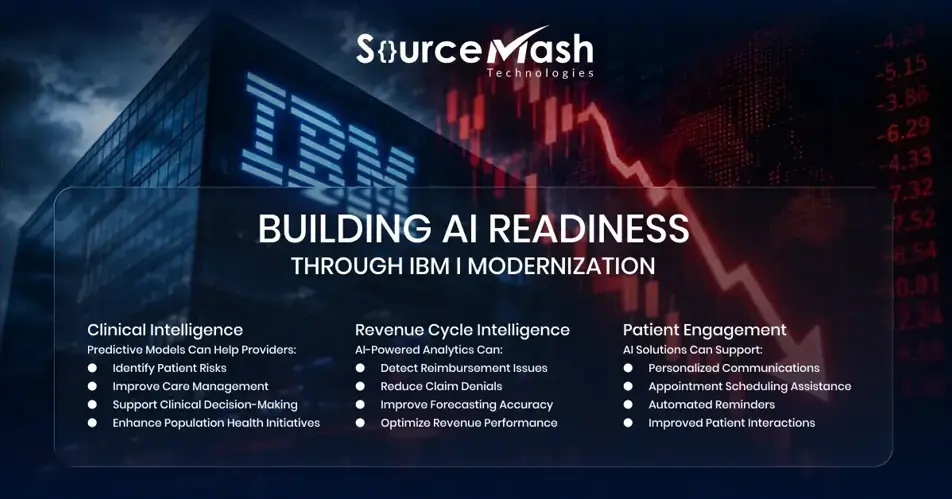
Building AI Readiness Through IBM i Modernization
Artificial Intelligence is rapidly becoming a strategic priority across healthcare.
However, AI success depends on one critical requirement: accessible, trustworthy, and integrated data.
Modernized IBM i environments create the foundation required for successful AI adoption.
✓ Clinical Intelligence
Predictive models can help providers:
- Identify patient risks
- Improve care management
- Support clinical decision-making
- Enhance population health initiatives
✓ Revenue Cycle Intelligence
AI-powered analytics can:
- Detect reimbursement issues
- Reduce claim denials
- Improve forecasting accuracy
- Optimize revenue performance
✓ Workforce Optimization
Predictive analytics can help organizations improve:
- Workforce planning
- Scheduling strategies
- Resource allocation
- Capacity management
✓ Patient Engagement
AI solutions can support:
- Personalized communications
- Appointment scheduling assistance
- Automated reminders
- Improved patient interactions
Future Trends Driving Healthcare Modernization
Several trends continue to accelerate healthcare transformation initiatives.
These include:
- Connected healthcare ecosystems
- Value-based care models
- Remote patient monitoring
- Digital patient engagement
- Predictive analytics
- AI-assisted operations
- Population health management
- Intelligent automation
Organizations modernizing today will be better positioned to capitalize on these opportunities tomorrow.
Measuring Modernization Success
Healthcare leaders should establish clear performance metrics before beginning a modernization initiative.
Operational Metrics
- Reduced manual processes
- Faster reporting
- Increased workforce productivity
- Improved process efficiency
Financial Metrics
- Faster claims processing
- Improved reimbursement cycles
- Lower administrative costs
- Reduced denial rates
Technology Metrics
- Increased integration capabilities
- Reduced technical debt
- Greater scalability
- Improved system flexibility
Strategic Metrics
- Enhanced interoperability
- Stronger analytics capabilities
- Increased AI readiness
- Faster innovation cycles
Defining these outcomes early helps demonstrate return on investment and guide long-term decision-making.
IBM i Healthcare Modernization Roadmap
Successful modernization initiatives typically follow a phased approach.
Phase 1: Assessment
Evaluate existing applications, integrations, infrastructure, security controls, and compliance requirements.
Phase 2: API Enablement
Introduce APIs that improve connectivity between IBM i applications and modern healthcare platforms.
Phase 3: User Experience Modernization
Transform green-screen applications into intuitive web-based and mobile-friendly experiences.
Phase 4: Interoperability Enablement
Implement HL7 and FHIR integration strategies that support information exchange across the healthcare ecosystem.
Phase 5: Data & Cloud Modernization
Expand analytics capabilities, improve data accessibility, and adopt hybrid cloud architecture where appropriate.
Phase 6: AI Readiness
Establish the data foundation required for predictive analytics, automation, and AI-driven innovation.
This phased approach reduces risk while delivering measurable business value at every stage.
Why Healthcare Organizations Choose SourceMash Technologies
SourceMash Technologies helps healthcare providers modernize IBM i applications while minimizing disruption to mission-critical operations.
Our expertise includes:
- IBM i modernization
- AS400 modernization
- RPG modernization
- API enablement
- Healthcare interoperability
- HL7 integration
- FHIR implementation
- Epic integration
- Oracle Health integration
- MEDITECH integration
- Security modernization
- Hybrid cloud solutions
- Analytics enablement
- AI readiness initiatives
We help organizations protect existing technology investments while creating secure, connected, and future-ready healthcare environments.
Ready to Modernize Your Healthcare Applications?
Modernization does not require abandoning the systems that have supported your organization for decades.
With the right strategy, healthcare providers can preserve the reliability and stability of IBM i while introducing interoperability, cloud connectivity, modern user experiences, advanced analytics, and AI capabilities.
Whether your priorities include revenue cycle management, healthcare interoperability, compliance readiness, patient engagement, or digital transformation, modernization can unlock the next stage of growth and innovation.
Conclusion
IBM i continues to power many of healthcare's most important applications because of its proven reliability, security, scalability, and operational stability.
The future of healthcare, however, depends on connected systems, interoperable data, modern digital experiences, advanced analytics, cybersecurity, automation, and Artificial Intelligence.
The organizations achieving the greatest success are not replacing technology simply because it is legacy. They are strategically modernizing proven systems to meet today's requirements while preparing for tomorrow's opportunities.
By embracing modernization, healthcare organizations can maximize existing investments, reduce operational risk, improve financial performance, strengthen patient experiences, and build a resilient foundation for long-term innovation.