Healthcare organizations are under increasing pressure to improve patient outcomes while reducing operational inefficiencies, controlling costs, and delivering more personalized experiences. Yet many providers still struggle with fragmented systems, disconnected patient data, manual referral processes, and inconsistent communication across care teams.
The result is often delayed care, frustrated providers, overwhelmed staff, and dissatisfied patients.
As healthcare shifts toward value-based care and consumer-centric experiences, organizations need more than just an Electronic Health Record (EHR). They need a platform that connects people, processes, data, and technology across the entire care journey.
This is where Salesforce Health Cloud is transforming healthcare delivery.
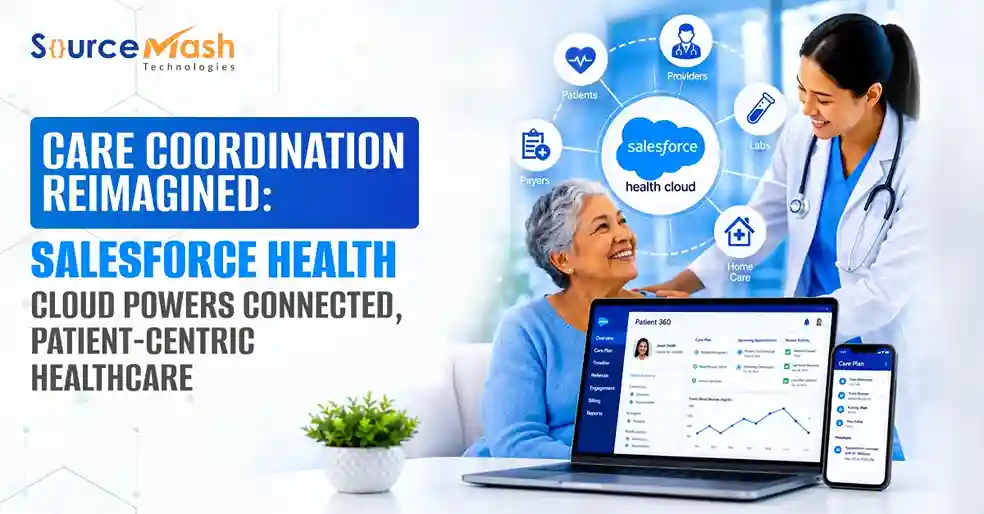
Built specifically for healthcare organizations, Salesforce Health Cloud brings together clinical, operational, and engagement data into a unified Patient 360 view, enabling providers, payers, specialty clinics, and care teams to coordinate care more effectively and deliver personalized patient experiences at scale.
Quick Answer
Salesforce Health Cloud is a healthcare-focused CRM and care management platform that helps providers, hospitals, specialty clinics, payers, home healthcare agencies, and life sciences organizations deliver connected, patient-centered care.
By unifying patient information, automating workflows, streamlining referrals, and enabling real-time collaboration, Health Cloud helps healthcare organizations improve care coordination, boost patient engagement, and increase operational efficiency.
Why Healthcare Organizations Are Struggling With Care Coordination
Most healthcare leaders don't have a data problem.
They have a connectivity problem.
Patient information often exists across multiple systems, including:
- Electronic Health Records (EHRs)
- Patient portals
- Scheduling platforms
- Billing systems
- Telehealth applications
- Laboratory systems
As patients move between providers and departments, critical information can become difficult to access or share efficiently.
Consider a common patient journey:
A patient visits a primary care physician, gets referred to a cardiologist, undergoes diagnostic testing at a separate facility, receives medication from a pharmacy, and participates in follow-up care from a home healthcare team.
If these stakeholders operate in separate systems, care coordination becomes increasingly difficult.
This often leads to:
- Delayed specialist appointments
- Referral leakage
- Duplicate testing
- Missed follow-ups
- Administrative inefficiencies
- Poor patient experiences
Healthcare organizations are now looking for technology platforms that bridge these gaps and create a more connected healthcare ecosystem.
What Is Salesforce Health Cloud?
Salesforce Health Cloud is a healthcare-specific customer relationship management and care coordination platform built on Salesforce.
Unlike traditional healthcare systems that primarily focus on storing records and managing transactions, Health Cloud focuses on managing the entire patient relationship.
It provides healthcare organizations with a centralized platform for:
- Patient engagement
- Care coordination
- Referral management
- Case management
- Population health initiatives
- Chronic disease management
- Workflow automation
- Healthcare analytics
At the center of the platform is Patient 360, a comprehensive view of an individual's healthcare journey.
Patient 360: Creating a Single Source of Truth
One of the biggest challenges in healthcare is fragmented patient information.
A physician may only see part of a patient's history, while care coordinators, specialists, or administrative staff operate with limited visibility.
Salesforce Health Cloud addresses this challenge by consolidating information from multiple systems into a unified profile.
Patient 360 can include:
- Medical history
- Diagnoses
- Medications
- Allergies
- Insurance information
- Appointments
- Referrals
- Care plans
- Communication history
- Social determinants of health
Rather than searching through multiple systems, providers can access critical patient information from a centralized location.
Business Benefits
- Faster clinical decision-making
- Better care continuity
- Reduced duplicate work
- Improved patient experiences
- Enhanced provider productivity
How Salesforce Health Cloud Improves Care Coordination
Technology alone does not improve healthcare outcomes.
Effective care coordination requires people, processes, and data working together.
Salesforce Health Cloud supports this through several key capabilities.
Connected Care Teams
Modern healthcare depends on collaboration among:
- Physicians
- Specialists
- Nurses
- Care coordinators
- Therapists
- Social workers
- Administrative teams
Health Cloud creates a shared environment where care teams can collaborate around a single patient record.
Instead of relying on emails, spreadsheets, or disconnected communication channels, stakeholders can access up-to-date information in real time.
Intelligent Referral Management
Referral management remains one of the biggest operational challenges in healthcare.
Many organizations still rely on manual processes that create delays, increase administrative workload, and contribute to referral leakage.
Health Cloud helps organizations:
- Create referrals
- Track referral status
- Manage authorizations
- Share documentation
- Automate notifications
The result is a faster and more transparent referral process for both providers and patients.
Care Plans and Care Programs
Organizations can design structured care programs for:
- Diabetes management
- Cardiovascular care
- Oncology
- Behavioral health
- Preventive care initiatives
By standardizing care pathways, healthcare teams can ensure more consistent treatment and improve patient adherence.
Reducing Administrative Burden Through Automation
Administrative work continues to be one of the largest sources of inefficiency in healthcare.
Care coordinators and clinical teams often spend significant time handling routine tasks such as:
- Appointment reminders
- Follow-up scheduling
- Referral routing
- Documentation workflows
- Patient outreach
Salesforce Health Cloud automates many of these activities.
This allows healthcare professionals to spend more time supporting patients and less time managing administrative processes.
Benefits include:
- Reduced manual workload
- Increased staff productivity
- Lower operational costs
- Improved patient engagement
How AI Is Shaping the Future of Healthcare Operations
Healthcare organizations are increasingly using artificial intelligence to identify risk, improve decision-making, and automate repetitive work.
Salesforce Health Cloud leverages Einstein AI and Agentforce capabilities to help organizations:
- Identify high-risk patients
- Detect care gaps
- Prioritize patient outreach
- Generate patient summaries
- Automate routine workflows
Rather than replacing healthcare professionals, AI enables teams to focus on higher-value patient interactions while automating time-consuming tasks.
Real-World Example: Improving Diabetes Care Management
Imagine a healthcare organization responsible for managing thousands of diabetes patients.
Without centralized visibility, providers may struggle to identify patients who miss appointments, skip screenings, or fall behind on treatment plans.
Using Salesforce Health Cloud, the organization can:
Step 1: Connect Patient Data
Integrate information across EHRs and operational systems.
Step 2: Identify At-Risk Patients
Use AI-driven insights to identify patients who require intervention.
Step 3: Automate Patient Engagement
Send appointment reminders, medication notifications, and preventive care communications.
Step 4: Coordinate Specialty Care
Improve collaboration between primary care providers and endocrinologists.
Step 5: Monitor Progress
Track adherence, screenings, and care plan completion.
Potential Outcomes
- Improved patient engagement
- Better adherence to treatment plans
- Reduced missed appointments
- Faster care coordination
- Improved health outcomes
Measuring Success With Salesforce Health Cloud
Healthcare organizations should define measurable objectives before implementation.
Common KPIs include:
Care Coordination Metrics
- Referral completion rates
- Referral turnaround times
- Follow-up completion rates
- Care plan adherence
Operational Metrics
- Administrative workload reduction
- Staff productivity improvements
- Scheduling efficiency
- Workflow automation adoption
Patient Experience Metrics
- Patient satisfaction scores
- Patient retention rates
- Engagement levels
- No-show reduction
Monitoring these metrics helps healthcare leaders demonstrate ROI and continuously optimize operations.
Common Health Cloud Implementation Mistakes
Organizations often underestimate the importance of preparation and change management.
The most common mistakes include:
Treating Health Cloud as Just a CRM
Health Cloud is a care coordination platform, not simply a patient database.
Delaying Integration Planning
Integration with EHRs and operational systems should be prioritized early.
Ignoring Data Quality
Migrating duplicate or incomplete records creates long-term challenges.
Overlooking User Adoption
Even the best technology delivers limited value if users are not properly trained.
Successful implementations focus equally on technology, people, processes, and governance.
Why Salesforce Health Cloud Is Becoming a Strategic Healthcare Platform
Healthcare leaders are increasingly viewing Salesforce Health Cloud as more than a CRM.
It has become a digital transformation platform that supports:
- Care coordination
- Patient engagement
- Workflow automation
- Population health management
- Provider collaboration
- Healthcare interoperability
- AI-driven decision support
By connecting patients, providers, and systems within a unified ecosystem, healthcare organizations can move from reactive care delivery toward more proactive, personalized, and efficient healthcare experiences.
How SourceMash Technologies Helps Healthcare Organizations
Successfully implementing Salesforce Health Cloud requires more than technical expertise.
Healthcare organizations need a partner that understands patient engagement, healthcare workflows, interoperability, compliance requirements, and organizational change management.
At SourceMash Technologies, we help healthcare organizations:
- Implement and optimize Salesforce Health Cloud
- Build Patient 360 solutions
- Integrate EHR systems such as Epic, Oracle Cerner, and Athenahealth
- Automate referral and care coordination workflows
- Enable Einstein AI and Agentforce capabilities
- Improve user adoption and long-term platform success
Whether you're planning a new Health Cloud implementation or optimizing an existing environment, our team helps ensure technology delivers measurable business and patient outcomes.
Conclusion
Healthcare organizations can no longer rely on disconnected systems and fragmented patient records to meet modern patient expectations.
Success now depends on delivering coordinated, personalized, and data-driven care experiences across the entire healthcare journey.
Salesforce Health Cloud helps make this possible through Patient 360, intelligent referral management, workflow automation, AI-powered insights, connected care teams, and deep healthcare integrations.
For organizations seeking to improve care coordination, enhance patient engagement, and accelerate digital transformation, Salesforce Health Cloud provides a scalable foundation for the future of connected healthcare.