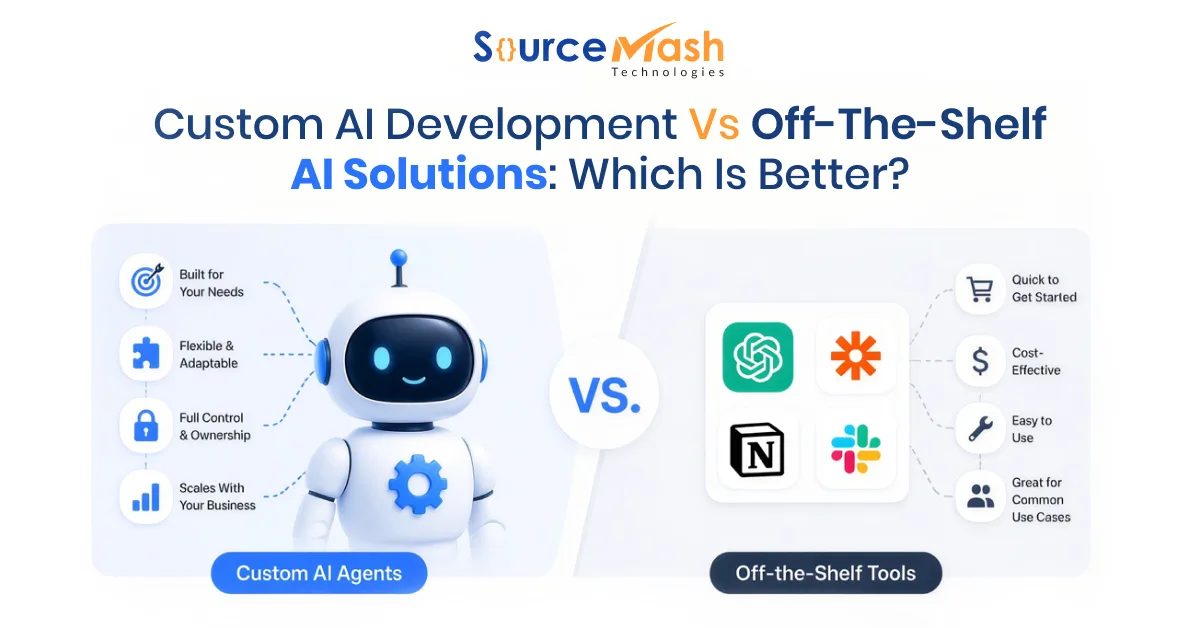
Artificial Intelligence (AI) is becoming a strategic business asset, helping organizations improve efficiency, automate processes, enhance customer experiences, and make smarter decisions. However, before investing in AI, many businesses face a critical question: should they choose a custom AI solution or implement an off-the-shelf AI platform?
The answer depends on your business objectives, operational requirements, budget, and long-term growth strategy. While both approaches can deliver value, they are designed for different scenarios and business needs.
This guide explains the differences between custom AI development and off-the-shelf AI solutions, helping you determine which option is the right fit for your organization.
Quick Answer: Which Is Better?
There is no universal winner because the best choice depends on your specific business requirements.
Choose Off-the-Shelf AI Solutions If You:
- Need a fast implementation timeline
- Have a limited budget
- Require standard AI capabilities
- Are adopting AI for the first time
- Want minimal development effort
Choose Custom AI Development If You:
- Need AI tailored to unique business processes
- Require advanced integrations with existing systems
- Have industry-specific requirements
- Need long-term scalability
- Want AI to create a competitive advantage
For businesses with specialized workflows, proprietary data, or long-term AI strategies, custom AI development often delivers greater value over time. For organizations seeking quick results and standardized functionality, off-the-shelf solutions are often the more practical option.
What Is Custom AI Development?
Custom AI development involves designing, building, and deploying AI solutions specifically for an organization's needs. These solutions are created around existing workflows, goals, challenges, and datasets rather than being designed for a broad audience.
Instead of adapting operations to fit software limitations, businesses develop AI capabilities through custom AI development that align directly with how they work.
Common Examples of Custom AI Solutions
- AI-powered recommendation engines
- Predictive maintenance systems
- Supply chain forecasting platforms
- Fraud detection solutions
- AI-powered document processing
- Healthcare analytics systems
- Customer behavior prediction models
- Enterprise knowledge assistants
Custom AI is particularly useful when businesses require functionality that generic AI software cannot adequately provide.
What Are Off-the-Shelf AI Solutions?
Off-the-shelf AI solutions are ready-made software products that provide AI capabilities for a wide range of businesses. These platforms are built to address common business needs and can usually be deployed quickly.
Most off-the-shelf solutions are available through subscriptions or cloud-based services, making AI adoption more accessible.
Common Examples of Off-the-Shelf AI Solutions
- AI chatbots
- AI writing assistants
- Marketing automation platforms
- AI-enhanced CRM systems
- Business intelligence tools
- Speech recognition software
- Customer service automation platforms
- Image recognition applications
These solutions provide convenience and speed but may offer less flexibility than custom-built systems.
Custom AI Development vs Off-the-Shelf AI Solutions: Key Differences
1. Business Alignment
Custom AI Development
- Built around specific business processes
- Supports unique operational requirements
- Addresses specialized challenges
Off-the-Shelf AI Solutions
- Designed for broad market needs
- Works well for common use cases
- May require process adjustments
2. Deployment Time
Custom AI Development
- Requires planning, development, testing, and implementation
- Longer deployment timeline
Off-the-Shelf AI Solutions
- Faster implementation
- Quicker return on investment
- Minimal setup requirements
3. Upfront Investment
Custom AI Development
- Higher initial investment
- Includes development, training, testing, and integration costs
Off-the-Shelf AI Solutions
- Lower entry cost
- Typically subscription-based
4. Flexibility
Custom AI Development
- Highly adaptable to changing requirements
- Supports unique workflows and business logic
Off-the-Shelf AI Solutions
- Limited by vendor functionality
- Customization options may be restricted
5. Long-Term Value
Custom AI Development
- Can evolve alongside the business
- Supports strategic innovation initiatives
Off-the-Shelf AI Solutions
- Effective for standard business requirements
- May have limitations as business needs become more complex
5 Advantages of Custom AI Development
1. Tailored Business Functionality
Custom AI solutions are designed to solve specific business challenges, ensuring a better fit with organizational objectives and operational processes.
2. Better Use of Proprietary Data
Businesses can train AI models using their own datasets, improving the relevance and accuracy of insights, recommendations, and predictions.
3. Seamless System Integration
Custom AI can be integrated with:
- ERP systems
- CRM platforms
- Inventory management software
- Customer support tools
- Internal databases
4. Greater Strategic Control
Organizations maintain greater control over features, functionality, data usage, and future enhancements.
5. Competitive Differentiation
Custom AI enables businesses to build capabilities that are difficult for competitors to replicate.
3 Limitations of Custom AI Development
1. Higher Initial Costs
Custom development requires investment in strategy, data preparation, model development, testing, and deployment.
2. Longer Implementation Cycles
Building a customized AI solution takes time compared to deploying pre-built software.
3. Ongoing Management Requirements
Organizations must plan for monitoring, updates, model optimization, and maintenance throughout the AI lifecycle.
4 Advantages of Off-the-Shelf AI Solutions
1. Faster Time to Value
Businesses can begin using AI capabilities quickly without lengthy development projects.
2. Lower Initial Financial Commitment
Subscription-based pricing allows organizations to access AI technologies with lower upfront investment.
3. Easier Adoption
The provider typically manages:
- Infrastructure
- Software updates
- Security enhancements
- Platform maintenance
4. Proven and Tested Technology
Many off-the-shelf AI products are already used by numerous businesses, providing confidence in their reliability and performance.
4 Limitations of Off-the-Shelf AI Solutions
1. Limited Customization Options
Organizations may not be able to fully align the solution with their operational requirements.
2. Generic Functionality
Broadly designed platforms may not effectively address industry-specific or highly specialized use cases.
3. Reliance on the Vendor
Businesses depend on the provider for:
- Feature updates
- Support services
- Pricing structures
- Future product direction
4. Growth Limitations
As requirements become more advanced, businesses may reach the platform's functional limits.
5 Key Factors to Evaluate Before Choosing an AI Solution
1. Data Availability
Organizations with high-quality proprietary data may benefit more from custom AI solutions.
2. Process Complexity
The more specialized your workflows are, the more likely a custom solution will be required.
3. Security and Compliance Requirements
Industries with strict regulatory requirements often need greater control over AI implementation and governance.
4. Available Resources
Businesses should assess whether they have the technical expertise and operational capacity to support their chosen AI solution.
5. Future Business Objectives
The selected solution should support both current requirements and future growth plans.
Industry Examples
Healthcare
Custom AI is commonly used for:
- Clinical analytics
- Medical image analysis
- Diagnostic support
- Patient risk assessment
Retail and eCommerce
Businesses frequently combine both approaches:
- Off-the-shelf AI for marketing automation
- Custom AI for personalized recommendations
- Customer behavior analysis
- Demand forecasting
Manufacturing
Custom AI often supports:
- Predictive maintenance
- Quality control
- Production optimization
- Equipment monitoring
Financial Services
Organizations use custom AI for:
- Fraud detection
- Risk management
- Transaction monitoring
- Financial forecasting
Customer Service
- Off-the-shelf chatbots for routine requests
- Custom AI assistants for specialized customer interactions
Custom AI Development vs Off-the-Shelf AI Solutions: Cost Comparison
When Off-the-Shelf AI Provides Better Value
Off-the-shelf solutions are often cost-effective when:
- Requirements are standard
- Rapid deployment is important
- AI use cases are limited
- Budget constraints are significant
When Custom AI Provides Better Value
Custom AI often delivers stronger returns when:
- AI directly impacts revenue growth
- Operational efficiencies generate measurable savings
- Business differentiation is a strategic priority
- Scalability is critical for long-term success
Organizations should evaluate total cost of ownership and expected return on investment rather than focusing solely on implementation costs.
Can Businesses Combine Both Approaches?
Yes. Many organizations adopt a hybrid AI strategy.
For example:
- Off-the-shelf AI tools may support content creation, marketing automation, or customer service.
- Custom AI solutions may handle forecasting, analytics, decision support, and industry-specific workflows.
A hybrid approach allows businesses to gain immediate benefits while building specialized AI capabilities over time.
How to Successfully Implement an AI Solution
Organizations should follow best practices for AI implementation to maximize long-term business value.
1. Define Clear Business Objectives
Identify the specific challenges or opportunities that AI will address.
2. Prepare High-Quality Data
AI systems perform best when trained or configured with accurate and relevant data.
3. Plan Integration Requirements
Ensure the solution can work effectively with existing business systems and workflows.
4. Measure Performance
Establish metrics to evaluate AI effectiveness and business impact over time.
5. Continuously Optimize
AI solutions should be monitored and refined to ensure they continue delivering value as business needs evolve.
Which AI Solution Is Right for Your Business?
Off-the-Shelf AI Is Best When:
- Speed is the priority
- Budget is limited
- Requirements are relatively standard
- Technical resources are minimal
Custom AI Is Best When:
- Business processes are unique
- Scalability is essential
- Specialized functionality is required
- AI is expected to drive long-term innovation and growth
The ideal choice depends on your organization's goals, complexity, and vision for AI adoption.
Conclusion
Choosing between custom AI development and off-the-shelf AI solutions is not about determining which option is universally better. It is about identifying which approach aligns most closely with your business goals, operational needs, and long-term strategy.
Off-the-shelf AI solutions are well-suited for organizations seeking rapid deployment, lower upfront costs, and proven functionality for common business use cases.
Custom AI development is often the better choice for businesses that require tailored capabilities, deeper system integration, greater control, and long-term scalability.
By carefully evaluating your requirements, available data, budget, and future growth plans, you can implement an AI solution that delivers meaningful business value and supports sustainable success.
Frequently Asked Questions
What is the main difference between custom AI development and off-the-shelf AI solutions?
Custom AI development creates solutions tailored to a business's specific requirements, while off-the-shelf AI solutions are pre-built products designed for a broad range of users.
Which option is more cost-effective?
Off-the-shelf AI is generally more cost-effective for standard use cases, while custom AI can provide better long-term value for businesses with specialized requirements.
Is custom AI better for large enterprises?
In many cases, yes. Large enterprises often have complex workflows, integration requirements, and scalability needs that are better addressed through custom AI development.
Can custom AI integrate with existing business systems?
Yes. Custom AI can be built to integrate with ERP platforms, CRM systems, databases, customer support software, and other enterprise applications.
Can small businesses use off-the-shelf AI solutions?
Yes. Off-the-shelf AI solutions are often a practical starting point for small and medium-sized businesses because they require less investment and can be implemented quickly.
Can a business use both custom AI and off-the-shelf AI?
Yes. Many organizations use a combination of both approaches, leveraging off-the-shelf tools for standard processes and custom AI for strategic or specialized business functions.
How do I determine the right AI solution for my business?
Evaluate your goals, budget, implementation timeline, data availability, integration needs, compliance requirements, and future growth plans. These factors will help determine whether custom AI development or an off-the-shelf solution is the better fit.