AI is transforming the way organizations approach digital transformation and legacy modernization. Instead of relying solely on lengthy, costly, and high-risk system replacement projects, businesses can now use AI to assess existing environments, automate modernization tasks, improve decision-making, and accelerate transformation initiatives.
This article explores how AI supports digital transformation and legacy system modernization, the benefits organizations can achieve, key modernization strategies, industry use cases, and best practices for success.
What Is Digital Transformation?
Digital transformation is the process of using modern technologies to improve how an organization operates, delivers services, and creates value for customers.
It involves rethinking business processes, technology systems, and workflows to increase efficiency, agility, innovation, and customer satisfaction.
Key Objectives of Digital Transformation
- Improve operational efficiency
- Enhance customer experiences
- Enable data-driven decision-making
- Increase business agility
- Accelerate innovation
- Improve workforce productivity
- Support business scalability
Successful digital transformation is not simply about adopting new technologies. It is about aligning technology investments with strategic business goals to achieve measurable outcomes.
What Is Legacy Modernization?
Legacy modernization refers to upgrading, transforming, or replacing outdated applications, infrastructure, and technology platforms to meet modern business demands and technical requirements.
Many legacy systems contain years of valuable business logic and operational data. Modernization helps organizations retain this value while improving flexibility, security, performance, and scalability.
Common Examples of Legacy Systems
- Mainframe applications
- Legacy ERP systems
- Older CRM platforms
- On-premises enterprise applications
- Monolithic software architectures
- Custom applications built using outdated technologies
Legacy Modernization vs. Digital Transformation
Although often used interchangeably, legacy modernization and digital transformation serve different purposes.
Legacy Modernization
Legacy modernization focuses on updating existing technology assets, including applications, databases, infrastructure, and architectures.
Digital Transformation
Digital transformation focuses on improving business outcomes through technology-enabled innovation, operational excellence, and better customer experiences.
The Relationship Between Both
Legacy modernization creates the technological foundation that makes broader digital transformation initiatives possible. Without modern systems, organizations often struggle to achieve true digital agility.
Why Organizations Are Modernizing Legacy Systems
Businesses across industries are modernizing legacy environments to remain competitive and support future growth.
Rising Maintenance Costs
Legacy applications often require specialized expertise and aging infrastructure that increase operating costs.
Increasing Security Risks
Older systems may lack support for modern security controls, exposing organizations to evolving cyber threats.
Limited Scalability
Legacy environments often struggle to support increased workloads and business expansion.
Integration Challenges
Connecting outdated systems with cloud platforms, analytics tools, AI solutions, and modern applications can be difficult and expensive.
Changing Customer Expectations
Customers expect fast, personalized, and seamless digital experiences that many legacy systems cannot deliver.
Slower Innovation
Technology teams frequently spend excessive time maintaining outdated systems instead of driving innovation.
How AI Supports Legacy Modernization
Artificial Intelligence is helping organizations modernize faster while reducing complexity, risk, and costs.
1. Automated Application Assessment
Before modernization begins, organizations must understand their existing technology landscape.
AI can analyze:
- Application dependencies
- System relationships
- Integration points
- Data flows
- Infrastructure requirements
Example
A manufacturing company operating multiple legacy applications can use AI to identify redundant systems and prioritize modernization efforts.
2. Intelligent Code Analysis and Refactoring
Legacy codebases are often complex and difficult to maintain.
AI-powered tools can:
- Analyze existing source code
- Identify inefficiencies
- Detect obsolete components
- Recommend improvements
- Support code refactoring efforts
Example
A financial institution can use AI to evaluate a legacy loan management platform before migrating it to a cloud-native architecture.
3. Accelerated Cloud Migration
Cloud migration is a critical component of many digital transformation strategies.
AI helps organizations:
- Identify cloud-ready applications
- Map dependencies
- Assess migration risks
- Recommend migration strategies
- Optimize cloud resource allocation
Example
A retail company can use AI to determine whether applications should be rehosted, replatformed, or refactored before migration.
4. Process Automation and Optimization
Legacy environments often depend heavily on manual processes.
AI can automate:
- Repetitive workflows
- Data processing
- Service request routing
- Document classification
- Approval processes
Example
An insurance provider can automatically classify claims and route them to the appropriate teams, reducing processing times.
5. Data Modernization and Advanced Analytics
Legacy systems often contain large volumes of valuable but underutilized data.
AI enables organizations to:
- Improve data quality
- Organize structured and unstructured data
- Discover hidden patterns
- Generate predictive insights
- Enable real-time decision-making
Example
A logistics company can analyze shipment histories to optimize transportation routes and reduce delivery delays.
6. Enhanced Security and Risk Management
AI-driven cybersecurity solutions improve visibility and protection across modernized environments.
AI can:
- Detect unusual activity
- Monitor systems continuously
- Identify vulnerabilities
- Support compliance initiatives
- Improve threat response times
Example
Healthcare organizations can use AI-powered monitoring tools to protect sensitive patient data and identify suspicious access attempts.
Technologies That Complement AI in Modernization Initiatives
Organizations often rely on enterprise data integration services to support cloud modernization, data migration, and digital transformation initiatives.
Cloud Computing
Provides scalable, flexible, and cost-efficient infrastructure.
APIs and Integration Platforms
Enable seamless connectivity between modern and legacy applications.
Robotic Process Automation (RPA)
Automates repetitive, rule-based business processes.
Advanced Analytics Platforms
Transform enterprise data into actionable business intelligence.
Microservices Architecture
Breaks monolithic applications into independently deployable services.
DevOps and Automation Tools
Accelerate software development, testing, deployment, and operational improvements.
AI-Powered Legacy Modernization Approaches
Organizations planning legacy modernization initiatives should evaluate proven Application Modernization Guidance for Azure to determine the most suitable strategy for rehosting, replatforming, refactoring, rebuilding, or replacing existing applications.
Rehosting (Lift and Shift)
Applications are migrated to new infrastructure with minimal code changes.
Best For
Stable applications that primarily require infrastructure modernization.
Refactoring
Application code is redesigned to improve scalability, performance, and maintainability.
Best For
Business-critical applications with long-term strategic value.
Replatforming
Applications move to a modern platform while retaining most of their functionality.
Best For
Organizations seeking moderate modernization improvements.
Rebuilding
Applications are redesigned from the ground up using modern architectures.
Best For
Systems that cannot support future business requirements.
Replacing
Legacy solutions are replaced by modern SaaS or commercial software.
Best For
Applications that no longer offer strategic business value.
Industry Use Cases of AI-Driven Legacy Modernization
Financial Services
Modernizing banking and lending systems improves customer experiences, fraud detection, and regulatory compliance.
Healthcare
Modernized healthcare platforms improve patient data security, accessibility, and operational efficiency.
Manufacturing
AI-powered modernization supports predictive maintenance, production optimization, and supply chain visibility.
Retail
Retailers modernize systems to improve inventory management, personalization, and omnichannel customer experiences.
Logistics and Transportation
Modernized platforms improve route planning, warehouse operations, and real-time shipment visibility.
Business Benefits of AI-Driven Modernization
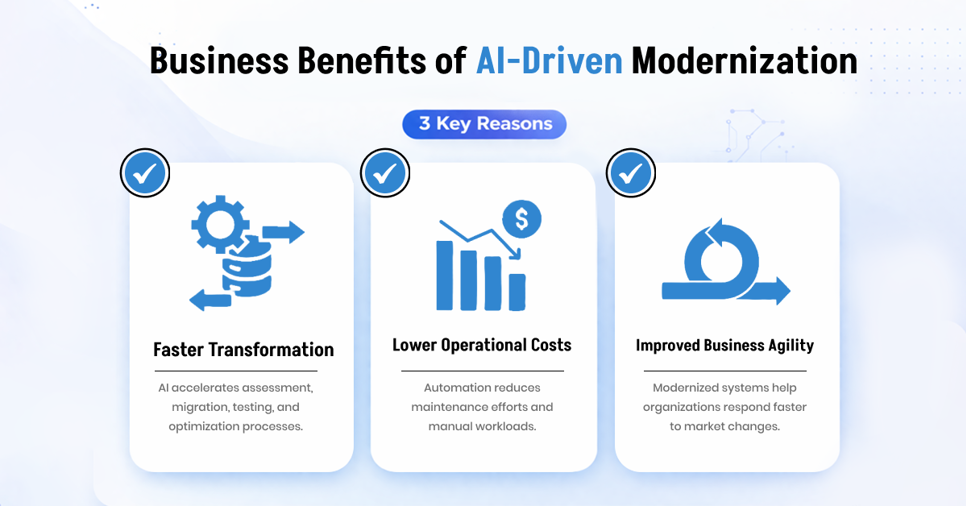
Organizations combining AI with modernization initiatives can achieve substantial business value.
Faster Transformation
AI accelerates assessment, migration, testing, and optimization processes.
Lower Operational Costs
Automation reduces maintenance efforts and manual workloads.
Improved Business Agility
Modernized systems help organizations respond faster to market changes.
Better Customer Experiences
Updated applications provide greater reliability, performance, and accessibility.
Increased Innovation
Technology teams spend more time developing new capabilities and less time maintaining outdated systems.
Stronger Risk Management
AI improves visibility into vulnerabilities, compliance requirements, and system risks.
Building an AI-Driven Legacy Modernization Roadmap
Step 1: Assess Existing Systems
Evaluate applications, infrastructure, integrations, and dependencies.
Step 2: Define Business Objectives
Set measurable goals related to cost reduction, scalability, security, and customer experience improvements.
Step 3: Prioritize Modernization Opportunities
Focus on systems that deliver the greatest business impact.
Step 4: Select the Right Modernization Strategy
Choose the most appropriate modernization approach based on business and technical requirements.
Step 5: Implement AI-Powered Modernization
Use AI to support assessment, migration, automation, testing, and optimization efforts.
Step 6: Measure and Optimize
Continuously evaluate outcomes and refine strategies.
Best Practices for Successful AI-Driven Modernization
Align Technology Investments With Business Goals
Ensure modernization efforts directly support measurable business objectives.
Focus on High-Impact Systems
Prioritize systems that affect customers, revenue, and operations.
Improve Data Quality
Reliable data improves both AI effectiveness and modernization outcomes.
Adopt a Phased Modernization Approach
Incremental projects reduce risk and minimize operational disruption.
Establish Strong Governance
Implement security, compliance, and risk management frameworks.
Continuously Measure Results
Monitor both technical and business KPIs throughout the modernization journey.
Key Metrics to Measure Modernization Success
Operational Metrics
- Application performance
- System uptime
- Deployment frequency
- Infrastructure utilization
- IT operating costs
Business Metrics
- Customer satisfaction
- Employee productivity
- Revenue growth
- Service delivery speed
- Process efficiency
Security Metrics
- Vulnerability reduction
- Incident frequency
- Compliance performance
- Threat detection speed
- Threat response time
Common Legacy Modernization Mistakes to Avoid
- Starting modernization without clear business goals
- Focusing only on technology improvements
- Ignoring data quality issues
- Underestimating integration complexity
- Neglecting cybersecurity requirements
- Attempting large-scale transformation all at once
- Failing to measure business outcomes
The Future of AI-Powered Digital Transformation
AI is expected to play an increasingly important role in application discovery, code modernization, cloud migration, intelligent automation, predictive maintenance, cybersecurity monitoring, and advanced analytics.
As AI technologies continue to evolve, modernization initiatives will become faster, more automated, and more data-driven. Organizations that strategically adopt AI today will be better positioned for long-term innovation and competitive advantage.
Conclusion
Digital transformation and legacy modernization are interconnected initiatives that help organizations remain competitive in an increasingly digital economy. While legacy systems continue to support critical business operations, they often limit scalability, innovation, agility, and integration.
AI is helping organizations overcome these limitations by accelerating application assessment, improving code modernization, supporting cloud migration, automating business processes, strengthening security, and unlocking greater value from enterprise data.
Organizations that align modernization initiatives with business goals, adopt the right modernization strategies, and leverage AI effectively can reduce costs, improve performance, enhance customer experiences, and build a future-ready digital foundation.
Frequently Asked Questions (FAQ)
How does AI help modernize legacy systems?
AI helps organizations analyze applications, automate code modernization, support cloud migration, improve security, automate processes, and generate insights from legacy data.
What is the difference between legacy modernization and digital transformation?
Legacy modernization focuses on updating technology systems, while digital transformation focuses on improving business outcomes using technology.
What are the biggest challenges of legacy modernization?
Common challenges include technical debt, integration complexity, high maintenance costs, security risks, and data migration concerns.
Which industries benefit most from AI-powered modernization?
Financial services, healthcare, manufacturing, retail, logistics, telecommunications, and government organizations can all benefit significantly from AI-driven modernization initiatives.
What is the first step in a legacy modernization project?
The first step is conducting a comprehensive assessment of current applications, infrastructure, integrations, dependencies, and business requirements.