Quick Answer
Computer Vision and Natural Language Processing (NLP) are creating more human-like AI systems by combining visual understanding with language comprehension. Computer Vision enables AI to analyze images, videos, objects, and visual patterns, while NLP helps it understand, interpret, and generate human language. Together, these technologies power multimodal AI systems that can process information from multiple sources simultaneously, resulting in more context-aware, intelligent, and natural interactions.
Key Takeaways
- Computer Vision enables AI to interpret visual information.
- NLP allows AI to understand and generate human language.
- Together, they form multimodal AI systems capable of processing multiple data types.
- Vision-Language Models (VLMs) are advancing the integration of visual and language intelligence.
- Multimodal AI improves contextual understanding and decision-making.
- Industries such as healthcare, retail, manufacturing, and customer service are already benefiting.
- AI can mimic aspects of human perception and communication, but it does not possess human consciousness or genuine understanding.
Can AI Really See, Understand, and Communicate Like Humans?
Imagine uploading a photo to an AI assistant and asking:
"What's happening in this image?"
Within seconds, the system identifies objects, analyzes relationships, interprets context, and responds in natural language.
A few years ago, this level of interaction seemed futuristic. Today, it is becoming increasingly common because of the convergence of two powerful Artificial Intelligence technologies: Computer Vision and Natural Language Processing (NLP).
Individually, these technologies have transformed how machines interact with people. Together, they are enabling a new generation of intelligent systems that can interpret visual information, process language, understand context, and communicate more naturally.
This convergence is driving the rise of multimodal AI, which allows machines to process text, images, audio, video, and other forms of data simultaneously.
As businesses increasingly invest in AI-powered automation, analytics, customer experiences, healthcare innovation, and intelligent operations, the combination of Computer Vision and NLP is becoming one of the most important drivers of human-like AI.
How Do Computer Vision and NLP Create More Human-Like AI Systems?
Computer Vision and NLP complement one another in a way that resembles how humans interact with the world. Computer Vision enables AI to perceive visual information, while NLP enables AI to process and communicate through language.
When these capabilities work together, AI systems can:
- Analyze images and text simultaneously
- Interpret context across multiple data sources
- Answer questions about images or videos
- Generate more accurate responses
- Understand user intent more effectively
- Deliver more natural conversational experiences
- Support intelligent decision-making
Instead of performing isolated tasks, AI can combine different forms of information and generate responses that feel far more human-like.
Why Human-Like AI Requires More Than One Sense
Human communication depends on more than words alone.
When interacting with others, people naturally:
- Listen to spoken language
- Observe facial expressions
- Read body language
- Interpret tone and emotion
- Consider environmental context
- Combine multiple signals before responding
Traditional AI systems often rely on a single type of data.
For example:
- A chatbot can understand text but cannot interpret a photograph.
- A computer vision model can identify objects but cannot explain them conversationally.
This limitation creates fragmented experiences.
Human-like AI emerges when systems can combine multiple forms of information, understand relationships between them, and respond appropriately. This is the foundation of multimodal AI.
Understanding the Technologies Behind Human-Like AI
What Is Computer Vision?
Computer Vision is a branch of Artificial Intelligence that enables machines to interpret and analyze visual information from images, videos, and live camera feeds.
Just as humans use their eyes to perceive their surroundings, Computer Vision helps machines identify objects, recognize patterns, detect motion, and understand environments.
Common Applications of Computer Vision
- Facial recognition
- Medical image analysis
- Autonomous vehicles
- Manufacturing quality inspection
- Retail product recognition
- Security and surveillance
- Visual search systems
- Traffic monitoring
Advances in deep learning and Convolutional Neural Networks (CNNs) have significantly improved the accuracy and reliability of computer vision systems.
What Is Natural Language Processing (NLP)?
Natural Language Processing (NLP) is a field of Artificial Intelligence that helps machines understand, interpret, and generate human language.
NLP bridges the gap between human communication and machine processing.
Common Applications of NLP
- AI chatbots
- Virtual assistants
- Language translation
- Sentiment analysis
- Speech recognition
- Intelligent search engines
- Document summarization
- Content recommendation systems
Modern NLP systems use transformer-based architectures capable of understanding context, intent, and language patterns far more effectively than earlier approaches.
The Rise of Vision-Language Models (VLMs)
One of the most significant developments in AI is the emergence of Vision-Language Models (VLMs). VLMs are designed to understand both images and language within a unified system.
Instead of using separate models for vision and text tasks, VLMs learn relationships between visual content and language simultaneously.
Examples of Vision-Language Models
- CLIP
- BLIP
- Flamingo
- LLaVA
- GPT-4o
- Gemini
- Multimodal Llama models
These models can:
- Describe images
- Answer questions about visual content
- Generate image captions
- Understand charts and diagrams
- Interpret screenshots and documents
- Support multimodal conversations
VLMs are accelerating the development of AI systems capable of more natural interactions and deeper contextual understanding.
What Are Foundation Models?
Modern AI systems are increasingly powered by Foundation Models.Foundation models are large-scale AI models trained on vast datasets containing text, images, audio, code, and other sources of information.
Examples include:
- GPT-family models
- Gemini models
- Claude models
- Llama models
These models provide a common foundation that can power multiple tasks, including:
- Content generation
- Language understanding
- Image interpretation
- Question answering
- Reasoning assistance
- AI-powered automation
Foundation models have made it possible to build AI systems that can process multiple forms of information within a single architecture.
The Rise of Multimodal AI
So what happens when AI can both see and understand language?
The answer is multimodal AI.
Multimodal AI refers to systems that can process and understand multiple types of data simultaneously.
Common Data Types Processed by Multimodal AI
- Text: Emails, documents, chat messages
- Images: Photos and scanned files
- Audio: Voice commands and conversations
- Video: Live streams and recorded footage
- Sensor Data: IoT devices and industrial systems
By combining Computer Vision and NLP, AI gains a richer understanding of context, enabling more accurate insights and more natural interactions.
How Computer Vision and NLP Work Together
1. Visual Question Answering (VQA)
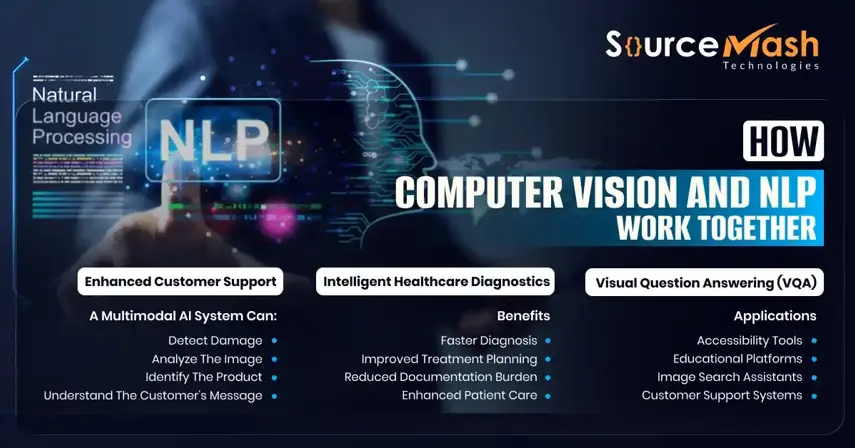
Visual Question Answering allows users to upload an image and ask questions about it.
For example:
"What is happening in this picture?"
The Computer Vision component analyzes visual elements while the NLP component interprets the question and generates the response.
Applications
- Accessibility tools
- Educational platforms
- Image search assistants
- Customer support systems
2. Intelligent Healthcare Diagnostics
Healthcare is one of the most impactful uses of multimodal AI.
Computer Vision can:
- Analyze X-rays
- Review MRI scans
- Detect abnormalities
- Identify disease indicators
NLP can:
- Process medical records
- Extract patient history
- Analyze physician notes
- Interpret clinical documentation
By combining both sources of information, healthcare organizations can support faster and more informed clinical decisions.
Benefits
- Faster diagnosis
- Improved treatment planning
- Reduced documentation burden
- Enhanced patient care
3. Enhanced Customer Support
Modern customer service increasingly relies on multimodal AI.
Imagine a customer uploads an image of a damaged product and asks for assistance.
A multimodal AI system can:
- Analyze the image
- Identify the product
- Detect damage
- Understand the customer's message
- Generate an appropriate response
This leads to faster, more personalized support experiences.
4. Intelligent Retail Experiences
Retailers are using Computer Vision and NLP to transform shopping experiences.
Applications
- Visual product search
- Product recommendations
- Inventory monitoring
- Sentiment analysis
- Shopping assistants
For example, a customer can upload a product image and ask:
"Do you have something similar in blue?"
The AI analyzes both the image and the query to provide relevant recommendations.
5. Accessibility and Inclusion
Multimodal AI is making digital experiences more accessible.
Examples
- Automatic image descriptions
- Real-time image captioning
- Visual content-to-speech conversion
- Navigation assistance for visually impaired users
These technologies help people access information more independently and effectively.
6. Autonomous Vehicles
Autonomous transportation relies heavily on the integration of Computer Vision and NLP.
Computer Vision enables vehicles to:
- Detect pedestrians
- Identify traffic signs
- Monitor lanes
- Recognize obstacles
NLP supports:
- Voice-assisted controls
- Driver communication systems
- Conversational navigation
Together, they help create safer and more intelligent transportation systems.
7. Security and Surveillance
Computer Vision and NLP are increasingly being combined in security environments.
Common Applications
- Threat detection
- Video analysis
- Incident reporting
- Behavioral monitoring
- Security operations support
Computer Vision analyzes visual events while NLP can summarize findings, generate reports, and assist security teams in interpreting large volumes of information.
The Role of Emotion and Context Recognition
Human communication depends heavily on context and emotion.
People naturally consider:
- Facial expressions
- Tone of voice
- Body language
- Language patterns
- Social context
Similarly, multimodal AI attempts to identify emotional and contextual signals.
Computer Vision can analyze visual cues, while NLP evaluates sentiment, intent, and language patterns.
This helps improve experiences in:
- Customer service
- Healthcare
- Education
- Virtual assistants
- Accessibility technologies
It is important to note, however, that AI does not genuinely experience emotions. It identifies patterns associated with emotional states and generates responses accordingly.
Multimodal AI vs Generative AI
These terms are often confused but serve different purposes.
Generative AI
Generative AI focuses on creating content such as:
- Text
- Images
- Audio
- Video
- Code
Multimodal AI
Multimodal AI focuses on understanding and processing multiple types of information simultaneously.
The Relationship
Many advanced AI systems today are both multimodal and generative.
For example, an AI assistant may analyze an image, understand a text prompt, and generate a response or new content based on both inputs.
Benefits of Combining Computer Vision and NLP
The integration of these technologies offers significant advantages.
Key Benefits
- More accurate decision-making
- Better contextual understanding
- Enhanced automation
- Improved customer experiences
- Greater personalization
- Increased accessibility
- Higher operational efficiency
- More natural interactions
These benefits are driving widespread adoption across industries.
Industries Being Transformed
Healthcare
- Medical imaging analysis
- Clinical documentation support
- Diagnostic assistance
- Treatment planning
Manufacturing
- Defect detection
- Production monitoring
- Quality control
- Predictive maintenance
Retail and E-Commerce
- Visual product search
- Automated customer support
- Demand forecasting
- Inventory optimization
Logistics
- Package recognition
- Delivery automation
- Warehouse intelligence
- Route optimization
Smart Cities
- Traffic management
- Public safety monitoring
- Infrastructure analysis
- Urban planning support
Traditional AI vs Human-Like Multimodal AI
Traditional AI
- Single data source
- Task-specific functionality
- Limited context awareness
- Basic personalization
- Lower adaptability
Human-Like Multimodal AI
- Multiple data sources
- Context-aware understanding
- Conversational interactions
- Advanced personalization
- Higher adaptability
- Richer decision-making capabilities
The result is AI that can support more complex and meaningful interactions.
Key Technologies Driving This Evolution
Transformer Models
Transformers have revolutionized language understanding and multimodal learning, making modern AI significantly more capable.
Deep Learning
Deep neural networks continue to improve:
- Object detection
- Image recognition
- Language understanding
- Speech processing
- Pattern discovery
Edge AI
Running AI on local devices enables:
- Faster responses
- Lower latency
- Enhanced privacy
- Real-time processing
IoT Integration
Combining AI with connected devices enables:
- Automated monitoring
- Anomaly detection
- Intelligent decision-making
- Operational optimization
Challenges in Building Human-Like AI
Although Computer Vision and NLP have made AI more advanced, there are still some challenges.
Data Quality: AI needs large amounts of high-quality image and text data to learn effectively.
Privacy and Security: Organizations must protect sensitive user data and follow privacy regulations.
Bias and Fairness: AI can sometimes produce biased results if the training data contains bias.
Transparency: It can be difficult to understand how AI makes certain decisions.
Computational Resources: Training and running multimodal AI models require powerful hardware and significant resources.
What Does the Future of Human-Like AI Look Like?
Future AI systems are expected to:
- Process visual, textual, and audio information simultaneously
- Deliver highly personalized experiences
- Improve contextual reasoning
- Support natural conversations
- Enhance collaboration between humans and machines
- Power intelligent automation at scale
As Vision-Language Models and foundation models continue to evolve, AI systems will become better at interpreting information across multiple modalities and providing more useful assistance.
However, these systems will continue to be pattern-recognition technologies rather than conscious entities.
Frequently Asked Questions (FAQs)
What is the difference between Computer Vision and NLP?
Computer Vision focuses on understanding visual information, while NLP focuses on understanding and generating human language.
How do Computer Vision and NLP work together?
Computer Vision interprets images and videos, while NLP processes language. Together, they allow AI to understand and respond using information from multiple sources.
What are Vision-Language Models (VLMs)?
VLMs are AI models trained to understand both visual and language information simultaneously, enabling image analysis, captioning, and visual question answering.
What is multimodal AI?
Multimodal AI refers to AI systems that process multiple types of data, including text, images, audio, video, and sensor information.
Are multimodal AI systems more accurate?
In many cases, yes. Combining multiple data sources often improves contextual understanding and decision-making accuracy.
Can Computer Vision and NLP make AI think like humans?
No. These technologies help AI simulate aspects of human perception and communication, but AI does not possess consciousness, self-awareness, or true human understanding.
Which industries benefit most from Computer Vision and NLP?
Healthcare, retail, manufacturing, logistics, customer service, transportation, accessibility services, and smart city initiatives are among the biggest beneficiaries.
Conclusion
Computer Vision and NLP are no longer evolving as separate technologies. Together, they form the foundation of modern multimodal AI, enabling systems to analyze visual information, understand language, interpret context, and communicate more naturally.
The emergence of Vision-Language Models (VLMs) and foundation models has accelerated this transformation, allowing AI to process and connect information across multiple modalities within a single system.
From healthcare and manufacturing to retail, accessibility, transportation, and customer service, organizations are already using the combined power of vision and language AI to improve efficiency, enhance user experiences, and unlock deeper insights.
The future of AI will not be defined solely by how much data machines can process. It will be defined by how effectively they can connect information, understand context, and assist people in ways that feel increasingly natural and intelligent.