Migrating from SAP ECC to SAP S/4HANA is one of the most significant transformation initiatives an organization can undertake. Beyond being a technology upgrade, it enables businesses to modernize operations, improve decision-making through real-time insights, streamline processes, and prepare for future innovations such as automation, artificial intelligence, and advanced analytics.
However, the migration process is not without challenges. Organizations often encounter issues related to data quality, custom code compatibility, system integrations, user adoption, and infrastructure readiness. Understanding these challenges and addressing them proactively is essential for achieving a successful SAP S/4HANA implementation.
Quick Answers: Common SAP ECC to SAP S/4HANA Migration Challenges
The most common SAP ECC to SAP S/4HANA migration challenges include poor data quality, complex custom code, integration complexities, process transformation requirements, user resistance to change, downtime concerns, compliance risks, budget constraints, and infrastructure readiness issues.
Organizations can overcome these challenges through thorough planning, comprehensive assessments, data cleansing, extensive testing, effective change management, and a well-defined migration roadmap.
Why Businesses Can No Longer Delay SAP ECC Migration
Many organizations are accelerating their migration initiatives because legacy ERP systems are becoming increasingly difficult and expensive to maintain. As businesses continue to embrace digital transformation, relying on outdated systems can create operational inefficiencies and limit growth opportunities.
Migrating to SAP S/4HANA allows organizations to:
- Gain real-time visibility into business operations
- Simplify business processes
- Improve decision-making with embedded analytics
- Support automation initiatives
- Enhance employee productivity
- Reduce system complexity
- Strengthen operational agility
- Build a future-ready ERP environment
Rather than viewing migration as a mandatory IT project, organizations should consider it an opportunity to improve efficiency, innovation, and competitiveness.
SAP ECC vs SAP S/4HANA: Key Differences
SAP S/4HANA introduces several improvements over SAP ECC that can significantly impact business performance.
- SAP ECC supports multiple database platforms, while SAP S/4HANA runs exclusively on SAP HANA.
- SAP ECC uses a more complex data architecture, whereas SAP S/4HANA features a simplified data model.
- Reporting in SAP ECC often relies on separate tools, while SAP S/4HANA provides embedded real-time analytics.
- SAP ECC primarily uses SAP GUI, while SAP S/4HANA offers a modern SAP Fiori user experience.
- SAP S/4HANA enables real-time processing and reporting capabilities.
- The platform is designed to support intelligent technologies such as AI, machine learning, and automation.
- SAP S/4HANA offers greater scalability and cloud readiness compared to traditional SAP ECC environments.
These enhancements make SAP S/4HANA a strategic platform for organizations looking to modernize their operations.
Understanding SAP ECC to SAP S/4HANA Migration
SAP ECC to SAP S/4HANA migration involves transitioning from SAP's traditional ERP architecture to its next-generation intelligent ERP platform. This transformation affects not only the technology environment but also business processes, data structures, reporting frameworks, integrations, and user experiences.
A successful migration requires close collaboration between business stakeholders, IT teams, process owners, and implementation partners to ensure business continuity throughout the transition.
Common SAP ECC to SAP S/4HANA Migration Challenges and Solutions
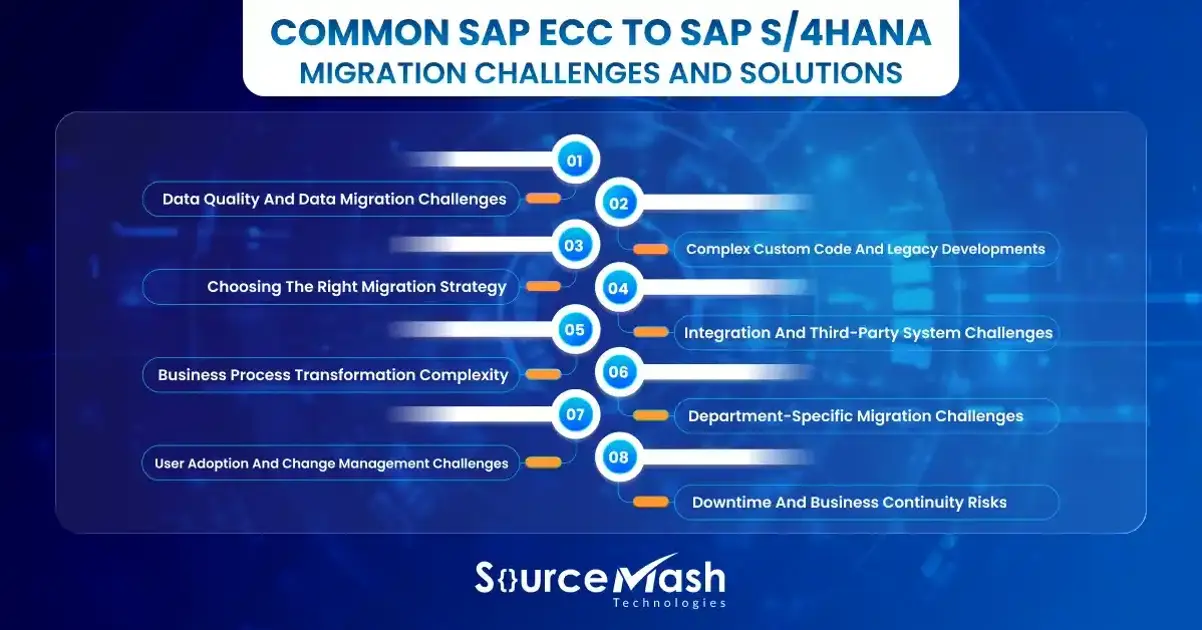
1. Data Quality and Data Migration Challenges
✔ The Challenge
Years of system usage often result in duplicate records, outdated information, inconsistent master data, and inaccurate business information. Migrating poor-quality data to SAP S/4HANA can lead to reporting issues, operational inefficiencies, and user frustration.
✔ The Solution
Organizations should begin data preparation well before migration activities start. This includes assessing data quality, eliminating obsolete records, standardizing master data, validating critical information, and establishing strong data governance practices. Conducting multiple test migrations can also help identify and resolve issues before production deployment.
2. Complex Custom Code and Legacy Developments
✔ The Challenge
Many SAP ECC environments contain years of custom enhancements, reports, interfaces, and modifications designed to meet specific business needs. Some of these custom developments may not be compatible with SAP S/4HANA.
✔ The Solution
A comprehensive custom code assessment should be performed to identify unused, redundant, or incompatible developments. Organizations should prioritize remediating critical customizations and replacing obsolete functionality with standard SAP S/4HANA capabilities wherever possible.
3. Choosing the Right Migration Strategy
✔ The Challenge
Selecting an unsuitable migration strategy can increase project complexity, cost, and risk.
✔ The Solution
Organizations should carefully evaluate available migration approaches based on business goals, system complexity, customization levels, and transformation requirements.
Brownfield Migration
Brownfield migration involves converting an existing SAP ECC system to SAP S/4HANA while retaining current business processes and configurations. This approach is suitable for organizations seeking a faster and less disruptive migration.
Greenfield Migration
Greenfield migration involves implementing SAP S/4HANA from scratch. It is ideal for organizations looking to redesign business processes and fully leverage SAP S/4HANA capabilities.
Hybrid (Selective Data Transition)
A hybrid approach combines elements of both Brownfield and Greenfield migrations, allowing organizations to selectively transform specific areas while retaining others.
4. Integration and Third-Party System Challenges
✔ The Challenge
SAP systems are typically connected to multiple applications, including CRM platforms, HR systems, supply chain solutions, manufacturing applications, and reporting tools. Changes introduced by SAP S/4HANA can affect existing integrations.
✔ The Solution
Organizations should create a complete inventory of integrations and dependencies before migration begins. Reviewing interfaces, updating APIs, validating middleware configurations, and conducting integration testing are critical steps for ensuring seamless connectivity.
5. Business Process Transformation Complexity
✔ The Challenge
Many organizations attempt to replicate existing SAP ECC processes within SAP S/4HANA. This can limit the value gained from migration and prevent businesses from realizing operational improvements.
✔ The Solution
Migration should be used as an opportunity to evaluate and optimize business processes. Organizations should identify process inefficiencies, eliminate unnecessary activities, standardize workflows, and align operations with SAP S/4HANA best practices.
6. Department-Specific Migration Challenges
Finance
✔ Challenge
Finance teams must adapt to new concepts such as the Universal Journal, streamlined financial processes, and updated reporting capabilities.
✔ Solution
Organizations should review financial processes, conduct reconciliation exercises, validate reporting requirements, and provide targeted training for finance users.
Supply Chain
✔ Challenge
Changes to logistics, inventory management, and planning processes can impact supply chain operations.
✔ Solution
Businesses should assess inventory data quality, validate logistics workflows, test planning processes, and ensure operational readiness before go-live.
Procurement
✔ Challenge
Inconsistent supplier records and fragmented procurement processes can create migration complications.
✔ Solution
Organizations should standardize procurement workflows, cleanse vendor master data, and validate purchasing processes before migration.
Manufacturing
✔ Challenge
Manufacturing environments often depend on numerous integrated systems and customized production processes.
✔ Solution
Production planning workflows, manufacturing integrations, and shop-floor processes should be thoroughly tested throughout the migration project.
7. User Adoption and Change Management Challenges
✔ The Challenge
One of the most overlooked aspects of migration is preparing employees for change. New interfaces, workflows, and responsibilities can create resistance and reduce productivity if users are not adequately prepared.
✔ The Solution
A structured change management program should include stakeholder engagement, executive sponsorship, role-based training, communication initiatives, user acceptance testing, and ongoing support following go-live.
8. Downtime and Business Continuity Risks
✔ The Challenge
Migration activities may require planned downtime, which can potentially disrupt critical business processes.
✔ The Solution
Organizations should develop detailed cutover plans, conduct migration rehearsals, prepare rollback procedures, establish contingency plans, and schedule migration activities during low-volume business periods whenever possible.
9. Security, Compliance, and Governance Challenges
✔ The Challenge
Migration projects often involve sensitive customer, employee, financial, and operational data. Ensuring compliance and maintaining data security throughout the migration process is essential.
✔ The Solution
Security and governance activities should be integrated into every phase of the migration project. This includes reviewing user roles, validating access controls, performing compliance assessments, conducting security testing, and documenting governance frameworks.
10. Budget and Resource Constraints
✔ The Challenge
Organizations frequently underestimate the resources, expertise, and time required to complete a successful SAP S/4HANA migration.
✔ The Solution
Strong project governance is essential. Businesses should define project scope clearly, allocate dedicated resources, establish realistic budgets, monitor project milestones, and proactively manage risks throughout the engagement.
11. Performance and Infrastructure Readiness
✔ The Challenge
SAP S/4HANA introduces different performance and infrastructure requirements compared to SAP ECC. Organizations may face issues related to server capacity, storage requirements, system performance, and scalability.
✔ The Solution
Infrastructure readiness assessments should be conducted early in the project. Key activities include system sizing, capacity planning, performance benchmarking, cloud readiness evaluation, and future scalability planning.
How to Assess Your SAP ECC Environment Before Migration
A readiness assessment is one of the most important steps in planning a successful migration.
System Landscape Assessment
Evaluate existing servers, databases, operating systems, applications, and system dependencies.
Data Readiness Assessment
Assess data quality, governance standards, data volumes, and migration requirements.
Custom Code Assessment
Analyze custom developments to determine compatibility with SAP S/4HANA.
Integration Assessment
Review APIs, middleware solutions, interfaces, and third-party system connections.
Business Process Assessment
Identify opportunities to streamline operations and improve efficiency.
Infrastructure Assessment
Determine whether current infrastructure can support SAP S/4HANA's technical requirements.
Typical SAP ECC to SAP S/4HANA Migration Timeline
Migration timelines vary based on organizational complexity, geography, customizations, and project scope. A standard migration often includes:
- Assessment and Discovery: 4 to 8 weeks
- Strategy and Planning: 4 to 6 weeks
- Preparation and Remediation: 2 to 4 months
- Migration and Testing: 2 to 6 months
- Go-Live Preparation: 2 to 4 weeks
- Hypercare and Stabilization: 1 to 2 months
Large enterprise migrations may require additional time depending on the scale of transformation.
Top SAP S/4HANA Migration Mistakes to Avoid
Underestimating Data Cleansing
Poor-quality data can create significant challenges throughout the migration process.
Delaying Custom Code Assessment
Waiting too long to address custom code issues often results in project delays and increased costs.
Ignoring Change Management
User adoption issues can prevent organizations from achieving expected business outcomes.
Insufficient Testing
Comprehensive testing is critical for ensuring system stability and business continuity.
Unrealistic Timelines
Aggressive schedules often increase project risk and impact implementation quality.
Overlooking Integration Dependencies
Undocumented interfaces and system dependencies can cause operational disruptions after go-live.
Post-Migration Success Strategies
Migration success extends beyond system deployment.
Organizations should continue focusing on optimization activities such as:
- Monitoring system performance
- Tracking key business metrics
- Optimizing workflows
- Expanding automation capabilities
- Strengthening security controls
- Increasing user adoption
- Enhancing analytics and reporting capabilities
Continuous improvement helps maximize the return on SAP S/4HANA investments.
Best Practices for a Successful SAP ECC to SAP S/4HANA Migration
Organizations that successfully migrate to SAP S/4HANA typically follow several proven practices:
- Begin with a comprehensive readiness assessment
- Define clear business objectives
- Prioritize data quality initiatives
- Establish strong governance structures
- Engage stakeholders early
- Conduct extensive testing cycles
- Invest in user training programs
- Implement effective change management
- Monitor project progress continuously
- Partner with experienced SAP specialists
Following these best practices can significantly reduce project risks while improving long-term business outcomes.
Frequently Asked Questions (FAQs)
What is the biggest challenge in SAP ECC to SAP S/4HANA migration?
Data quality issues, custom code remediation, integration complexity, and user adoption challenges are among the most common obstacles organizations face.
Which migration strategy is safer: Greenfield or Brownfield?
Brownfield migration is generally considered less disruptive because it preserves existing processes and configurations. Greenfield migration offers greater transformation opportunities but typically requires more planning and change management.
How long does SAP ECC to SAP S/4HANA migration take?
The timeline varies depending on system complexity, data volume, customization levels, and business requirements. Most projects take several months, while large enterprise migrations can extend beyond a year.
Can SAP ECC custom developments be migrated to SAP S/4HANA?
Yes, but they must first be assessed for compatibility. Some custom developments may require remediation, optimization, or replacement.
What are the benefits of SAP S/4HANA after migration?
Benefits include real-time reporting, simplified business processes, improved system performance, enhanced user experiences, increased operational agility, and support for intelligent technologies.
How can businesses reduce migration risk?
Organizations can reduce migration risk through readiness assessments, data cleansing, extensive testing, strong governance, comprehensive training, and effective change management practices.
Conclusion
SAP ECC to SAP S/4HANA migration presents numerous challenges, including data quality issues, legacy customizations, integration complexities, process transformation requirements, security concerns, and infrastructure readiness. However, these challenges can be addressed successfully with proper planning, governance, testing, and stakeholder engagement.
Organizations that approach migration as a business transformation initiative rather than simply a technical upgrade are better positioned to achieve long-term success. By selecting the right migration strategy, investing in preparation efforts, and focusing on continuous improvement, businesses can unlock the full value of SAP S/4HANA and establish a strong foundation for future growth.
Ready for a Successful SAP ECC to SAP S/4HANA Migration?
Whether you are evaluating migration options, building a migration roadmap, or preparing for implementation, a strategic and structured approach is essential. By addressing challenges early and following proven best practices, organizations can minimize risk, accelerate adoption, and maximize the long-term business value of SAP S/4HANA.