How Cloud Migration & Infrastructure Modernization Combined with ServiceNow ITSM Automation Drive Sustainable Digital Transformation
Digital transformation initiatives have shifted from isolated technology upgrades to enterprise-wide business transformation programs. Organizations today must support hybrid work models, cloud-native applications, data-driven decision-making, heightened cybersecurity requirements, and growing customer expectations. To meet these demands, businesses need more than modern infrastructure. They need an operational framework capable of managing complexity, maintaining service reliability, and enabling continuous innovation.
Many organizations successfully migrate workloads to the cloud but struggle to realize the expected business value because operational processes remain outdated. Manual service management, fragmented monitoring tools, inconsistent governance, and limited visibility can significantly reduce the benefits of cloud adoption.
This is why leading enterprises increasingly combine Cloud Migration & Infrastructure Modernization with ServiceNow ITSM Automation. Together, these initiatives create a modern IT backbone that aligns infrastructure, operations, and service delivery to support long-term business growth.
Executive Summary
Cloud migration enables organizations to move applications, data, and workloads from on-premises infrastructure to cloud environments, improving scalability, flexibility, and operational efficiency. Organizations should develop a robust Cloud Migration Strategy before moving workloads and applications to the cloud to minimize risks and maximize operational efficiency. The anchor text should link to What is Cloud Migration?.
A successful modernization strategy requires:
- Modern cloud infrastructure
- Standardized IT processes
- Automated service workflows
- Real-time operational visibility
- Governance and compliance controls
- Scalable operating models
ServiceNow provides the service management layer that enables organizations to effectively manage modern cloud environments. By integrating cloud modernization with ITSM automation, businesses can create a more efficient, resilient, and future-ready IT ecosystem.
The Growing Need for IT Infrastructure Modernization
Traditional IT environments were designed for a different business landscape. Most legacy infrastructures were built around predictable workloads, limited scalability requirements, and centralized operations.
Today's environment is fundamentally different.
Businesses must support:
- Remote and hybrid employees
- Multi-cloud ecosystems
- Continuous application delivery
- Digital customer experiences
- AI-powered business processes
- Real-time operational decision-making
Legacy infrastructure often creates barriers to these objectives.
Common Limitations of Legacy Environments
1. High Maintenance Costs
Older infrastructure requires significant investment in hardware maintenance, upgrades, and support.
2. Limited Scalability
Scaling traditional environments often involves lengthy procurement and deployment cycles.
3. Technical Debt
Years of customizations and disconnected systems increase operational complexity.
4. Security Risks
Legacy systems may lack modern security capabilities required to address evolving threats.
5. Poor Operational Visibility
IT teams frequently struggle to understand dependencies between systems, applications, and business services.
These challenges make infrastructure modernization a strategic business requirement rather than simply a technology initiative.
Understanding Cloud Migration and Infrastructure Modernization
Although often used together, cloud migration and infrastructure modernization are not the same thing.
What Is Cloud Migration?
Cloud migration refers to moving applications, data, and workloads from on-premises environments to cloud platforms such as:
- Microsoft Azure
- Amazon Web Services (AWS)
- Google Cloud Platform (GCP)
- Hybrid cloud environments
The goal is to improve scalability, flexibility, and resource efficiency.
What Is Infrastructure Modernization?
Infrastructure modernization focuses on redesigning technology environments to support modern business requirements.
This includes:
- Updating architectures
- Optimizing application portfolios
- Improving security frameworks
- Automating infrastructure operations
- Enhancing monitoring capabilities
- Strengthening operational resilience
While cloud migration changes where workloads operate, infrastructure modernization improves how those workloads are managed and delivered.
Why Cloud Migration Projects Often Struggle After Go-Live
Many organizations assume that operational improvements automatically follow a cloud migration.
Unfortunately, cloud adoption can expose existing process inefficiencies rather than eliminate them.
Challenge 1: Lack of Service Visibility
As environments expand, identifying service dependencies becomes increasingly difficult.
Without visibility, teams struggle to understand business impacts when incidents occur.
Challenge 2: Manual IT Service Processes
Many organizations continue relying on:
- Email-driven approvals
- Manual ticket assignments
- Spreadsheet-based asset tracking
- Disconnected workflows
These practices limit agility and increase response times.
Challenge 3: Inconsistent Change Management
Cloud environments enable rapid deployment, but without structured governance, organizations risk introducing service disruptions.
Challenge 4: Operational Silos
Infrastructure, operations, security, and service desk teams often work in separate systems.
This fragmentation slows problem resolution and reduces accountability.
Challenge 5: Cloud Cost Sprawl
Uncontrolled cloud provisioning can lead to unnecessary spending and inefficient resource utilization.
To overcome these challenges, organizations must modernize the way they operate, not just the technologies they deploy.
The Role of ServiceNow in Modern IT Operations
ServiceNow provides a unified platform for managing services, operations, workflows, and infrastructure across modern enterprises.
Rather than functioning solely as a ticketing system, ServiceNow acts as a digital workflow platform that connects people, processes, and technology.
This enables organizations to:
- Improve service delivery
- Automate repetitive tasks
- Enhance operational visibility
- Standardize governance
- Accelerate issue resolution
- Support continuous improvement
As cloud environments become more dynamic, ServiceNow helps organizations manage complexity without increasing operational overhead.
Understanding ServiceNow ITSM Automation
IT Service Management (ITSM) focuses on delivering reliable IT services that support business objectives.
ServiceNow automates these service management processes to improve consistency, efficiency, and user experiences.
✓ Incident Management
Automated incident workflows ensure issues reach the right support teams without unnecessary delays.
✓ Request Management
Self-service capabilities allow employees to access services through a centralized portal.
✓ Problem Management
Teams can identify recurring incidents and address root causes before they affect business operations.
✓ Change Management
Structured approval workflows reduce deployment risks and improve governance.
✓ Knowledge Management
Organizations create centralized knowledge repositories that empower employees to find answers independently.
✓ Workflow Automation
Routine activities can be automated, reducing manual workloads and accelerating service delivery.
The primary goal of ITSM automation is to improve operational efficiency while maintaining service quality.
ServiceNow Capabilities That Support Cloud Modernization
While ITSM focuses on service delivery, several ServiceNow capabilities directly support cloud migration and infrastructure modernization initiatives.
✓ Configuration Management Database (CMDB)
The CMDB serves as a centralized source of truth for infrastructure and service relationships.
Benefits include:
- Asset visibility
- Dependency mapping
- Improved impact analysis
- Better governance
✓ Discovery
ServiceNow Discovery automatically identifies and maps infrastructure assets across environments.
This eliminates the challenges associated with manual asset tracking.
✓ Service Mapping
Service Mapping helps organizations understand how infrastructure components support business-critical services.
This improves troubleshooting and change planning.
✓ IT Operations Management (ITOM)
ITOM provides operational intelligence across modern infrastructure environments.
Capabilities include:
- Event management
- Service mapping
- Infrastructure visibility
- Operational analytics
✓ Cloud Resource Visibility
Organizations gain better insight into cloud assets, helping improve governance and cost management.
Unlike ITSM, which manages service processes, these capabilities focus on understanding and controlling complex technology environments.
Business Outcomes of Combining Cloud Migration and ITSM Automation
Organizations invest in modernization initiatives to achieve measurable business improvements.
When cloud transformation and ServiceNow automation work together, several outcomes become possible.
✓ Improved Service Reliability
Automated workflows and better operational visibility help reduce service disruptions.
✓ Faster Resolution of Technology Issues
Intelligent routing and standardized workflows accelerate support processes.
✓ Increased Business Agility
Organizations can deploy new services faster while maintaining governance controls.
✓ Better Employee Experiences
Employees gain access to self-service capabilities and faster support responses.
✓ Stronger Operational Governance
Standardized workflows improve compliance, accountability, and process consistency.
✓ Greater Executive Visibility
Leadership teams can make informed decisions using centralized operational data and reporting.
These outcomes directly support broader business objectives such as growth, innovation, and customer satisfaction.
Industry Use Cases
Financial Services
Challenge: Financial institutions must modernize infrastructure while maintaining strict regulatory compliance.
Solution: Cloud modernization combined with automated incident, change, and governance workflows.
Outcome: Improved operational resilience, enhanced compliance visibility, and reduced risk exposure.
Healthcare
Challenge: Healthcare providers require highly available systems that support patient care and clinical operations.
Solution: ServiceNow-powered automation integrated with modern cloud infrastructure.
Outcome: Improved uptime, faster issue resolution, and more reliable healthcare services.
Manufacturing
Challenge: Manufacturers rely on connected systems across production facilities, warehouses, and supply chains.
Solution: Modernized infrastructure with automated service management processes.
Outcome: Reduced disruptions, improved system performance, and stronger operational efficiency.
Retail
Challenge: Retail organizations must support both physical and digital customer experiences.
Solution: Cloud-first infrastructure combined with standardized IT service operations.
Outcome: Greater scalability during peak demand periods and improved customer experiences.
Technology Companies
Challenge: Rapid innovation often increases operational complexity.
Solution: Integrated cloud operations and automated service management.
Outcome: Faster deployment cycles, improved reliability, and increased productivity.
A Six-Stage Framework for Successful Transformation
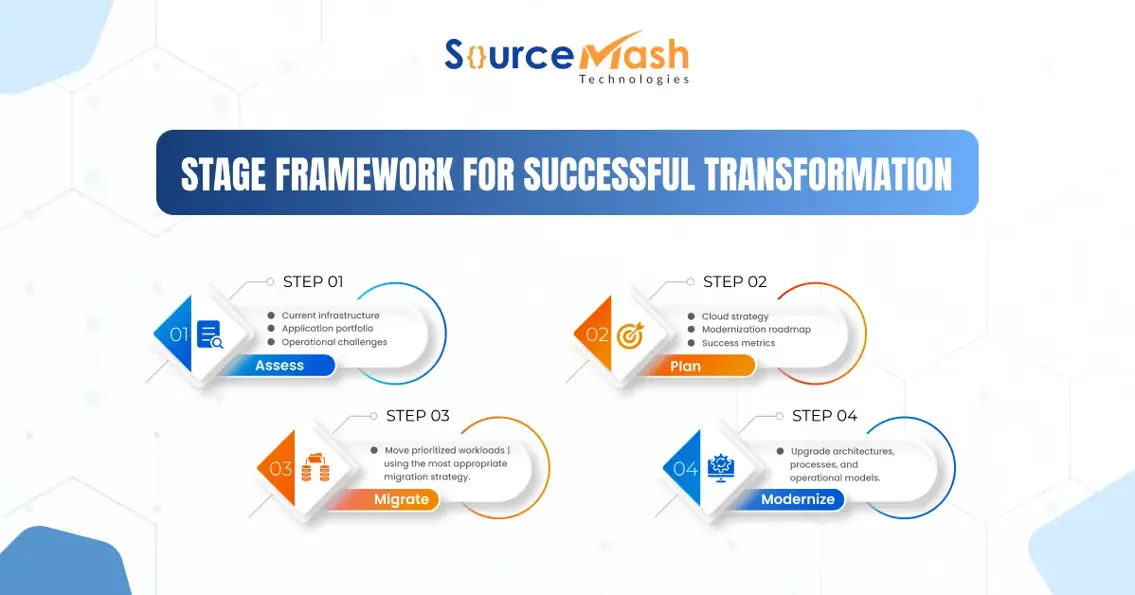
Stage 1: Assess
Evaluate:
- Current infrastructure
- Application portfolio
- Service management maturity
- Operational challenges
Stage 2: Plan
Develop:
- Cloud strategy
- Modernization roadmap
- Governance framework
- Success metrics
Stage 3: Migrate
Move prioritized workloads using the most appropriate migration strategy.
Stage 4: Modernize
Upgrade architectures, processes, and operational models.
Stage 5: Automate
Implement ServiceNow workflows and service automation capabilities.
Stage 6: Optimize
Continuously improve performance using analytics, monitoring, and operational insights.
Best Practices for Cloud and ITSM Transformation
- Align Technology Goals with Business Objectives
Modernization initiatives should support measurable business outcomes.
- Establish Governance Early
Governance frameworks should be defined before large-scale migrations begin.
- Maintain Accurate Configuration Data
Reliable CMDB data improves automation, reporting, and decision-making.
- Standardize Core Processes
Consistent workflows improve efficiency across teams and locations.
- Focus on User Experience
Technology modernization should improve both employee and customer experiences.
- Measure Success Continuously
Track key performance indicators such as:
- Service availability
- Incident resolution times
- Change success rates
- User satisfaction
- Operational efficiency metrics
Future Trends Shaping Modern IT Operations
✓ AIOps
Artificial intelligence is increasingly being used to predict and prevent service disruptions.
✓ Hyperautomation
Organizations are automating end-to-end workflows across multiple business functions.
✓ Generative AI
AI-powered assistants are enhancing service desk productivity and employee support experiences.
✓ Unified Service Operations
The future of IT management lies in bringing together ITSM, ITOM, cloud management, and security operations through a single operational platform.
Why Organizations Partner with ServiceNow Transformation Experts
Successfully modernizing infrastructure and implementing ServiceNow requires more than just the right technology. Organizations need a clear strategy, streamlined processes, and the expertise to ensure cloud migration and ITSM transformation deliver the expected business outcomes.
This is where Sourcemash Technologies helps. With expertise in Cloud Migration, Infrastructure Modernization, ServiceNow ITSM, ITOM, CMDB, Discovery, and Workflow Automation, Sourcemash helps organizations simplify complex transformation initiatives, automate service operations, and gain greater visibility across their IT environment.
From migration planning and ServiceNow implementation to ongoing optimization, Sourcemash enables businesses to improve service delivery, strengthen governance, reduce operational complexity, and build a scalable IT foundation that supports long-term growth and innovation.
Conclusion
Building a modern IT backbone requires a holistic approach to transformation. Cloud migration delivers the scalability and flexibility needed to support future business growth, while infrastructure modernization creates a stronger technological foundation. However, sustainable success depends on an organization's ability to manage and operate those environments efficiently.
ServiceNow ITSM automation provides the operational framework that transforms cloud investments into measurable business outcomes. By combining infrastructure modernization with intelligent service management, organizations can improve service reliability, strengthen governance, increase efficiency, and create a resilient platform for continued innovation.
The organizations that will lead tomorrow's digital economy are not simply migrating to the cloud. They are modernizing the way technology, operations, and services work together to create lasting business value.