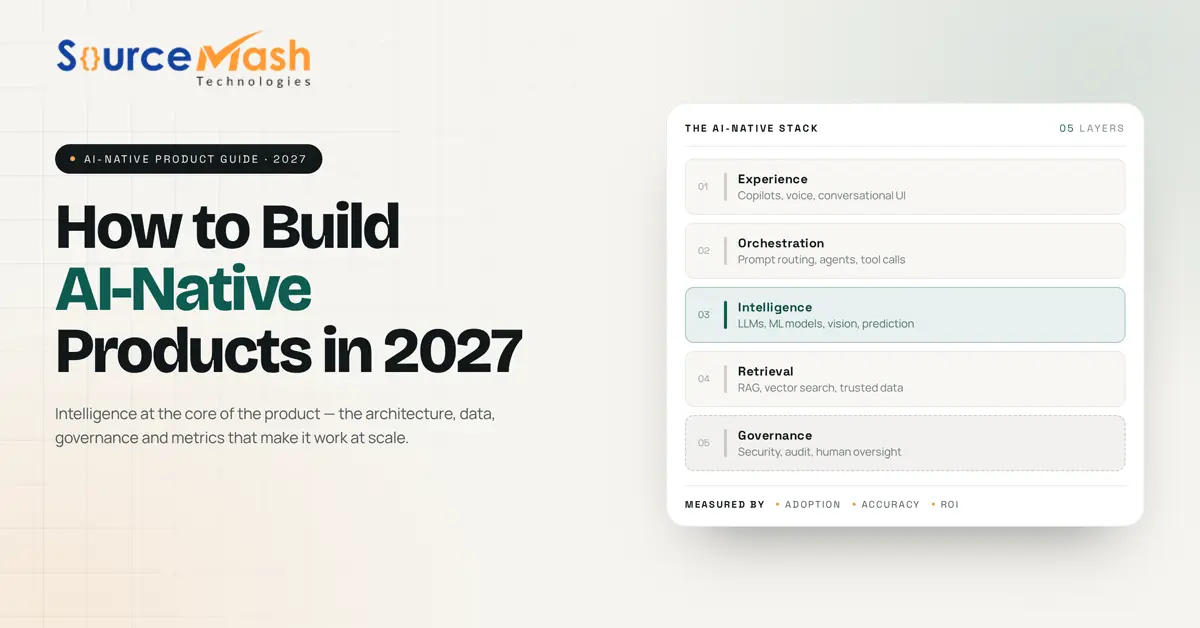
Artificial Intelligence is reshaping the future of digital products. In 2027, businesses are no longer treating AI as an add-on feature. Instead, they are building AI-native products where intelligence is woven into the core of the user experience, workflows, and decision-making processes.
From AI-powered SaaS platforms and enterprise copilots to intelligent automation systems, AI-native products are helping organizations improve efficiency, enhance customer experiences, and unlock new business opportunities. However, building a successful AI-native product requires much more than integrating a large language model (LLM). It requires a strategic approach that combines business goals, data readiness, scalable architecture, security, governance, and continuous optimization.
This guide explores proven strategies, frameworks, technologies, and best practices for building AI-native products in 2027 while answering the most important questions businesses have before starting their AI journey.
What Is an AI-Native Product?
An AI-native product is a software application built with Artificial Intelligence as a foundational component rather than incorporating AI features after development.
Unlike traditional software that follows predefined rules and workflows, AI-native products learn from data, adapt to user behavior, automate tasks, and continuously improve performance over time.
Key Characteristics of AI-Native Products
- Natural language interactions
- Context-aware decision-making
- Intelligent automation
- Personalized user experiences
- Adaptive workflows
- Continuous learning
- Predictive insights
- Real-time optimization
The defining difference is that AI directly drives the core product experience and value proposition.
Why Businesses Are Investing in AI-Native Products in 2027
Organizations are increasingly adopting AI-native development because customer expectations have changed. Users now expect products that understand their needs, automate repetitive work, and provide personalized experiences.
Enhanced Customer Experiences
AI-native products analyze user behavior and preferences to deliver relevant recommendations, smarter interactions, and more personalized journeys.
Improved Operational Efficiency
Organizations can automate repetitive tasks, reduce manual workloads, and improve productivity across departments.
Faster Decision-Making
AI systems process large volumes of data quickly, enabling organizations to identify insights and make faster decisions.
Greater Scalability
AI-powered automation allows businesses to support more users and processes without significantly increasing operational costs.
Competitive Advantage
Companies that adopt AI-first strategies can innovate faster and better respond to changing customer demands.
AI-Native Products vs Traditional Software
Understanding this distinction helps businesses make better technology and product decisions.
| Traditional Software | AI-Native Products |
|---|---|
| Rule-based workflows | Learning-based systems |
| Fixed functionality | Adaptive functionality |
| Static experiences | Personalized experiences |
| Manual optimization | Continuous optimization |
| Structured interactions | Natural language interactions |
| Predictable outputs | Context-aware outputs |
| Limited adaptability | Continuous improvement |
Traditional software executes instructions. AI-native products learn, adapt, and evolve through interactions and data.
Real-World AI-Native Product Development Example
Before exploring frameworks and technologies, let's examine how AI-native thinking creates business value.
Business Challenge
A growing SaaS company struggles with increasing customer support requests, longer response times, and rising support costs.
AI-Native Solution
The company develops an AI-powered support system incorporating:
- Conversational AI
- Knowledge base search
- Intelligent ticket classification
- Response recommendations
Business Outcomes
The organization achieves:
- Faster customer support responses
- Improved support team productivity
- Reduced operational costs
- Higher customer satisfaction
This example demonstrates how AI-native products focus on solving business challenges instead of simply adding AI features.
Core Components of an AI-Native Product
Successful AI-native products rely on several interconnected layers working together.
User Experience Layer
This layer enables user interactions through:
- Web applications
- Mobile applications
- AI copilots
- Voice interfaces
- Conversational experiences
The goal is to create seamless and intuitive experiences.
Data Layer
The data layer manages:
- Data collection
- Data processing
- Data storage
- Data governance
- Data quality management
Reliable data is essential for AI performance.
Intelligence Layer
This layer provides AI capabilities through:
- Large Language Models (LLMs)
- Machine Learning models
- Recommendation engines
- Predictive analytics systems
- Computer vision models
Automation Layer
The automation layer transforms AI insights into actions and orchestrates workflows.
Governance Layer
This layer ensures:
- Security
- Compliance
- Accountability
- Transparency
- Responsible AI usage
AI-Native Product Development Lifecycle
Building an AI-native product involves a structured process.
Step 1: Define the Business Problem
Identify a specific challenge where AI can create measurable business value.
Questions to ask:
- What problem are users trying to solve?
- Which processes are inefficient?
- Where can automation improve outcomes?
Step 2: Assess and Prepare Data
Organizations must evaluate available data and improve its quality through:
- Cleansing
- Validation
- Classification
- Governance
Step 3: Select the Right AI Technologies
Choose technologies based on the use case and business objectives.
Examples include:
- Generative AI
- Predictive analytics
- Recommendation engines
- Computer vision
- Speech AI
Step 4: Design the User Experience
An AI-native product should prioritize:
- Transparency
- Explainability
- Accessibility
- User trust
- Human oversight
Step 5: Develop and Integrate
This stage includes:
- API development
- AI integrations
- Workflow creation
- Infrastructure setup
- Security implementation
Step 6: Test and Validate
Assess:
- Accuracy
- Reliability
- Security
- Scalability
- Compliance
Step 7: Launch the Product
Deploy the solution with monitoring and governance controls in place.
Step 8: Continuously Improve
Use analytics, user feedback, and AI monitoring to optimize performance over time.
AI-Native Product Architecture Framework
A scalable architecture supports long-term growth and adaptability.
User Interface Layer
Supports interactions across websites, applications, and conversational interfaces.
Application Layer
Handles:
- Authentication
- Business logic
- User management
- Workflow coordination
AI Orchestration Layer
Manages:
- Prompt routing
- Context handling
- Tool execution
- Agent coordination
Intelligence Layer
Provides AI capabilities using:
- GPT-based models
- Claude
- Gemini
- Open-source models
- Custom-trained models
Retrieval-Augmented Generation (RAG) Layer
RAG connects AI models with trusted data sources to improve accuracy and reduce hallucinations.
Vector Database Layer
Supports semantic search and intelligent information retrieval.
Popular databases include:
- Pinecone
- Weaviate
- Chroma
- Milvus
Security Layer
Protects systems through:
- Encryption
- Authentication
- Access control
- Threat monitoring
Monitoring Layer
Tracks:
- Model performance
- User engagement
- Costs
- Accuracy
- System health
Recommended Technology Stack for AI-Native Products
The technology stack should align with both business goals and scalability requirements.
Frontend Technologies
- React
- Next.js
- Angular
- Vue.js
Backend Technologies
- Python
- FastAPI
- Django
- Node.js
- .NET
AI Technologies
- GPT models
- Claude
- Gemini
- Open-source LLMs
- Custom AI models
Vector Databases
- Pinecone
- Chroma
- Weaviate
- Milvus
Cloud Platforms
- Microsoft Azure AI
- AWS AI Services
- Google Cloud AI
MLOps Tools
- Deployment automation
- Monitoring systems
- Model versioning
- Performance optimization
12 Proven Strategies for Building AI-Native Products
1. Start with a Clear Business Objective
Define the problem before choosing technologies.
2. Build Strong Data Foundations
High-quality data improves AI accuracy and reliability.
3. Design for Human-AI Collaboration
Allow users to review, refine, and guide AI-generated outputs.
4. Prioritize Explainability
Users should understand how AI arrives at recommendations.
5. Implement Responsible AI Practices
Address privacy, fairness, accountability, and transparency.
6. Adopt Modular Architecture
Create systems that support future technology upgrades.
7. Create Continuous Feedback Loops
User feedback helps improve AI performance.
8. Focus on AI User Experience
Successful AI products are intuitive and easy to use.
9. Strengthen Security Measures
Protect users, data, and systems from risks.
10. Plan for Scalability
Build infrastructure capable of supporting future growth.
11. Measure Business Impact
Track metrics that demonstrate real business value.
12. Future-Proof Your Product
Design systems that can adapt to emerging AI technologies.
Build vs Buy: Choosing the Right AI Strategy
Many organizations debate whether to build a custom solution or adopt an existing platform.
When to Build
Building is ideal when:
- Competitive differentiation is important
- Unique workflows exist
- Proprietary data creates value
- Extensive customization is required
Benefits of Building
- Complete ownership
- Greater flexibility
- Long-term competitive advantage
- Better control over innovation
When to Buy
Purchasing may be better when:
- Speed to market is critical
- Requirements are standardized
- Budgets are limited
- Internal AI expertise is unavailable
Benefits of Buying
- Faster implementation
- Lower initial cost
- Easier maintenance
- Reduced development effort
Industry Use Cases for AI-Native Products
Healthcare
- Clinical documentation
- Patient support
- Diagnostic assistance
- Medical knowledge retrieval
Financial Services
- Fraud detection
- Risk assessment
- Compliance monitoring
- Customer support automation
Retail and E-Commerce
- Product recommendations
- Dynamic pricing
- Inventory forecasting
- AI shopping assistants
Manufacturing
- Predictive maintenance
- Production optimization
- Quality control automation
- Supply chain intelligence
SaaS Platforms
- AI copilots
- Workflow assistants
- Intelligent reporting
- Knowledge management systems
Key KPIs for Measuring AI-Native Product Success
Tracking the right metrics helps organizations evaluate performance.
User Adoption Metrics
- Active users
- Feature adoption rates
- User engagement
Customer Experience Metrics
- Customer Satisfaction Score (CSAT)
- Net Promoter Score (NPS)
- Retention rate
Operational Metrics
- Productivity improvements
- Time savings
- Automation rates
AI Performance Metrics
- Accuracy
- Precision
- Recall
- Response quality
Business Metrics
- Revenue growth
- Cost reduction
- Customer acquisition
- Return on Investment (ROI)
Factors That Influence AI-Native Product Development Costs
Several elements affect development costs.
Data Preparation
Data collection and cleaning often require significant investment.
AI Infrastructure
Cloud resources, storage, and model usage contribute to ongoing expenses.
Development Resources
AI projects typically involve:
- AI engineers
- Product managers
- Software developers
- Data scientists
Security and Compliance
Regulatory and security requirements can increase project complexity.
Ongoing Maintenance
AI-native products require continuous monitoring and optimization.
AI Security and Governance Best Practices
Trust and compliance are critical for AI adoption.
Establish Data Governance Policies
Define how data is collected, stored, and processed.
Maintain Audit Trails
Track key activities to improve accountability and transparency.
Monitor AI Performance
Regularly evaluate model behavior and reliability.
Protect Access
Implement authentication, authorization, and role-based access controls.
Ensure Human Oversight
Critical decisions should remain reviewable by qualified stakeholders.
Common Reasons AI-Native Product Initiatives Fail
Many organizations face challenges because they overlook key success factors.
Poor Problem Definition
AI projects often fail when business objectives are unclear.
Weak Data Foundations
Poor-quality data leads to unreliable outcomes.
Lack of Governance
Insufficient oversight creates security and compliance risks.
Unrealistic Expectations
Expecting immediate transformation often results in disappointment.
Low User Adoption
Users must trust and understand AI capabilities.
Inadequate Measurement
Success becomes difficult to prove without meaningful KPIs.
Step-by-Step Roadmap for Building an AI-Native Product
Phase 1: Strategy and Discovery
- Define goals
- Identify use cases
- Assess readiness
Phase 2: Validation
- Build prototypes
- Test feasibility
- Collect stakeholder feedback
Phase 3: Development
- Design architecture
- Integrate AI models
- Build workflows
Phase 4: Launch
- Deploy systems
- Train users
- Monitor adoption
Phase 5: Scale
- Expand capabilities
- Improve governance
- Optimize performance
Key Considerations Before Starting Development
Before investing in AI-native development, evaluate:
Data Maturity
Determine whether existing data is sufficient and trustworthy.
Infrastructure Readiness
Assess cloud platforms, integrations, and scalability needs.
Security Requirements
Identify data protection and risk management requirements.
Compliance Obligations
Understand industry regulations and governance standards.
Team Capabilities
Evaluate internal skills and resource availability.
Budget Constraints
Plan for both development and long-term operating costs.
Long-Term Business Goals
Ensure AI initiatives support broader organizational objectives.
Future Trends Shaping AI-Native Products Beyond 2027
Autonomous AI Agents
AI systems will increasingly complete tasks independently.
Multi-Agent Collaboration
Multiple specialized AI agents will work together to solve complex problems.
Multimodal AI
Products will process text, images, video, audio, and structured data simultaneously.
Hyper-Personalization
Experiences will adapt in real time based on user context and behavior.
Industry-Specific AI Models
Organizations will increasingly adopt models tailored to their sectors.
Privacy-First AI
Security, transparency, and governance will become key competitive differentiators.
Conclusion
AI-native products represent the next evolution of software development. Organizations that combine clear business goals, strong data foundations, scalable architecture, responsible governance, and excellent user experiences will be best positioned to succeed.
Rather than treating AI as a feature, leading companies are making intelligence the foundation of their products. This approach enables them to create smarter experiences, streamline operations, improve decision-making, and maintain a competitive advantage in a rapidly evolving digital landscape.
Frequently Asked Questions (FAQs)
What is an AI-native product?
An AI-native product is software built with Artificial Intelligence as a core component, enabling automation, personalization, and continuous learning.
How are AI-native products different from traditional software?
Traditional software follows fixed rules, while AI-native products adapt through data, learning, and intelligent decision-making.
What technologies are commonly used in AI-native product development?
Common technologies include LLMs, machine learning models, RAG frameworks, vector databases, cloud AI platforms, and MLOps tools.
What are the biggest challenges in building AI-native products?
Major challenges include data quality, security, governance, scalability, compliance, and user trust.
Should businesses build or buy AI solutions?
The decision depends on business goals, budget, customization needs, internal expertise, and time-to-market requirements.
How can organizations measure AI-native product success?
Success can be measured through adoption rates, satisfaction scores, productivity improvements, operational efficiency, revenue growth, and ROI.
Why do AI-native initiatives fail?
Common reasons include unclear objectives, poor data foundations, weak governance, unrealistic expectations, and low user adoption.
How can businesses future-proof AI-native products?
Organizations can future-proof products by adopting modular architectures, maintaining strong governance, prioritizing scalability, and continuously evaluating emerging AI technologies.