Many organizations successfully use Salesforce to manage leads, opportunities, accounts, and forecasts. Yet despite having a powerful CRM in place, they often face a larger business challenge: customer information, business processes, teams, and systems remain disconnected.
Marketing operates on one platform. Sales works in Salesforce. Customer service uses another application. Finance relies on ERP data. Employees manage critical information in spreadsheets, while leadership teams spend valuable time reconciling reports from multiple sources.
As a result, Salesforce may effectively support sales activities without providing the connected customer experience and operational visibility required for sustainable growth.
This is where Salesforce CRM transformation becomes essential.
Rather than focusing solely on pipeline management, Salesforce CRM transformation helps organizations connect customer data, people, processes, applications, analytics, automation, governance, and AI across the entire customer lifecycle.
Instead of thinking only about:
Lead → Opportunity → Proposal → Deal
Organizations begin managing a complete customer journey:
Attract → Engage → Convert → Onboard → Support → Retain → Grow
The objective is not to move every business process into Salesforce. The goal is to ensure that employees have access to the right information at the right time, enabling better decisions, seamless customer experiences, and scalable business operations.
Executive Summary
Salesforce CRM transformation is a business transformation initiative enabled by technology.
Unlike a traditional Salesforce implementation that focuses primarily on deployment and configuration, CRM transformation examines how customer data, business processes, employees, and technology work together to deliver better outcomes throughout the customer lifecycle.
Organizations typically invest in CRM transformation to:
- Eliminate data silos
- Improve customer experiences
- Increase Salesforce adoption
- Reduce manual work
- Improve reporting accuracy
- Enable automation and AI
- Strengthen governance
- Improve operational efficiency
- Support long-term growth
Most importantly, successful CRM transformation requires alignment between business strategy, people, processes, systems, and performance measurement.
Key Takeaways
- Salesforce CRM transformation is broader than a Salesforce implementation.
- Business outcomes should drive technology decisions.
- Customer journeys should guide transformation priorities.
- Data quality and governance are foundational success factors.
- Simplification should happen before automation.
- AI initiatives depend on strong data and process foundations.
- Adoption and change management are just as important as technology.
- Success should be measured using business KPIs rather than deployment milestones.
- A phased transformation roadmap reduces risk.
- CRM transformation is a continuous improvement journey, not a one-time project.
What Is Salesforce CRM Transformation?
Salesforce CRM transformation is the strategic effort to improve how an organization acquires, serves, retains, and grows customer relationships using Salesforce and connected technologies.
While many organizations think of CRM initiatives as software projects, real transformation extends far beyond system implementation.
It may involve:
- Customer journey redesign
- Process optimization
- Data modernization
- Integration initiatives
- Workflow automation
- Analytics improvements
- Governance enhancements
- Security improvements
- User adoption programs
- AI-enabled capabilities
The focus is not on implementing Salesforce features.
The focus is identifying business problems and using Salesforce strategically to solve them.
Organizations that view Salesforce purely as a CRM platform often limit its value. Organizations that treat it as a transformation platform are far more likely to improve customer experiences, operational efficiency, and business performance.
Salesforce CRM Transformation Quick Answers
What is the Salesforce CRM transformation?
Salesforce CRM transformation is the process of improving customer engagement, operational efficiency, decision-making, and business growth through Salesforce, connected systems, automation, analytics, and governance.
Is CRM transformation only about sales?
No. While sales is an important component, transformation often impacts marketing, customer service, customer success, finance, operations, leadership teams, and IT departments.
How is transformation different from implementation?
Implementation focuses on deploying technology. Transformation focuses on improving business outcomes through a combination of technology, process design, governance, and organizational change.
Does CRM transformation require replacing existing systems?
Not necessarily. In many cases, transformation connects and optimizes existing systems rather than replacing them completely.
Why CRM Transformation Goes Beyond the Sales Pipeline
The sales pipeline remains critical to revenue growth, but customers rarely experience companies through a single department.
Their journey often spans multiple teams, systems, and interactions:
Marketing → Sales → Onboarding → Service → Billing → Customer Success → Renewal
The challenge is that these functions frequently operate independently.
Sales representatives may not know about unresolved support issues. Service teams may lack visibility into commitments made during the sales cycle. Marketing teams may not fully understand purchasing behaviors and customer outcomes.
When information becomes fragmented, customer experiences suffer.
CRM transformation addresses these challenges by creating continuity across departments, ensuring that information follows the customer journey instead of remaining trapped within individual systems.
Salesforce Implementation vs CRM Transformation
A Salesforce implementation and a Salesforce CRM transformation are closely related but fundamentally different.
A traditional implementation focuses on deploying Salesforce successfully. Success is often measured by system go-live dates, migration completion, or feature adoption.
CRM transformation focuses on business improvement.
Instead of asking:
"Did Salesforce get implemented successfully?"
Organizations ask:
"Did we improve customer experiences, business efficiency, decision-making, and revenue performance?"
A successful implementation can support transformation, but implementation by itself does not guarantee meaningful business change.
Who Needs Salesforce CRM Transformation?
Organizations should consider CRM transformation when they experience recurring challenges that involve multiple departments, systems, and processes.
Common indicators include:
- Fragmented customer information
- Low Salesforce adoption
- Duplicate data entry
- Manual reporting
- Spreadsheet-dependent workflows
- Poor customer visibility
- Inconsistent metrics
- Complex handoffs between teams
- Integration limitations
- Scalability challenges
When business issues repeatedly involve customer journeys, processes, systems, and data simultaneously, a transformation approach often delivers more value than isolated technology initiatives.
What Salesforce CRM Transformation Looks Like
Before Transformation
Customer information often exists in multiple disconnected systems.
Employees spend significant time searching for information, re-entering data, and manually creating reports. Different departments maintain conflicting records, creating confusion and reducing confidence in business decisions.
Processes become slower and collaboration becomes more difficult as organizations grow.
After Transformation
Data becomes accessible within business workflows.
Employees spend less time on administrative activities and more time delivering customer value. Reporting becomes more reliable, collaboration improves, and business leaders gain clearer visibility into performance.
Most importantly, customers experience more consistent interactions across every stage of their relationship with the organization.
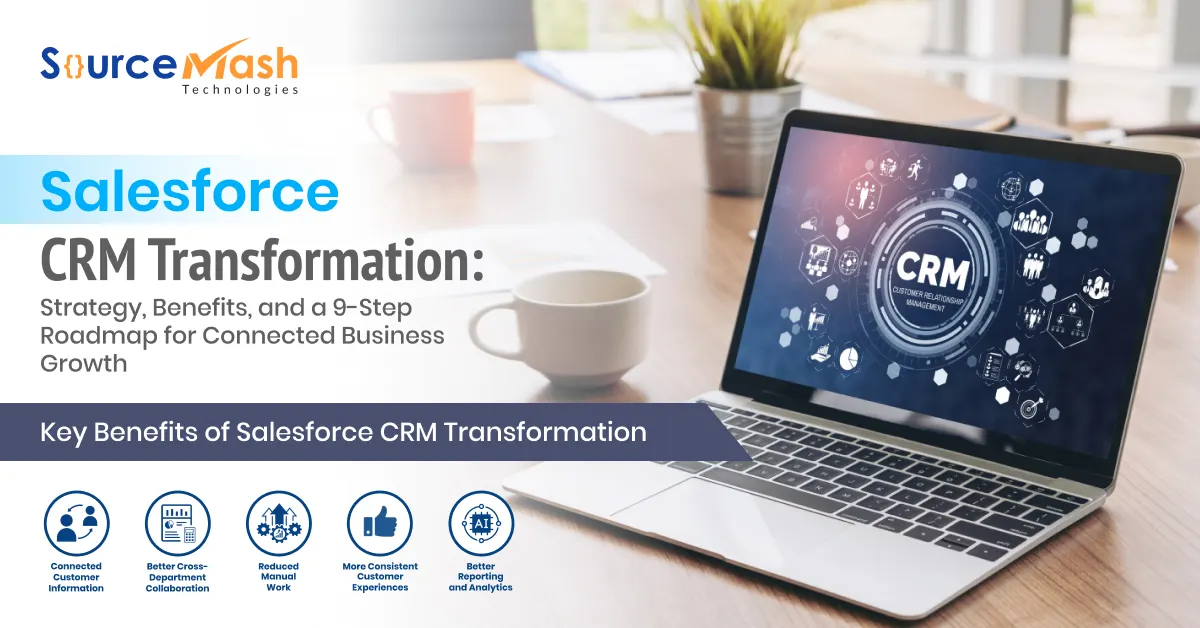
Key Benefits of Salesforce CRM Transformation
1. Connected Customer Information
One of the biggest advantages of CRM transformation is creating a unified view of the customer.
Rather than switching between multiple applications to gather information, employees can access the context they need within their workflows.
This improves decision-making, accelerates response times, and supports better customer conversations.
2. Better Cross-Department Collaboration
Customer relationships rarely belong to a single team.
Transformation creates alignment across marketing, sales, service, operations, and customer success by establishing shared visibility and consistent processes.
The result is smoother handoffs and a more coordinated customer experience.
3. Reduced Manual Work
Many organizations discover that employees spend significant time performing administrative tasks.
CRM transformation identifies opportunities to eliminate unnecessary work, simplify processes, and automate repetitive activities.
This improves productivity while reducing operational costs.
4. More Consistent Customer Experiences
Customers expect organizations to understand their history regardless of which team they interact with.
When customer context follows the entire journey, conversations become more personalized, support becomes more effective, and customer satisfaction improves.
5. Better Reporting and Analytics
Disconnected systems often create conflicting reports and unreliable metrics.
CRM transformation strengthens reporting by improving data quality, governance, and system integration.
Leaders gain greater confidence in forecasting, planning, and decision-making.
6. Greater AI Readiness
Organizations are increasingly exploring Salesforce AI capabilities, but AI depends on high-quality data and well-defined processes.
CRM transformation establishes the foundation necessary for successful AI initiatives by improving governance, system connectivity, and process consistency.
Real-World CRM Transformation Examples
Manufacturing Company
A manufacturing organization maintained customer information across Salesforce and several ERP platforms.
Sales teams lacked visibility into order history, while service teams struggled to access accurate customer information.
By integrating Salesforce with ERP systems and standardizing data management processes, the organization improved account visibility, customer service responsiveness, and forecasting accuracy.
SaaS Organization
A rapidly growing SaaS company experienced onboarding challenges because customer success teams lacked visibility into sales commitments.
The organization connected sales and onboarding workflows, automated key activities, and improved information sharing across teams.
As a result, onboarding became smoother, customer satisfaction improved, and renewal rates increased.
Financial Services Firm
A financial services organization relied heavily on spreadsheets and disconnected systems to manage customer relationships.
After consolidating customer information and standardizing workflows, advisors gained better visibility into client activity while leadership gained more reliable reporting and compliance oversight.
Seven Areas CRM Transformation Can Improve
1. Customer Data Management
Data quality, ownership, governance, integration, and security.
2. Sales and Marketing Alignment
Lead management, qualification, funnel visibility, and revenue attribution.
3. Customer Service Operations
Case management, customer context, resolution workflows, and service efficiency.
4. Workflow Automation
Lead routing, approvals, notifications, escalations, and renewals.
5. Salesforce Integrations
ERP systems, finance applications, marketing platforms, data warehouses, and e-commerce solutions.
6. Reporting and Analytics
Forecasting, customer insights, executive dashboards, and operational visibility.
7. AI-Enabled CRM Capabilities
Lead scoring, service recommendations, intelligent insights, sales assistance, and workflow automation.
Salesforce CRM Transformation Framework: A 9-Step Roadmap
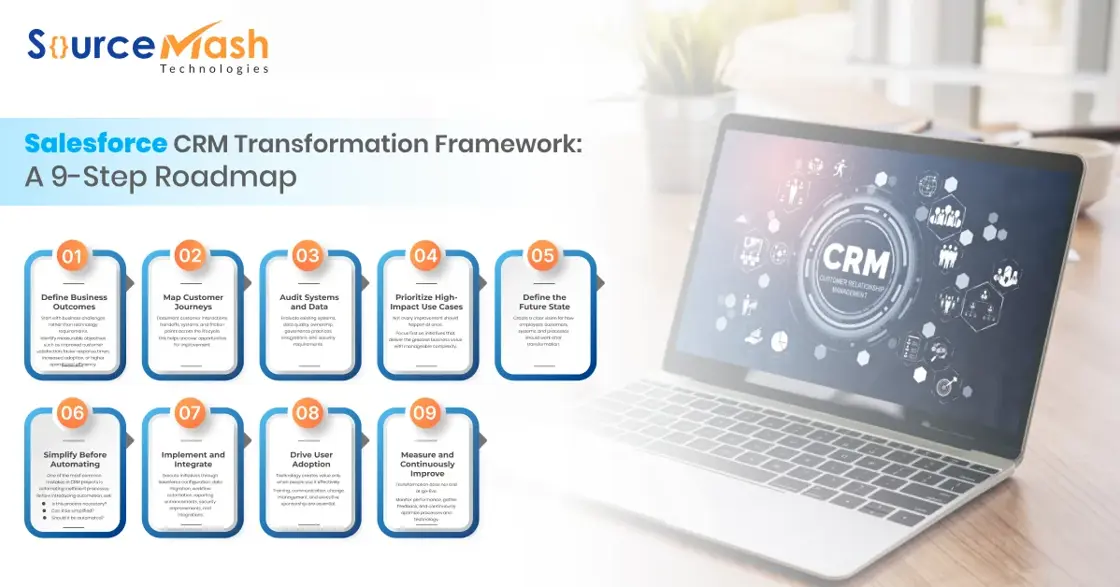
Step 1: Define Business Outcomes
Start with business challenges rather than technology requirements.
Identify measurable objectives such as improved customer satisfaction, faster response times, increased adoption, or higher operational efficiency.
Step 2: Map Customer Journeys
Document customer interactions, handoffs, systems, and friction points across the lifecycle.
This helps uncover opportunities for improvement.
Step 3: Audit Systems and Data
Evaluate existing systems, data quality, ownership, governance practices, integrations, and security requirements.
Step 4: Prioritize High-Impact Use Cases
Not every improvement should happen at once.
Focus first on initiatives that deliver the greatest business value with manageable complexity.
Step 5: Define the Future State
Create a clear vision for how employees, customers, systems, and processes should work after transformation.
Step 6: Simplify Before Automating
One of the most common mistakes in CRM projects is automating inefficient processes.
Before introducing automation, ask:
- Is this process necessary?
- Can it be simplified?
- Should it be automated?
Step 7: Implement and Integrate
Execute initiatives through Salesforce configuration, data migration, workflow automation, reporting enhancements, security improvements, and integrations.
Step 8: Drive User Adoption
Technology creates value only when people use it effectively.
Training, communication, change management, and executive sponsorship are essential.
Step 9: Measure and Continuously Improve
Transformation does not end at go-live.
Monitor performance, gather feedback, and continuously optimize processes and technology.
Six Common CRM Transformation Challenges
1. Treating CRM as an IT Project
Solution: Involve business stakeholders from the beginning.
2. Poor Data Quality
Solution: Establish governance, standards, and ownership.
3. Automating Inefficient Processes
Solution: Simplify before automation.
4. Integration Overload
Solution: Prioritize integrations based on business value.
5. Feature-Focused Thinking
Solution: Focus on outcomes rather than technology capabilities.
6. Ignoring End Users
Solution: Design around employee workflows and user needs.
Measuring Salesforce CRM Transformation Success
Effective transformation measurement should include multiple dimensions.
Sales KPIs
- Lead response time
- Conversion rates
- Win rates
- Pipeline progression
- Forecast accuracy
Service KPIs
- First response time
- Resolution time
- Escalation rates
- Customer satisfaction
Operational KPIs
- Manual processing effort
- Duplicate records
- Reporting effort
- Workflow completion time
Adoption KPIs
- User engagement
- Data completeness
- Process compliance
- Feature utilization
How to Calculate CRM Transformation ROI
Organizations should establish baseline metrics before transformation begins.
ROI Formula
ROI = (Financial Benefit − Cost) ÷ Cost × 100
Example
- Transformation Investment: $200,000
- Business Benefit: $300,000
- ROI: 50%
Calculation:
($300,000 − $200,000) ÷ $200,000 × 100 = 50%
Measuring ROI becomes significantly easier when organizations define success metrics at the start of the initiative.
Salesforce CRM Transformation Readiness Checklist
Your organization may be ready for CRM transformation if:
✅ Customer data exists in multiple systems
✅ Teams rely on spreadsheets outside Salesforce
✅ Reporting is unreliable or inconsistent
✅ CRM adoption remains low
✅ Information is duplicated across systems
✅ Processes break during team handoffs
✅ Manual workload continues to increase
✅ Automation opportunities are being missed
✅ AI initiatives lack trusted data
✅ Customer experiences feel inconsistent
✅ Leadership lacks trusted performance metrics
9 Salesforce CRM Transformation Best Practices
1. Start With Business Outcomes
Technology should support clearly defined objectives.
2. Design Around Customer Journeys
Optimize experiences across the entire lifecycle.
3. Establish Data Ownership Early
Assign accountability for data quality and governance.
4. Integrate With Purpose
Every integration should support a business objective.
5. Simplify Before Automating
Remove unnecessary complexity before introducing automation.
6. Design for Users
Prioritize usability and workflow efficiency.
7. Embed Governance
Governance should be built into transformation efforts from the beginning.
8. Transform in Phases
Incremental delivery reduces risk and improves adoption.
9. Measure Before and After
Baseline metrics make it easier to demonstrate business value.
Frequently Asked Questions
How long does Salesforce CRM transformation take?
Timelines vary depending on complexity, integrations, data quality, and organizational readiness. Most organizations benefit from a phased approach rather than a single large-scale initiative.
How much does Salesforce CRM transformation cost?
Costs depend on factors such as implementation scope, integrations, migration requirements, consulting support, training, governance initiatives, and ongoing optimization.
Who should be involved?
Typical stakeholders include sales, marketing, service, operations, IT, executives, Salesforce administrators, security teams, and end users.
Should CRM transformation happen all at once?
In most cases, no. A phased roadmap reduces risk, improves adoption, and delivers value more quickly.
Is CRM transformation only for companies new to Salesforce?
Not at all. Many transformations focus on optimizing and modernizing existing Salesforce environments.
Planning a Salesforce CRM Transformation?
Before investing in additional Salesforce functionality, take a step back and evaluate:
- Where customer journeys break down
- Which processes create friction
- How customer information is fragmented
- Which integrations create measurable value
- Whether workflows should be simplified
- How effectively Salesforce is being used today
- Whether governance and AI readiness are sufficient
- Which KPIs will define success
The most successful organizations align technology investments directly to measurable business outcomes.
Need Help With Salesforce CRM Transformation?
Our Salesforce CRM transformation experts can help you:
- Assess your current Salesforce environment
- Identify process inefficiencies
- Improve customer journeys
- Optimize integrations
- Increase CRM adoption
- Build AI-ready foundations
- Develop a phased transformation roadmap
Schedule a Salesforce CRM Transformation Assessment to identify the highest-value opportunities for your organization.
Final Thoughts
Salesforce CRM transformation goes far beyond managing leads, opportunities, accounts, and forecasts.
It focuses on how customer data, employees, business processes, applications, integrations, analytics, governance, automation, and AI work together across the customer lifecycle.
The most successful organizations:
- Define measurable business outcomes.
- Map customer journeys.
- Connect systems strategically.
- Simplify before automating.
- Establish data governance.
- Prioritize high-value initiatives.
- Invest in user adoption.
- Measure performance continuously.
- Improve iteratively over time.
The most important question is not:
"What else can we configure in Salesforce?"
The more valuable question is:
"What business problem should we solve next, and how can Salesforce help us solve it?"
That shift in thinking ultimately separates a Salesforce implementation from a true Salesforce CRM transformation.